
Net Revenue Retention (NRR): what it is and how to calculate it
By Tiago Costa · Updated on July 9, 2026

Definition
Net Revenue Retention (NRR) is the net retention of a base revenue over time.
- Takes the base starting revenue plus expansion.
- Subtracts contraction and churn.
- Above 100% the base grows without new customers.
What NRR is
NRR takes a group of customers at a point in time and asks: how much of their recurring revenue do you still have after a period? It combines into a single number the effect of expansion and churn on that base MRR, looking only at the customers who already existed at the start. You will also find it under the name Net Dollar Retention (NDR): it is the same metric.
It is the difference between a base that leaks and a base that works in your favor. Two companies can have the same number of customers today; the one with higher NRR is worth more, because each customer cohort earns more over time, at no acquisition cost.
How to calculate NRR
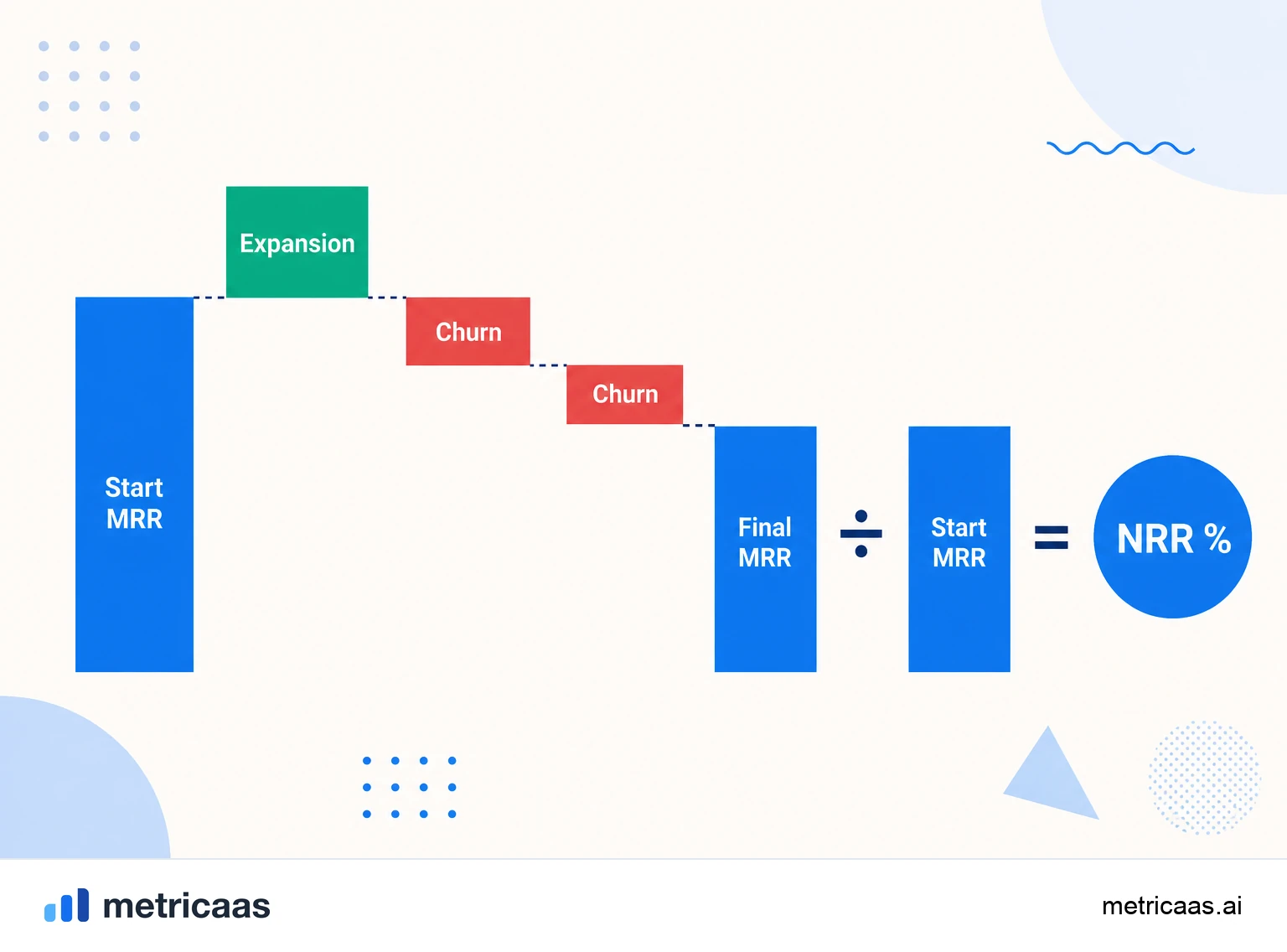
Take the base MRR at the start of the period, add expansion and subtract contraction and cancellations over the period, and divide by the starting MRR. NRR looks only at the existing base: revenue from new customers does not count.
- Starting base MRR.
- Plus expansion (upgrades and add-ons).
- Minus contraction (downgrades) and churn.
- Divided by the starting base MRR.
Example: a base starts the period with $100k of MRR. Over it, it gains $18k of expansion, loses $4k in downgrades and $6k in cancellations. That leaves $108k over $100k, an NRR of 108%. The base grew 8% without a single new customer.
NRR and GRR: the two retentions
NRR has a more conservative sibling: GRR (Gross Revenue Retention). The difference is a single thing, but it changes everything: GRR ignores expansion and measures only how much you lose.
- NRR: start plus expansion, minus contraction and churn. Can go above 100%.
- GRR: start minus contraction and churn, no expansion. Never goes above 100%.
In the example above, GRR would be $90k over $100k, or 90%. Looking at both together reveals the truth: an NRR of 108% with a GRR of 90% means expansion is strong, but base leakage is too. Expansion is masking a churn that, on its own, would be worrying.
What a good NRR looks like
The classic benchmark is simple: above 100% is good, and the higher the better. According to the annual private SaaS survey by KeyBanc Capital Markets, industry net revenue retention stayed above 100%, while gross retention sat around 86% in 2023, meaning average expansion more than offsets the losses.
The expected bar rises with contract size. SaaS Capital shows NRR rising with deal size: in the $25k to $50k annual contract bracket, median NRR was 102% and the top quartile reached 111%. An NRR of 105% can be excellent in a self-serve product and merely average in an enterprise SaaS.
Why pass 100%
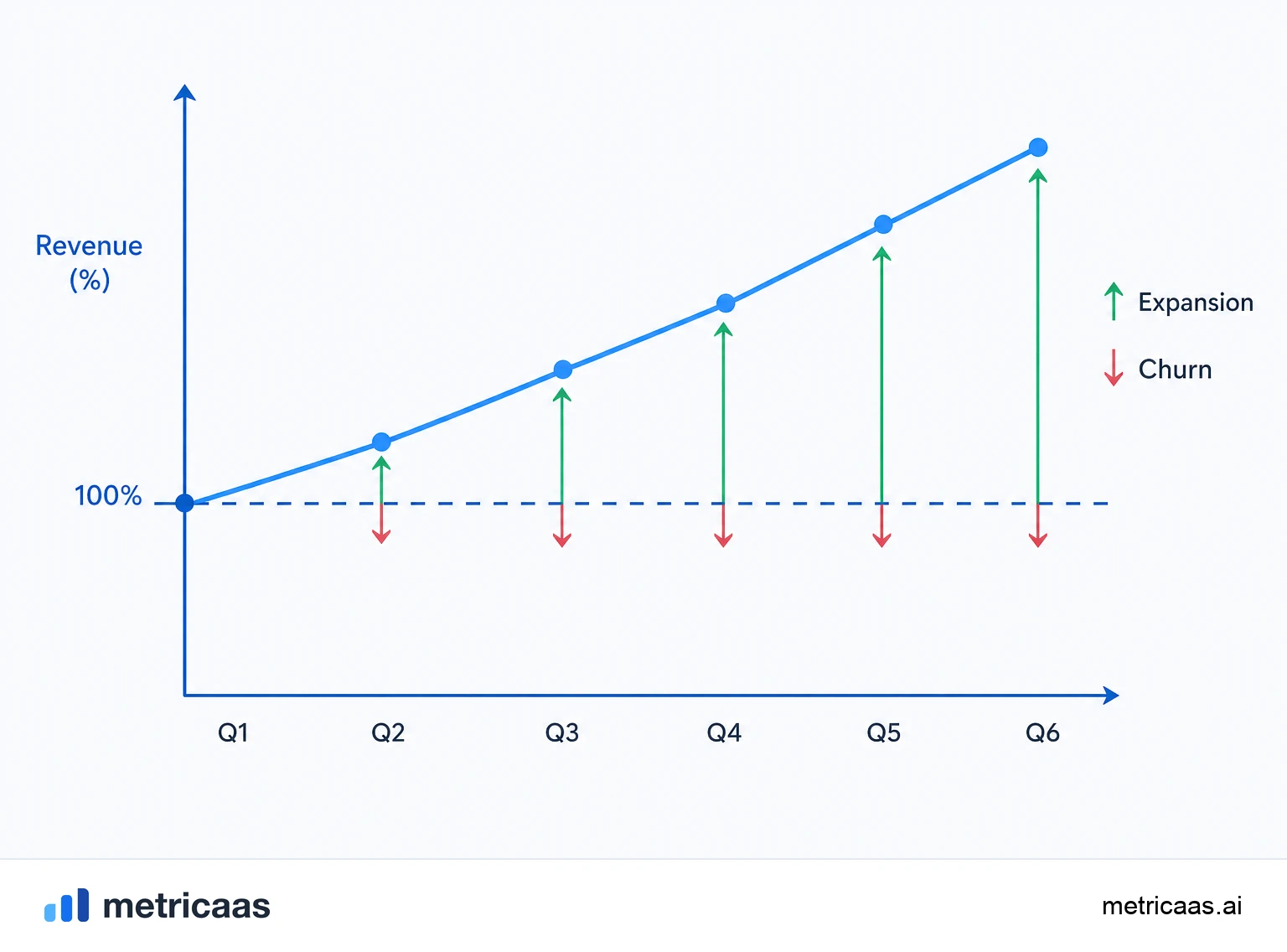
An NRR above 100% is the most powerful engine in a SaaS, because it turns the installed base into an asset that grows on its own. If acquisition stopped today, revenue would still rise, purely from the expansion of the customers who stayed.
The effect compounds: each period, the larger base expands on a larger number, and growth accelerates without depending on new sales. In practice, this eases the pressure on CAC, because part of the growth comes for free, and raises LTV, because each customer earns more over its lifetime.
How to improve NRR in practice
Improving NRR means working both sides of the equation: growing expansion and stopping the losses. A playbook:
- Design natural expansion paths: usage-based plans, seats, add-ons and upgrades that track customer success.
- Attack churn and contraction, which erode the base before any expansion.
- Segment NRR by cohort and customer size: the average hides bases that grow and bases that shrink.
- Tie expansion to value delivered, not billing tricks, so customers pay more because they use more.
Tracked by cohort, NRR stops being a vanity number and becomes the best gauge that the product delivers growing value to who is already a customer.
Frequently asked questions
NRR is the net retention of base revenue over time, already counting expansion, contraction and churn, and looking only at the customers who existed at the start.
By taking the starting base MRR, adding expansion and subtracting contraction and churn, and dividing by the starting MRR. Revenue from new customers does not count.
NRR counts expansion and can go above 100%; GRR (gross retention) ignores expansion, only measures how much you lose and never goes above 100%.
Passing 100% is the goal, and the expected bar rises with deal size. In larger contracts, median NRR sits around 102% and the top passes 110%.
No. NRR looks only at the existing base; new sales are left out of the calculation, precisely to isolate the behavior of the base.
It means that, over the period, base revenue grew 20% from expansion alone, after subtracting contraction and churn, and with no new customers at all. It is considered an excellent level.
Related concepts

Gross Revenue Retention (GRR)
Gross Revenue Retention (GRR) measures how much of the recurring revenue from your current base you keep over time counting only the losses, contraction and cancellations, and ignoring any expansion. That is why it never goes above 100%: it shows the pure leakage of the base.

Expansion
Expansion (expansion revenue or expansion MRR) is the additional recurring revenue that comes from customers you already have, without relying on new sales. It comes from upsell (higher plan), cross-sell (more products), add-ons and usage growth. It is the force that pushes net revenue retention above 100% and makes the base grow on its own.

Churn
Churn is the loss of customers or revenue in a period. In a SaaS, it measures how many customers cancel (customer churn) or how much recurring revenue disappears (revenue churn). It is the metric that reveals whether growth is sustainable: the higher the churn, the more new sales you need just to avoid shrinking.