
Expansion revenue: what it is and how to grow base MRR
By Tiago Costa · Updated on July 9, 2026

Definition
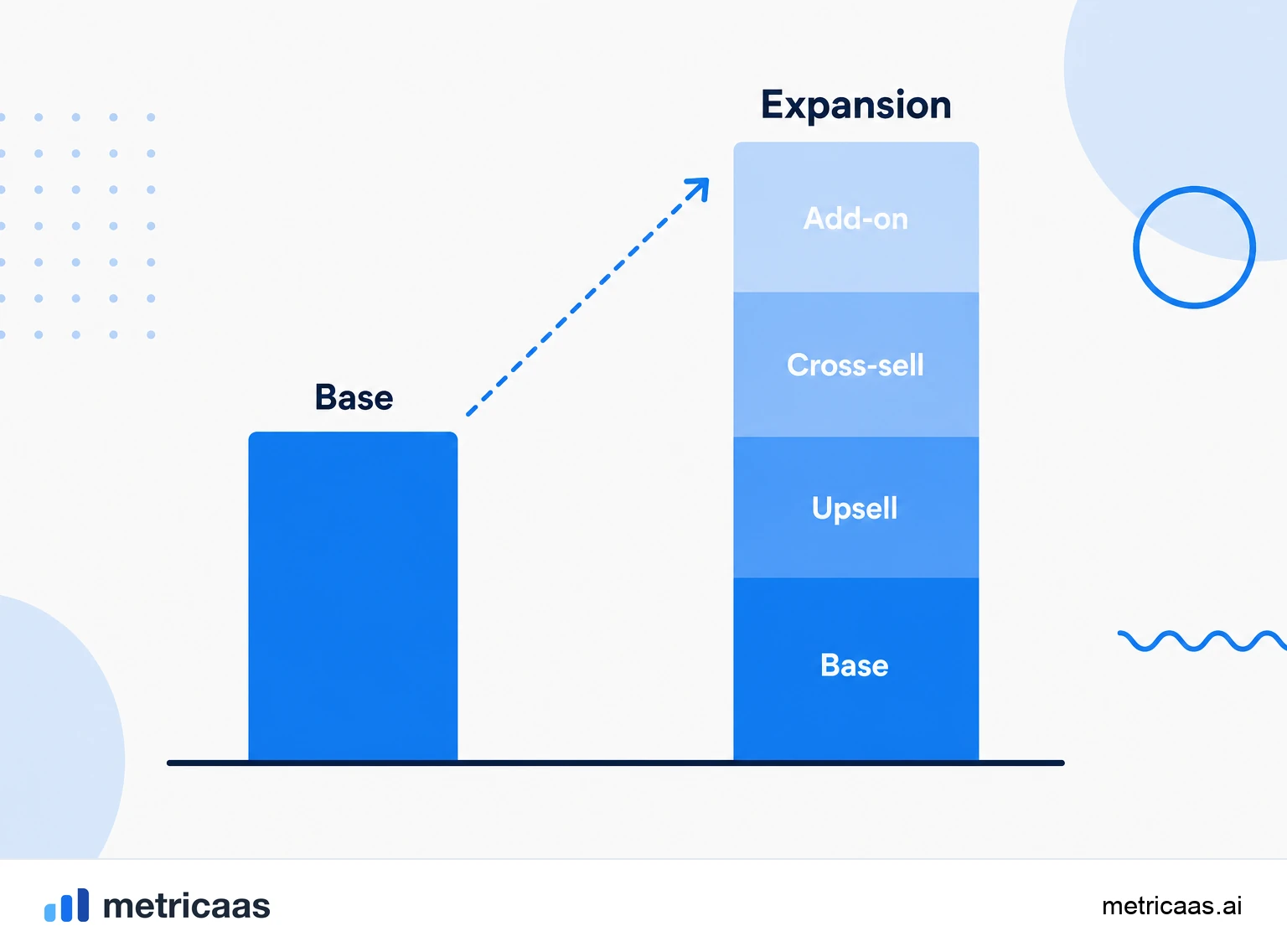
Expansion (expansion MRR) is the additional recurring revenue that comes from your current customer base.
- Comes from upsell, cross-sell, add-ons and usage growth.
- It is one of the MRR movements, on the positive side.
- It is what pushes NRR above 100%.
What expansion revenue is
Expansion (expansion revenue, or expansion MRR) is the additional recurring revenue that comes from customers you already have. Instead of growing only by bringing in new people, the company earns more from the same base: a customer who moves to a higher plan, adds another product or starts using more volume pays more per month, and that increase flows into recurring MRR.
It is the difference between a bucket that only fills through the acquisition tap and a bucket where the water level itself rises. Expansion does not replace new sales, but adds to them, and in a mature SaaS it is usually the cheapest, most predictable source of growth, because it starts from customers who already trust the product and already pay.
Where expansion comes from
Expansion has four classic sources, and most SaaS combine more than one:
- Upsell: the customer moves to a higher plan, with more features, limits or service level.
- Cross-sell: the customer adds another product or module from your portfolio.
- Add-ons: standalone items that stack onto the subscription, such as extra features or paid integrations.
- Usage growth: in consumption or seat-based models, the bill grows on its own when the customer uses more volume or adds users.
What they share is that all of them start from the installed base. None requires a new customer: it requires the current customer to find more value in the product and be willing to pay for it. That is why healthy expansion goes hand in hand with customer success, not sales pressure.
How to measure expansion MRR
Expansion is measured in MRR, and its natural home is inside the MRR movements. All the change in recurring revenue over a period breaks down into new, expansion, contraction and churn: expansion is the positive piece that comes from customers who already existed and started paying more.
- Expansion MRR: the sum of MRR increases from existing customers in the period.
- It does not count new customers, who come in as new MRR.
- On the other side sit contraction (downgrades) and churn, which reduce MRR.
Example: if in the month three customers move up a plan adding $8k and one takes a $2k add-on, expansion for the month is $10k, no matter how many new customers came in. Measuring expansion on its own shows how much growth force comes from within the base.
Expansion vs upsell: the difference
It is common to treat expansion and upsell as synonyms, but they are not on the same level. Upsell is one of the ways to expand: the customer moves to a higher plan. Expansion is the umbrella that gathers every way the base earns more, including upsell, cross-sell, add-ons and usage growth.
In practice: every upsell is expansion, but not every expansion is upsell. A customer who doubles the number of seats without changing plan expanded through usage, not upsell. A customer who adds a second product expanded through cross-sell. Calling everything upsell hides where growth actually comes from and makes it harder to know which lever to pull.
Expansion and NRR
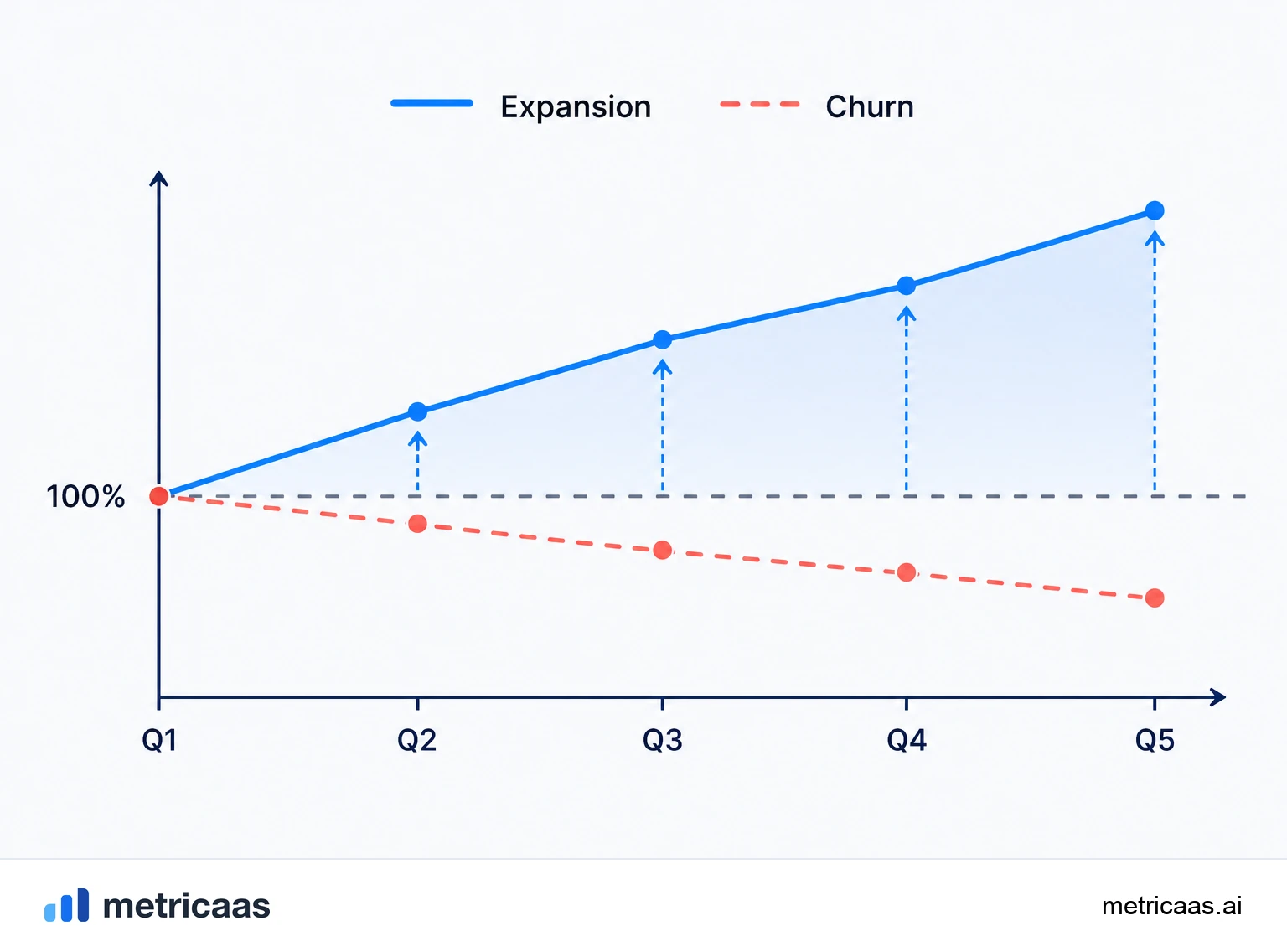
Expansion is what pushes NRR above 100%. Net revenue retention measures how much of the base you keep after adding expansion and subtracting contraction and churn: when expansion beats the losses, the base grows on its own, without a single new customer.
It is not rare: according to the private SaaS survey by KeyBanc Capital Markets, industry net revenue retention stayed above 100%, meaning average expansion more than offsets the losses. And the effect grows with contract size: SaaS Capital shows retention rising with deal size, with median NRR of 102% in the $25k to $50k annual contract bracket. Consistent expansion is what separates a base that leaks from a base that compounds.
How to build expansion in practice
Building expansion means designing product and pricing so that paying more is the natural result of getting more value, never a forced charge. Some paths:
- Tie price to usage or value: consumption and seat-based models make the bill grow along with adoption.
- Offer tiered plans and add-ons, so the customer moves up when they hit the limit of what they bought.
- Anchor expansion to customer success: those who use more and get more results are the ones who naturally expand.
- Avoid billing tricks: expansion that comes from fine print or surprise increases turns into churn next cycle.
The best expansion is almost invisible: the customer grows, uses more and pays more without feeling squeezed, because price tracks value. Tracked inside the MRR movements and by cohort, it becomes the most honest gauge that the product delivers growing value to who is already a customer.
Frequently asked questions
It is the additional recurring revenue that comes from customers you already have, via upsell, cross-sell, add-ons and usage growth, without relying on new sales.
By summing all the MRR increases from existing customers in the period. New customers do not count: they come in as new MRR. Expansion is one of the MRR movements.
Upsell (moving to a higher plan) is one form of expansion. Expansion is the umbrella that gathers upsell, cross-sell, add-ons and usage growth. Every upsell is expansion, but not every expansion is upsell.
Expansion is what pushes NRR above 100%: when it beats contraction and churn, the base grows on its own, without new customers.
By tying price to usage and value (consumption, seats), offering tiered plans and add-ons, and anchoring expansion to customer success, never to billing tricks.
Related concepts

MRR
MRR (Monthly Recurring Revenue) is the monthly recurring revenue of a SaaS: the sum of all active subscriptions normalized to a month. It is the core metric of a subscription business because it shows, predictably, how much the company earns on a recurring basis each month, without counting one-off charges.

MRR Movements
MRR movements are the breakdown of the monthly change in MRR into its causes: new, expansion, contraction, churn and reactivation MRR. Instead of watching only the final number, you separate every dollar that came in and every dollar that left, and see why recurring revenue grew, stalled or fell. The sum of all movements is the net new MRR for the period.

Net Revenue Retention (NRR)
Net Revenue Retention (NRR) measures how much of the recurring revenue from your current base you keep over time, already accounting for upgrades and expansion, minus downgrades and cancellations. Above 100% it means the base grows on its own, even without new customers.