
MRR: what monthly recurring revenue is and how to calculate it
By Tiago Costa · Updated on July 9, 2026

Definition
MRR (Monthly Recurring Revenue) is the monthly recurring revenue of a SaaS: the sum of all active subscriptions normalized to a month.
- Counts only recurring revenue, not one-off charges.
- Annual plans are divided by 12.
- It is the base for ARR, revenue churn and forecasts.
What MRR is
MRR measures the predictable revenue that comes in every month from active subscriptions. It looks only at what repeats, ignoring one-off charges like setup fees or ad hoc services, which makes it the best gauge of a SaaS health. While a single month of revenue can spike from one large one-time contract, MRR shows the stable base the business actually stands on.
Think of it as the company heartbeat: a number you track month over month to know whether the body is growing, flat or shrinking.
How to calculate MRR
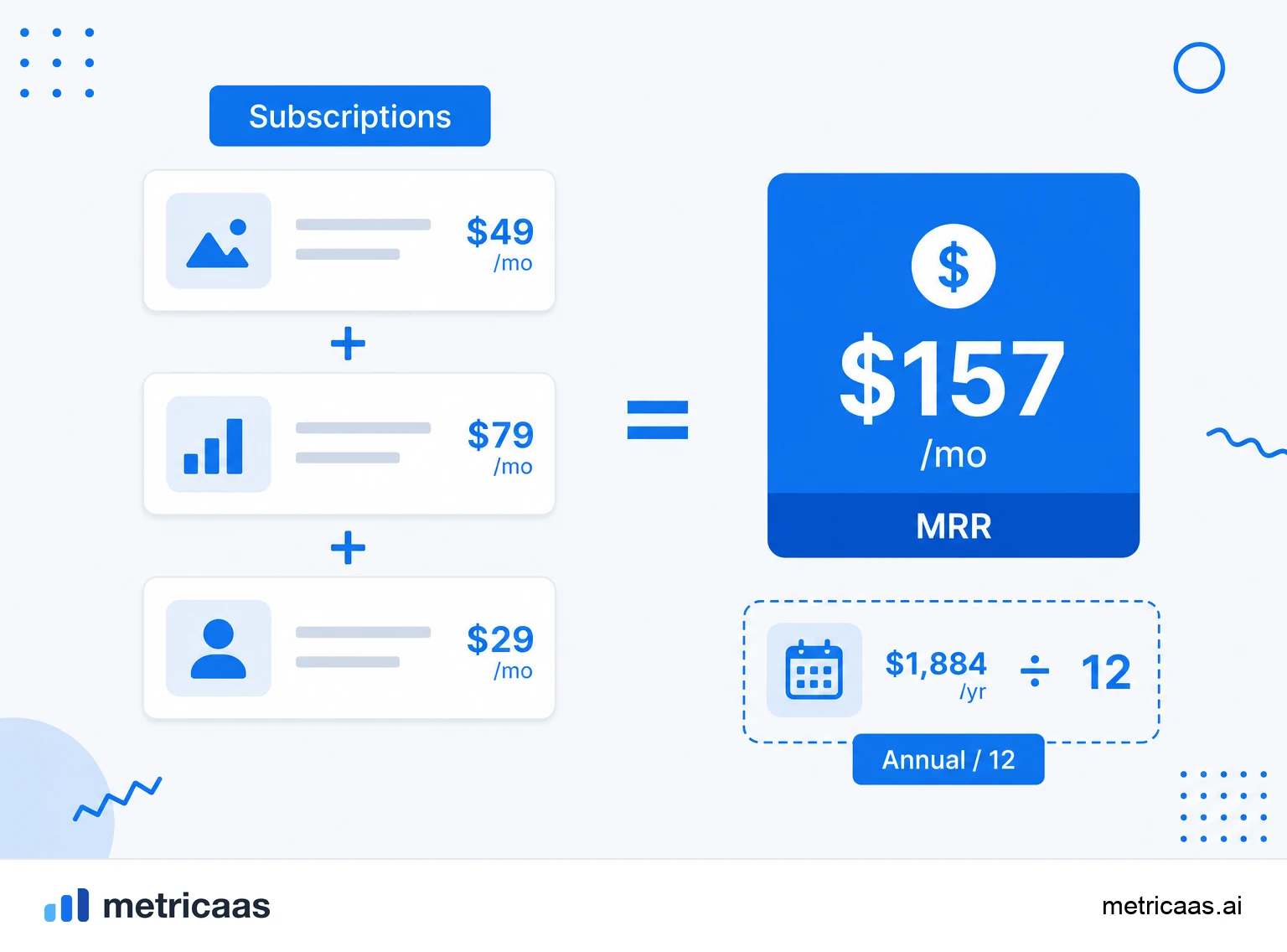
The calculation is a simple sum: take the monthly value of every active subscription and add it up. The care is in the normalization, because not every customer pays on the same cadence.
- Add up the monthly value of each active subscription.
- Divide annual contracts by 12, to reflect the value equivalent to a single month.
- Include recurring discounts (MRR is always the net amount the customer pays per month).
- Exclude one-time fees, taxes and ad hoc usage charges.
A common trap is putting the full value of an annual plan into a single month: that inflates MRR and it vanishes the next month. Dividing by 12 keeps the MRR line stable and comparable across months.
The movements of MRR
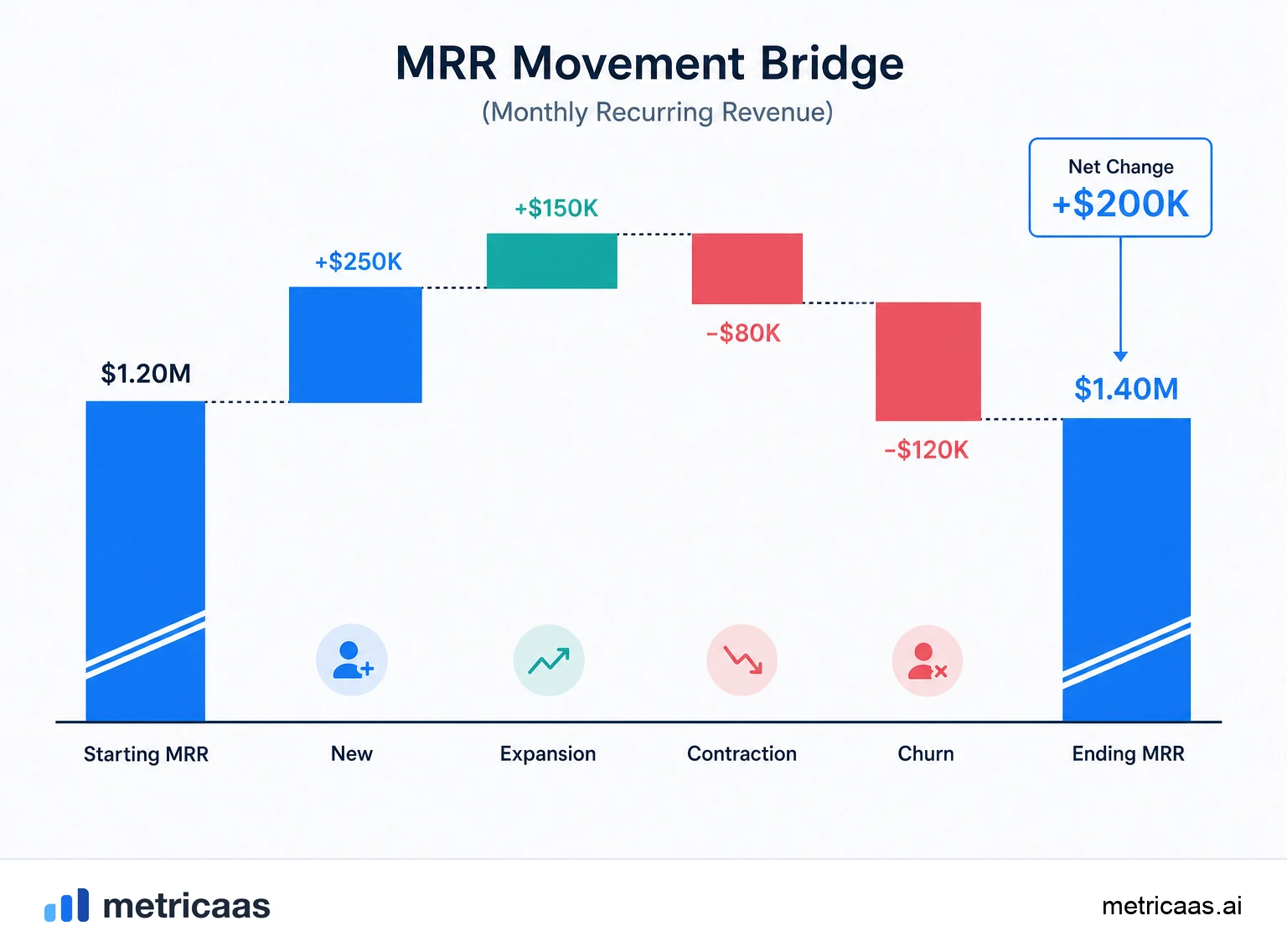
A month of MRR rarely changes for a single reason. Breaking that change into its parts, the MRR movements, is what turns the number into a diagnosis:
- New: MRR from customers who just subscribed.
- Expansion: upgrades and add-ons from existing customers.
- Contraction: downgrades that reduce the amount paid.
- Churn: MRR that disappears with cancellations.
- Reactivation: customers who came back after cancelling.
Two companies can grow the same net MRR in a month and be in opposite situations: one grows through new sales while losing its base to churn, the other grows through expansion of the customers it already has. Only the breakdown tells them apart.
MRR, ARR and the subscription economy
ARR (annual recurring revenue) is just annualized MRR: MRR times 12. Companies selling annual contracts tend to talk in ARR, but the engine behind it is the same normalized MRR.
This revenue model is no longer a niche. According to Gartner, worldwide spending on SaaS applications is set to approach $300 billion in 2025, up from just over $250 billion in 2024. Behind each of those companies there is an MRR being summed, forecast and defended month after month.
Why MRR is the core metric
Predictability is what makes MRR so valuable. Because it repeats, you can forecast cash, plan hiring and measure the effect of every decision on recurring revenue. It is also the base of almost every other metric: Net Revenue Retention measures how much of the base MRR you keep and expand over time, and revenue churn measures how much of it disappears.
The power of recurring revenue shows up in the industry numbers: according to the annual private SaaS survey by KeyBanc Capital Markets, net revenue retention at SaaS companies has stayed above 100%, meaning the base revenue on average grows on its own, even before any new sales. That is MRR working in the business favor.
How to track MRR in practice
Tracking MRR properly is less about the final number and more about understanding where it comes from. A simple routine:
- Rebuild MRR from the subscriptions and invoices in your gateway, not from manual estimates.
- Look at the movements (new, expansion, contraction, churn) every week, not just the total.
- Cross new-customer MRR with CAC to see whether acquisition pays off.
- Compare the value generated over time with the LTV of each cohort.
When MRR is rebuilt from scratch out of real payment data, it stops being a fragile spreadsheet and becomes a reliable compass for business decisions.
Frequently asked questions
MRR is monthly recurring revenue, the sum of active subscriptions normalized to a month, not counting one-off charges.
By adding the monthly value of all active subscriptions, with annual plans divided by 12 and no one-time fees or taxes.
No. Revenue includes one-off charges and full contract values; MRR counts only the recurring part, normalized per month.
Yes, divided by 12, to reflect the value equivalent to a single month and keep the MRR line comparable across months.
ARR is annualized MRR: just multiply MRR by 12. They are the same recurring revenue seen over different windows.
Related concepts

ARR
ARR (Annual Recurring Revenue) is the annual recurring revenue of a SaaS: MRR multiplied by 12. It represents how much the company earns on a recurring basis over a year, counting only active subscriptions, with no one-off charges. It is the metric of choice for companies selling annual contracts and the standard language of investors.

MRR Movements
MRR movements are the breakdown of the monthly change in MRR into its causes: new, expansion, contraction, churn and reactivation MRR. Instead of watching only the final number, you separate every dollar that came in and every dollar that left, and see why recurring revenue grew, stalled or fell. The sum of all movements is the net new MRR for the period.

Churn
Churn is the loss of customers or revenue in a period. In a SaaS, it measures how many customers cancel (customer churn) or how much recurring revenue disappears (revenue churn). It is the metric that reveals whether growth is sustainable: the higher the churn, the more new sales you need just to avoid shrinking.