
LTV: what customer lifetime value is and how to calculate it
By Tiago Costa · Updated on July 9, 2026

Definition
What LTV is
LTV estimates how much revenue a customer generates, net of margin, from the first payment to cancellation. It turns the central SaaS question into a number: is each customer worth more than it cost to acquire?
You will find the same idea under three names: LTV (lifetime value), CLV (customer lifetime value) and CLTV. They are synonyms for the value a customer delivers over the entire relationship. What differs between companies is not the name, it is the rigor: a well-built LTV uses margin, not just gross revenue.
How to estimate LTV
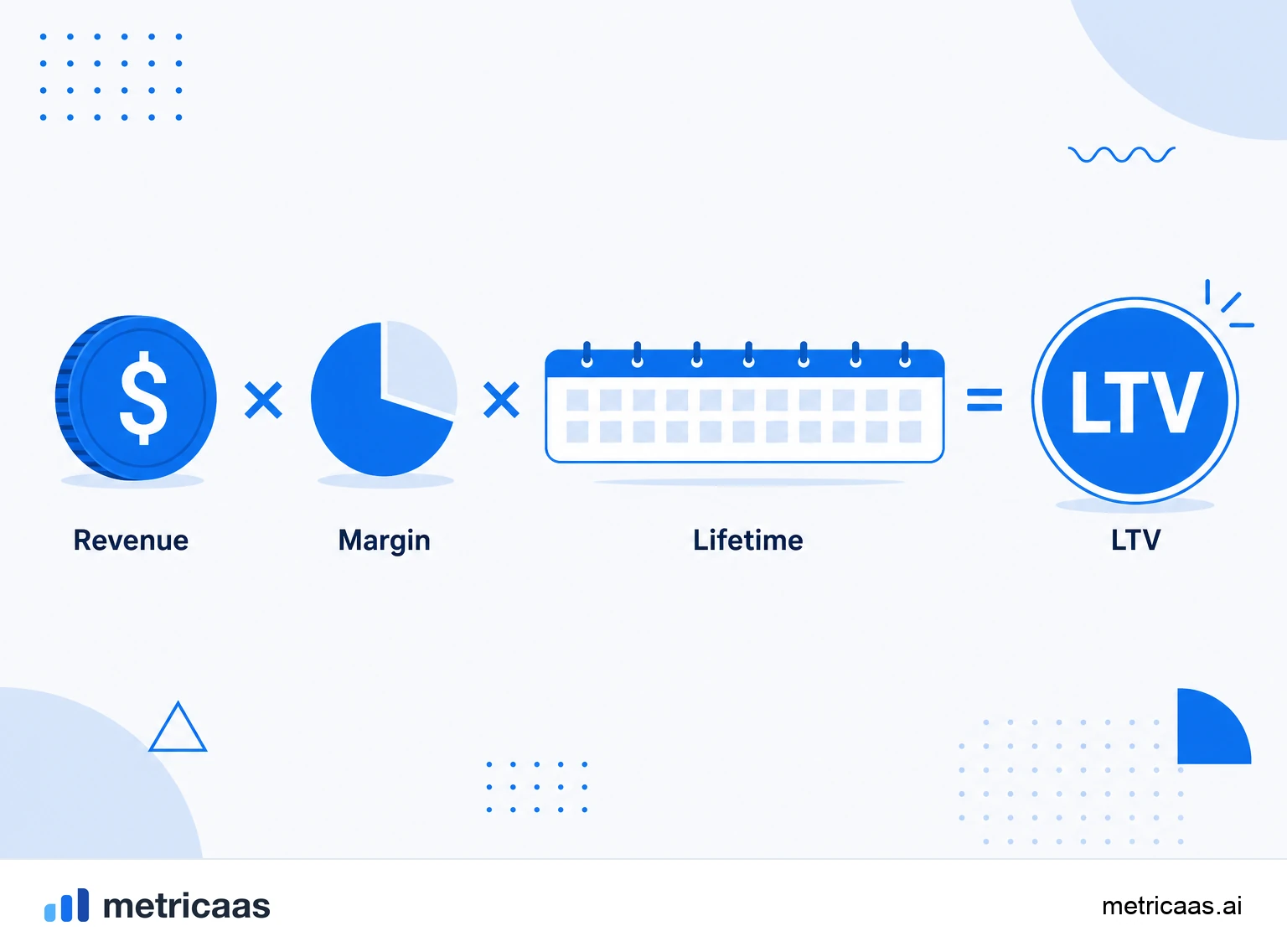
A common approach starts from the recurring average revenue, applies gross margin, and multiplies by the customer lifetime, which is roughly the inverse of churn.
- Recurring average revenue per customer (the average monthly or annual revenue).
- Gross margin on that revenue (what is left after the cost to serve).
- Lifetime estimated from churn (1 divided by churn).
Example: a customer pays $300 a month, at 80% margin, which is $240 of monthly margin. If churn is 2% a month, the average lifetime is about 50 months (1 divided by 0.02). LTV lands around $240 times 50, or $12k. Notice how churn dominates the result: cutting churn in half doubles the lifetime and, with it, the LTV.
What drives LTV up
LTV has three levers, and the most powerful is usually retention. Because lifetime is the inverse of churn, small improvements in retention have a disproportionate effect on the value of each customer.
- Lifetime: less churn lengthens the relationship and multiplies everything that comes after.
- Average revenue: upsell and expansion raise the recurring revenue per customer.
- Margin: lowering the cost to serve makes each dollar of revenue yield more LTV.
Retention does not improve equally for every customer. SaaS Capital shows retention rises with contract size: larger customers stay longer, so they tend to have a longer lifetime and higher LTV. That is why LTV should almost always be viewed by segment, not as a single average blending very different profiles.
LTV and CAC: the ratio that matters
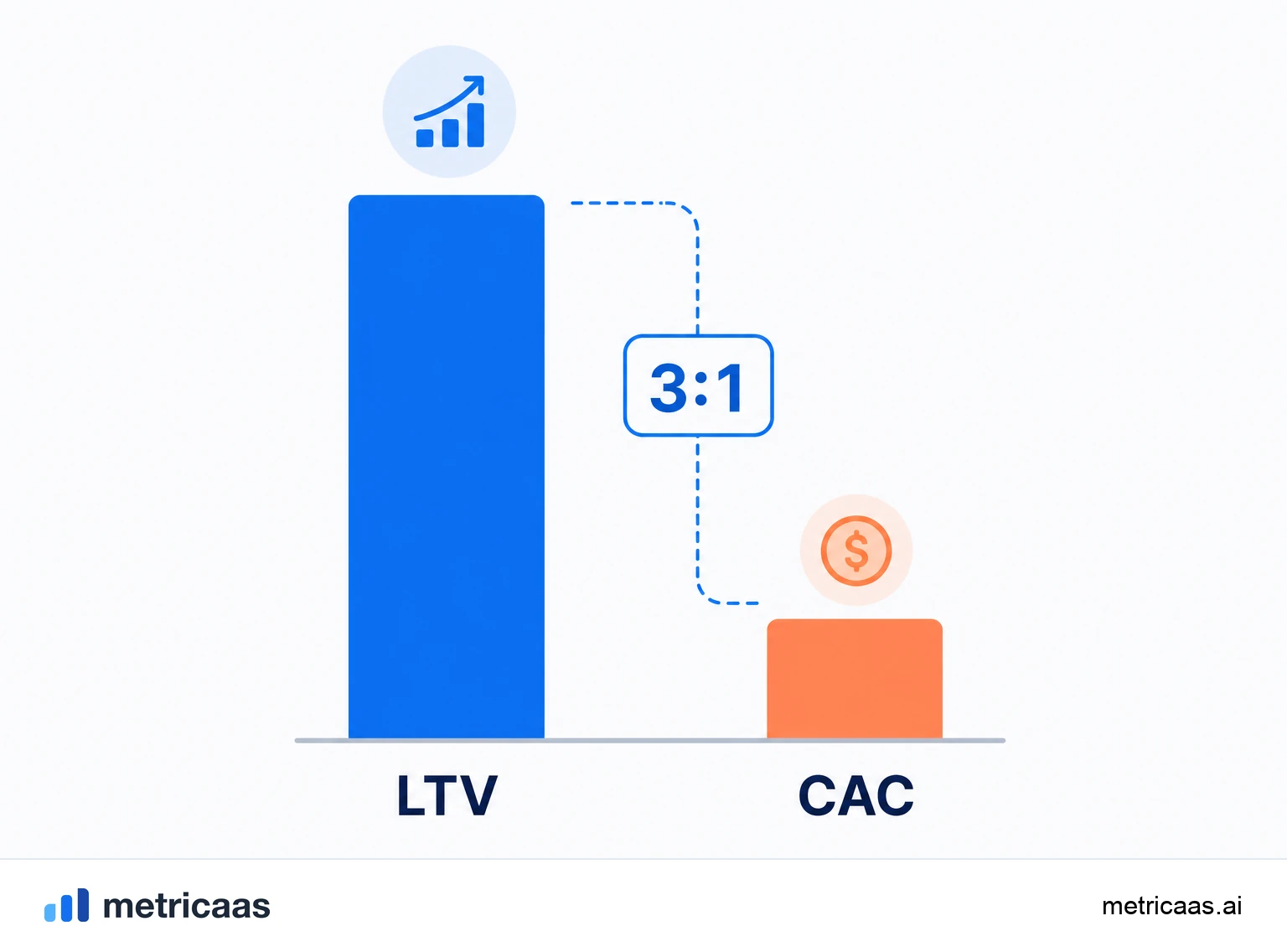
On its own, LTV says little. It only makes sense compared to CAC, the acquisition cost. The ratio between the two shows whether each customer returns, over time, more than it cost to win.
The classic benchmark, from David Skok, is an LTV to CAC ratio above 3 to 1. Below that, acquisition consumes too much value; mature SaaS companies tend to run closer to 5 to 1. But beware the compounding: because LTV depends on margin and lifetime, an LTV inflated by optimistic churn lies about the health of the business. A healthy ratio only means something if the lifetime is real.
LTV as an investment compass
The biggest use of LTV is not to decorate a slide, it is to decide how much you can spend to grow. If each customer is worth $12k of LTV, you can afford a much higher CAC than a competitor whose customer is worth $3k, and still keep the math standing.
That is the competitive advantage hidden in retention: whoever has the highest LTV can invest more in acquisition without breaking the economics. LTV also frames payback, telling you how many months of margin fit inside the customer lifetime. That is why it talks directly to new-customer MRR and to the CAC of each cohort.
How to increase LTV in practice
Increasing LTV means working the three levers at once, starting with the one that pays most: retention.
- Attack churn, especially at activation, where most of the loss happens.
- Build natural expansion (upsell, add-ons) to raise revenue and, with it, Net Revenue Retention.
- Improve margin, minding the cost to serve and infrastructure.
- Measure LTV by segment and cohort, not as a single average, to invest where the return is highest.
When NRR passes 100%, LTV stops being a static estimate and becomes a growing curve, because the base generates more value each period at no extra acquisition cost.
Frequently asked questions
LTV is the total value a customer generates while they stay in your base, net of margin, from the first payment to cancellation.
Yes. LTV (lifetime value), CLV (customer lifetime value) and CLTV are three names for the same idea: the value a customer delivers over the entire relationship.
By multiplying recurring average revenue by margin and by the customer lifetime, which is roughly the inverse of churn. A customer with $240 of monthly margin over 50 months has an LTV of about $12k.
The classic David Skok benchmark is above 3 to 1: each customer should return at least three times what it cost to win. Mature companies tend to run closer to 5 to 1.
By reducing churn (the strongest lever, because it lengthens lifetime), raising average revenue with upsell and expansion, and improving margin.
Related concepts

CAC
CAC (Customer Acquisition Cost) is how much, on average, you spend to win a new customer. Add up everything invested in marketing and sales over a period and divide by the number of new customers who came in during that period. It is the metric that tells you whether your growth is economically healthy.

CAC payback
CAC payback is the time, in months, a customer takes to return the CAC in recurring margin. Divide the CAC by the monthly gross margin each customer generates (recurring revenue per customer times gross margin). It is the metric that shows how fast the acquisition investment comes back to cash.

ARPA
ARPA (Average Revenue Per Account) is a SaaS recurring revenue divided by the number of active accounts. It shows how much each account generates, on average, per month or year. It is the metric that reveals the typical value of a customer and one of the main levers for growing revenue without relying only on new sales.