
Churn: what it is, how to calculate it and how to reduce it in SaaS
By Tiago Costa · Updated on July 9, 2026

Definition
Churn is the loss of customers or revenue in a period. It shows up in two main forms:
- Customer churn: the percentage of customers who cancel.
- Revenue churn: the percentage of MRR lost to cancellations and downgrades.
What churn is
Churn measures how much of your base or revenue you lose over an interval. It is the flip side of growth: even with plenty of new sales, high churn keeps revenue flat, because part of what comes in only replaces what left.
Think of a bathtub. New sales are the open tap; churn is the drain. You can open the tap all the way, but if the drain is wide, the water level never rises. That is why measuring acquisition alone is misleading: without looking at churn, you cannot tell whether you are filling the tub or just offsetting the leak.
Customer churn and revenue churn
There are two ways to count the loss, and they tell different stories. Customer churn (or logo churn) counts cancellations by number of accounts. Revenue churn looks at the MRR that disappeared, and can differ sharply from customer churn depending on whether those who cancel pay above or below average.
- Gross MRR churn: losses only (cancellations and downgrades).
- Net MRR churn: losses minus expansion from the base in the same period.
The difference matters. If you lose ten small customers but keep the large ones, customer churn looks high while revenue churn stays low. Lose a single huge customer and it is the opposite. Tracking both prevents wrong conclusions.
How to calculate churn
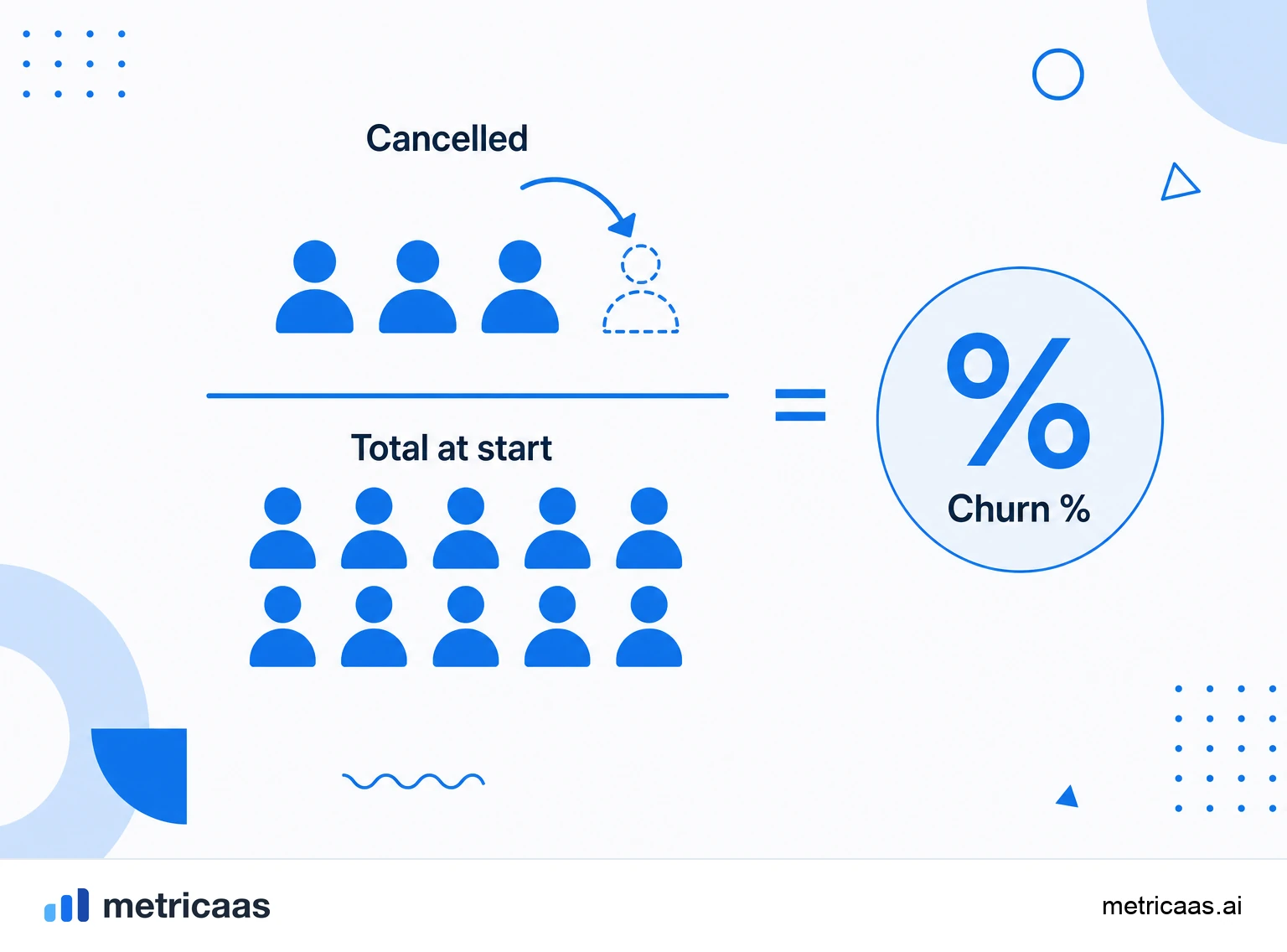
The basic customer churn formula is straightforward: divide the number of customers who cancelled in the period by the total number of customers at the start of the period.
- Customer churn: cancelled in the month / customers at the start of the month. E.g. 6 cancellations out of 200 customers = 3% per month.
- Gross MRR churn: MRR lost / MRR at the start. E.g. $8k lost out of $100k = 8%.
- Net MRR churn: (MRR lost minus expansion) / MRR at the start. With $5k of expansion, the net drops to 3%.
Two traps: pick the right window (monthly for self-serve, annual for long contracts) and do not confuse the base. The denominator is always the start of the period, not the end, so new customers who joined mid-period do not dilute the loss.
What a healthy churn looks like
There is no magic number, but there are reference ranges. According to the annual private SaaS survey by KeyBanc Capital Markets, gross revenue retention sat around 86% in 2023, meaning even healthy companies lose roughly 14% of recurring revenue per year to churn alone, before any expansion.
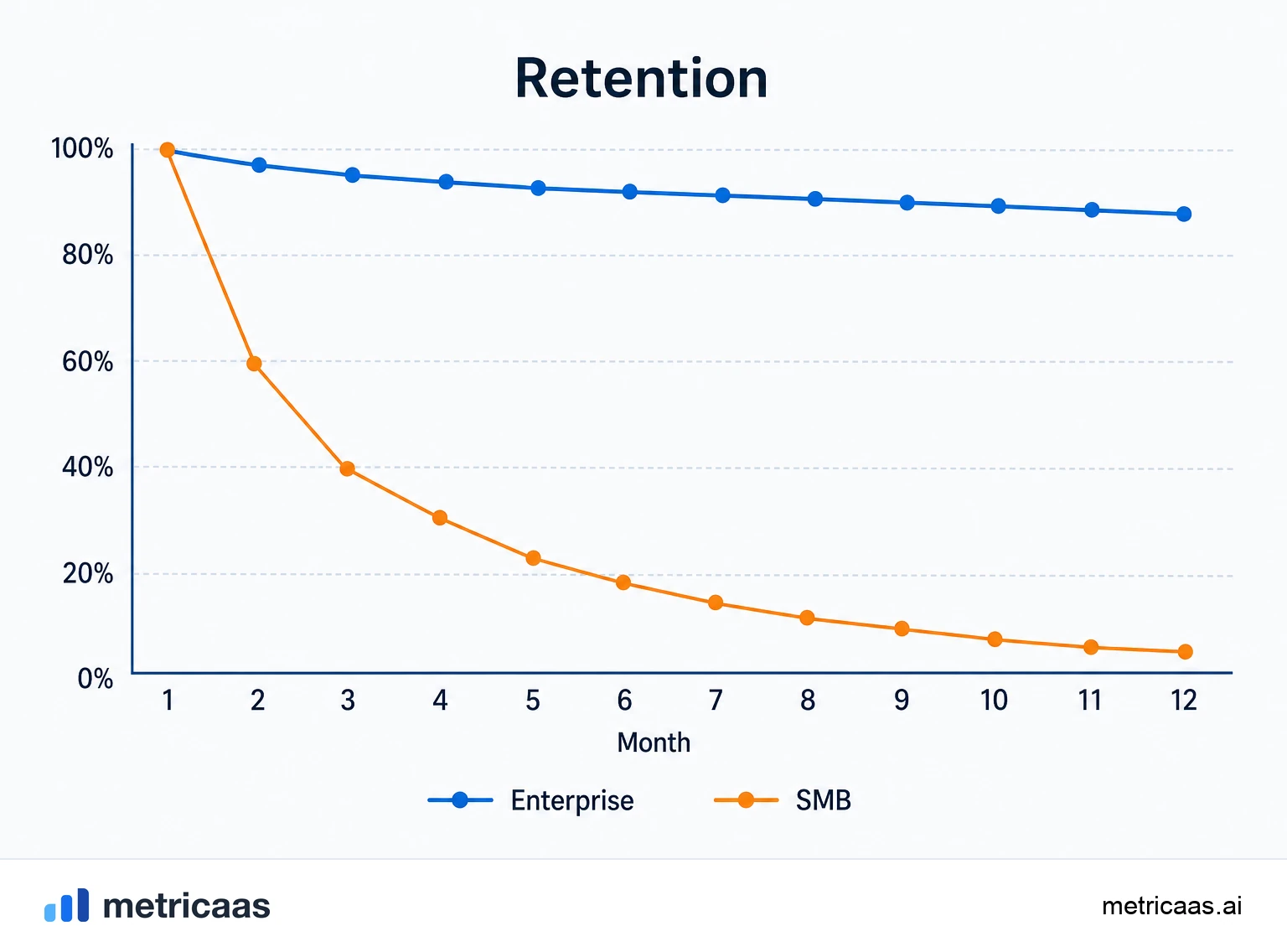
Customer size changes everything. SaaS Capital shows retention rising with contract value: in the $25k to $50k annual contract bracket, median net revenue retention was 102%. The smaller the deal, the easier it is to cancel, so a churn rate that would be alarming in an enterprise SaaS can be normal in a self-serve product for small businesses.
Negative churn and base expansion
The best churn possible is negative churn: when expansion from the base (upgrades and add-ons) beats everything you lose to cancellations and downgrades. In that case, base revenue grows on its own, even if you sell to no new customer at all.
That is exactly what Net Revenue Retention captures. When NRR is above 100%, net churn is negative. That is what KeyBanc observed: industry net revenue retention stayed above 100%, a sign that, on average, the installed base is worth more each year.
How to reduce churn in practice
Reducing churn starts with understanding why customers leave, and the causes almost always fall into three buckets: weak activation (the customer never reached value), price (perceived value does not justify the cost) and involuntary churn (declined card, failed charge).
- Strengthen activation: the first value delivered in the first days is the strongest predictor of retention.
- Fight involuntary churn with payment retries and expiring-card notices.
- Segment by LTV: not every churn weighs the same, prioritize retaining who generates more value.
- Cross retention with CAC: high churn makes every acquisition more expensive, because the customer leaves before paying itself back.
And track Net Revenue Retention as your compass: it shows, in a single number, whether base expansion is beating the losses.
Frequently asked questions
Churn is the loss of customers or recurring revenue in a period. It measures how much of the base or MRR disappears to cancellations and downgrades.
By dividing the number of customers who cancelled in the period by the total number of customers at the start of the period. Six cancellations out of 200 customers is 3% per month.
Customer churn counts cancellations by account; revenue churn measures how much MRR was lost, which can differ if those who cancel pay above or below average.
It depends on the deal size. Retention rises with contract value, so an enterprise SaaS usually has much lower churn than a self-serve SaaS for small businesses.
Yes. When expansion from the base beats the losses, net churn goes negative and base revenue grows even without new customers. That is what an NRR above 100% indicates.
There are two main cuts: by object, customer churn (accounts that cancel) and revenue churn (MRR lost); and by cause, voluntary churn (the customer decides to leave) and involuntary churn (failed payment, declined card).
Related concepts

Net Revenue Retention (NRR)
Net Revenue Retention (NRR) measures how much of the recurring revenue from your current base you keep over time, already accounting for upgrades and expansion, minus downgrades and cancellations. Above 100% it means the base grows on its own, even without new customers.

Gross Revenue Retention (GRR)
Gross Revenue Retention (GRR) measures how much of the recurring revenue from your current base you keep over time counting only the losses, contraction and cancellations, and ignoring any expansion. That is why it never goes above 100%: it shows the pure leakage of the base.

Expansion
Expansion (expansion revenue or expansion MRR) is the additional recurring revenue that comes from customers you already have, without relying on new sales. It comes from upsell (higher plan), cross-sell (more products), add-ons and usage growth. It is the force that pushes net revenue retention above 100% and makes the base grow on its own.