
Gross Revenue Retention (GRR): what it is and how to calculate it
By Tiago Costa · Updated on July 9, 2026

Definition
Gross Revenue Retention (GRR) is the gross retention of a base revenue over time.
- Starts from the base starting revenue.
- Subtracts contraction and churn, and ignores expansion.
- Never goes above 100%: it is the pure leak.
What GRR is
GRR takes a group of customers at a point in time and asks: how much of their recurring revenue do you still have after a period, counting only what you lost? It looks only at the existing base MRR and subtracts contraction and churn, without adding a single cent of expansion. That is why it measures the pure leak: the revenue that drains from the base before any new sale or upgrade.
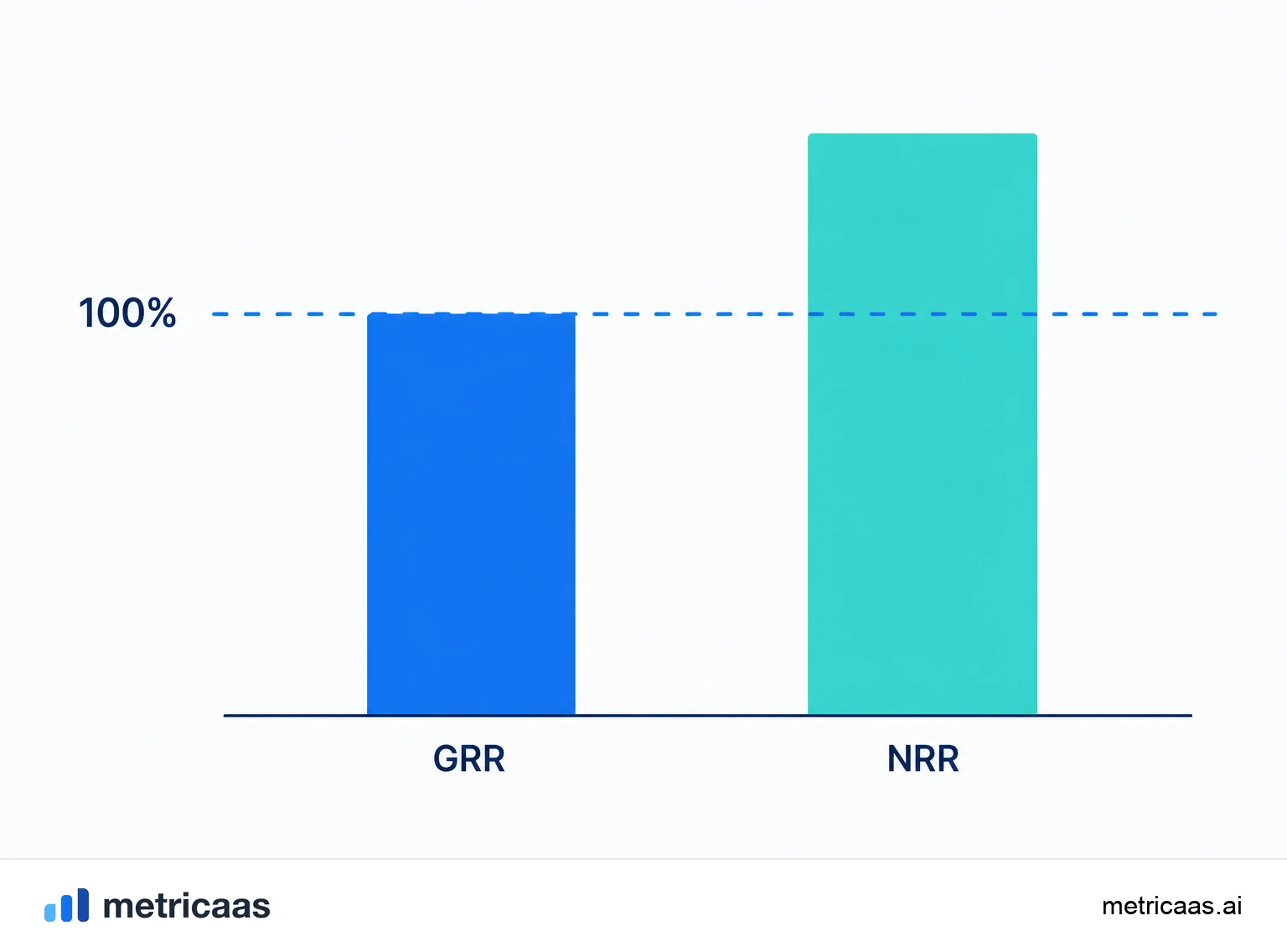
It is the conservative sibling of NRR. While NRR can go above 100% because it counts expansion, GRR is capped at 100%, since it only subtracts. Looking at both together separates what the base loses from what expansion recovers, and keeps a strong upsell from hiding a worrying churn.
How to calculate GRR
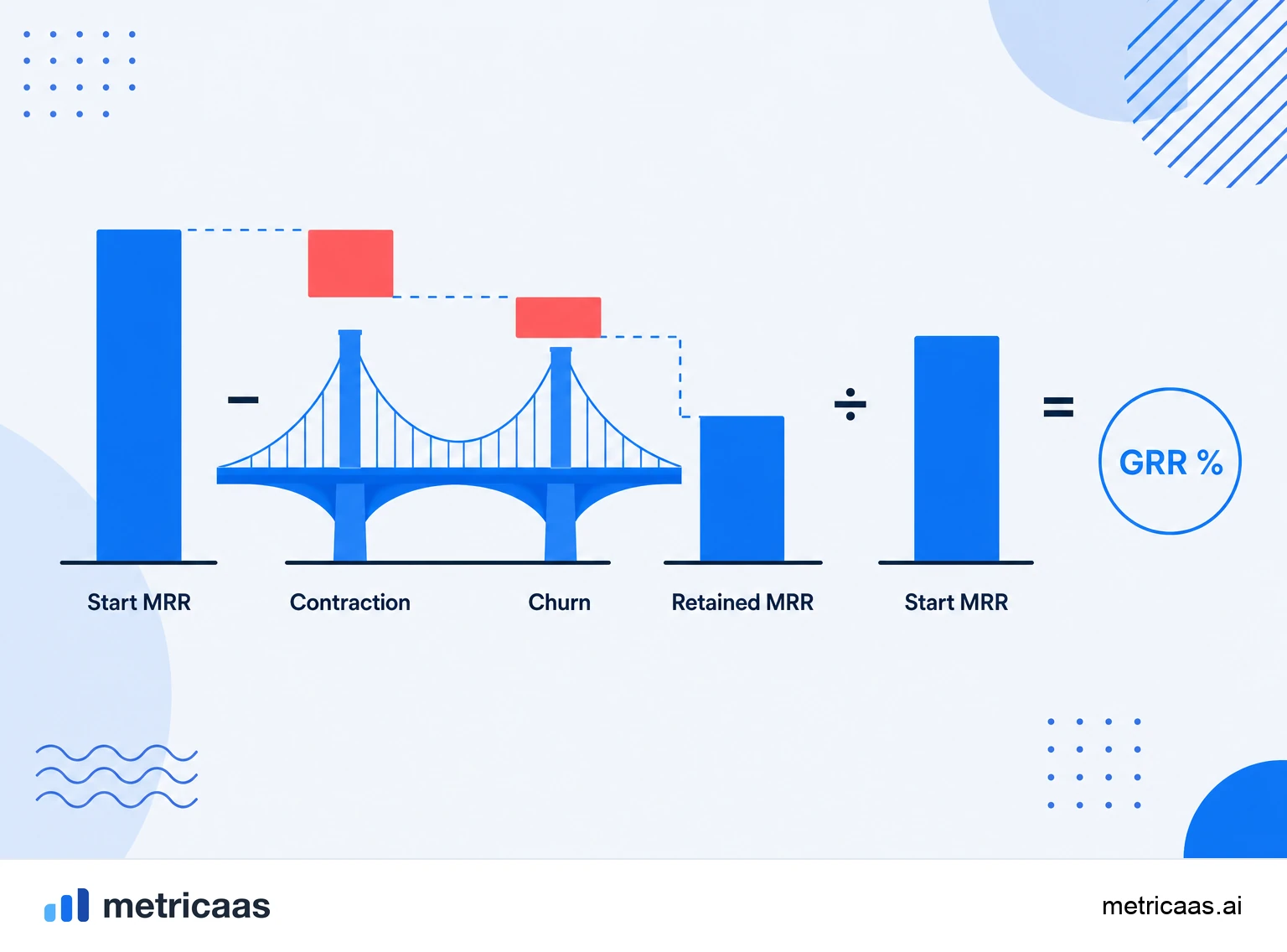
Take the base MRR at the start of the period, subtract contraction and cancellations over it, and divide by the starting MRR. Expansion is left out: by definition, GRR ignores any extra revenue from upgrades and add-ons.
- Starting base MRR.
- Minus contraction (downgrades).
- Minus churn (cancellations).
- Divided by the starting base MRR.
- Expansion does not count.
Example: a base starts the period with $100k of MRR. Over it, it loses $4k in downgrades and $6k in cancellations. That leaves $90k over $100k, a GRR of 90%. Note the contrast with NRR: if that same base had gained $18k of expansion, NRR would be 108%, but GRR would still be 90%, because it never counts expansion.
GRR and NRR: the single difference
Both metrics start from exactly the same point: the starting base MRR, from which they subtract the same contraction and the same churn. The single difference, and it changes everything, is expansion: NRR adds the upgrades of the base, GRR does not.
- GRR: start minus contraction and churn. Never goes above 100%.
- NRR: the same, plus expansion. Can go above 100%.
The gap between the two is precisely the size of your expansion. In the example above, an NRR of 108% with a GRR of 90% tells a clear story: the base leaks 10% a year, and expansion not only covers that hole but still grows revenue by 8%. GRR on its own reveals the leak that NRR, by itself, masks.
What a good GRR looks like
The benchmark is simple: the closer to 100%, the better, because every point below is revenue draining from the base. According to the annual private SaaS survey by KeyBanc Capital Markets, industry gross revenue retention sat around 86% in 2023, while net retention stayed above 100%. In other words, the typical SaaS loses about 14% of its base a year and relies on expansion to grow despite that.
The expected bar rises with contract size. SaaS Capital shows retention rising with deal size: in the $25k to $50k annual contract bracket, median NRR was 102%, a sign of more loyal bases. Larger accounts tend to have higher GRR than self-serve products, so a GRR of 90% can be excellent in a self-serve product and merely average in an enterprise SaaS.
Does GRR include contraction and can it exceed 100%
Yes, GRR includes contraction. Downgrades and plan reductions are lost base revenue, and the metric was built precisely to capture every loss: both the full cancellation (churn) and the partial reduction (contraction). No loss is left out.
And by construction GRR never goes above 100%. Because it only subtracts, and adds nothing, the best possible outcome is losing no one, which lands at exactly 100%. If you see a GRR above 100%, it is a sign that expansion was mixed into the calculation by mistake, and what is actually being measured is NRR. Keeping the two apart is what gives an honest read of the base.
How to improve GRR in practice
Because GRR only measures losses, improving it means attacking the pure leak: reducing churn and contraction. There is no expansion shortcut here, which makes it the most honest test that the base holds on its own. A playbook:
- Invest in onboarding and activation: customers who reach value fast cancel less.
- Monitor downgrade and risk signals, and act before renewal, not after.
- Close the product gaps that push customers to smaller plans or out the door.
- Segment GRR by cohort and customer size: the average hides bases that hold and bases that leak.
Tracked by cohort, GRR becomes the cleanest gauge of base health. A high GRR is the foundation expansion works on: without stopping the leak first, no high NRR holds up for long.
Frequently asked questions
GRR is the gross retention of base revenue over time, counting only the losses: contraction and churn, and ignoring any expansion. That is why it never goes above 100%.
By taking the starting base MRR, subtracting contraction and churn, and dividing by the starting MRR. Expansion is left out. A $100k base losing $4k and $6k gives a GRR of 90%.
Both start from the same base and subtract the same losses; the single difference is expansion. NRR adds the upgrades and can go above 100%; GRR does not count them and never goes above 100%.
The closer to 100%, the better. In private SaaS, gross retention sat around 86% in 2023, and the expected bar rises with contract size.
No. Because it only subtracts losses and never adds expansion, the best possible outcome is 100%, meaning losing nothing. A GRR above 100% is a sign that expansion crept into the calculation by mistake.
Yes. GRR captures every loss of base revenue: the full cancellation (churn) and the partial plan reduction (contraction). Only expansion is left out.
Related concepts

Net Revenue Retention (NRR)
Net Revenue Retention (NRR) measures how much of the recurring revenue from your current base you keep over time, already accounting for upgrades and expansion, minus downgrades and cancellations. Above 100% it means the base grows on its own, even without new customers.

Churn
Churn is the loss of customers or revenue in a period. In a SaaS, it measures how many customers cancel (customer churn) or how much recurring revenue disappears (revenue churn). It is the metric that reveals whether growth is sustainable: the higher the churn, the more new sales you need just to avoid shrinking.

MRR
MRR (Monthly Recurring Revenue) is the monthly recurring revenue of a SaaS: the sum of all active subscriptions normalized to a month. It is the core metric of a subscription business because it shows, predictably, how much the company earns on a recurring basis each month, without counting one-off charges.