
ARPA: what average revenue per account is and how to calculate it
By Tiago Costa · Updated on July 9, 2026

Definition
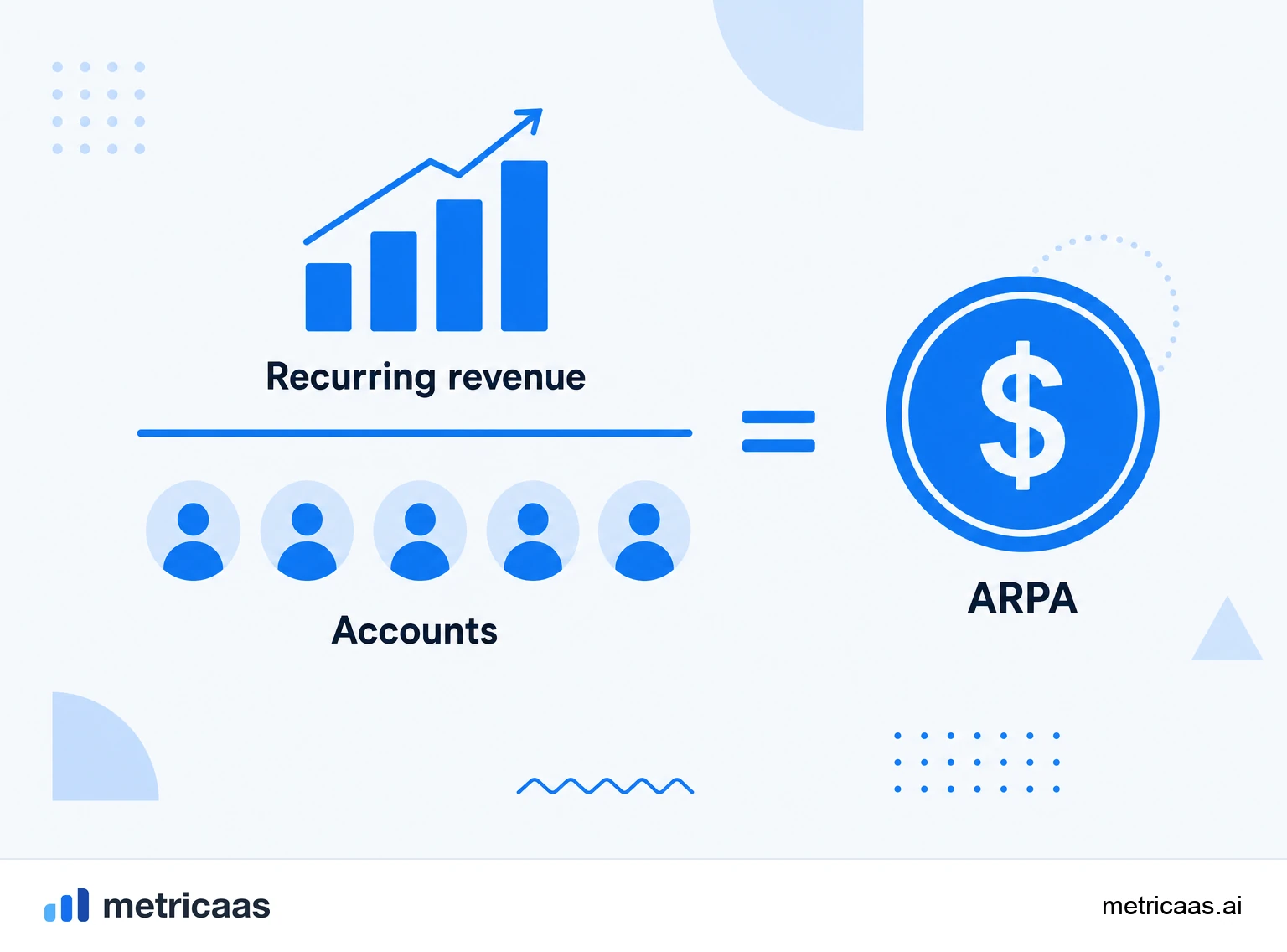
ARPA (Average Revenue Per Account) is a SaaS recurring revenue divided by the number of active accounts.
- Formula: recurring revenue / active accounts.
- Use MRR for monthly ARPA and ARR for annual ARPA.
- It differs from ARPU, which divides by the number of users.
What ARPA is
ARPA (Average Revenue Per Account) measures how much each active account generates in recurring revenue, on average. Instead of looking at total revenue, it divides that revenue by the number of accounts to reveal the typical value of a customer. It is a single number that summarizes how heavy each contract in your base really is.
Known in many markets simply as average ticket, ARPA gets a specific cut in a SaaS: it counts only the recurring revenue from subscriptions, not one-off sales. A rising ARPA signals that the company is selling larger plans, charging more for the value it delivers, or expanding the customers it already has. A falling one can point to aggressive discounts or a base increasingly concentrated in cheap plans.
How to calculate ARPA
The formula is a simple division: take the recurring revenue of a period and divide it by the number of active accounts in the same period.
- ARPA = recurring revenue / active accounts.
- Use MRR for a monthly ARPA, or ARR for an annual ARPA.
- Count only active, paying accounts, with no trials or cancelled ones.
- Always use net recurring revenue, already without one-time fees and taxes.
Example: if MRR is $100k and you have 500 active accounts, monthly ARPA is $200 (100,000 / 500). If the next month MRR rises to $120k with the same 500 accounts, ARPA becomes $240: the base grew in value, not in number. That is the reading total revenue alone hides.
ARPA vs ARPU: account or user
ARPA and ARPU look like synonyms but measure different things. ARPA divides revenue by the number of accounts (companies, organizations, subscriptions). ARPU (Average Revenue Per User) divides it by the number of individual users. The difference matters when a single account has many users, the typical case of B2B products sold by seat.
- ARPA: recurring revenue / number of accounts. Best for B2B sales and per-company contracts.
- ARPU: recurring revenue / number of users. Best for B2C products or those sold per seat.
In a tool sold to companies, one account may have 10 users; ARPA will be ten times ARPU in that case. Choosing the right metric avoids confusion: use ARPA when the unit of business is the account, and ARPU when what matters is the value per person inside it.
ARPA, LTV and pricing
ARPA is the gateway to other metrics. It feeds directly into LTV: the higher the average revenue per account, the greater the value each customer generates over the relationship, as long as retention keeps pace. That is why ARPA is a central pricing lever: raising the price or packaging more value per account increases ARPA and, with it, the return on every sale.
There is a counterintuitive virtuous effect here: higher-ticket accounts tend to stay longer. Data from SaaS Capital shows that net revenue retention rises with contract value: the median sits around 102% in the $25k to $50k annual contract bracket. In other words, increasing ARPA not only lifts revenue per account, it usually comes with customers who stay and expand more.
How to increase ARPA
Increasing ARPA means growing revenue without relying only on bringing in new accounts. The most common levers:
- Upsell: move the customer to a higher plan, with more features or limits.
- Expansion: add-ons, extra seats and additional usage within the account.
- Value-based pricing: charge according to the value delivered, not a low flat price.
- Focus on larger accounts: move acquisition toward segments that buy more robust plans.
- Cut discounts: every recurring discount lowers ARPA permanently.
Expansion is the most efficient lever because it acts on customers who already trust the product, at an acquisition cost close to zero. An ARPA that rises through expansion of the base is the healthiest sign of growth: revenue grows from within, not just from outside.
Why ARPA matters
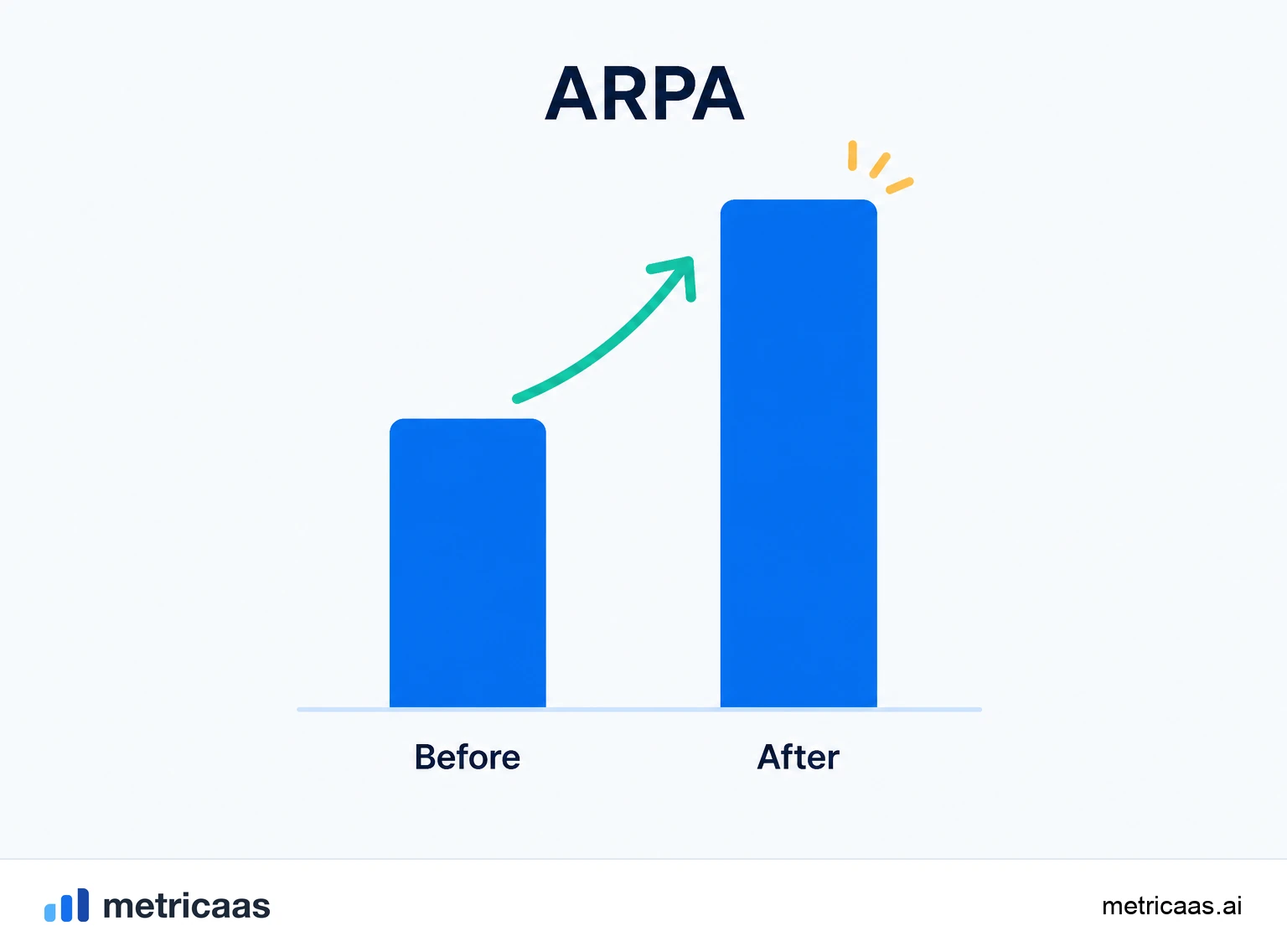
ARPA is a test of the quality of growth, not just its size. Two companies with the same MRR can have very different ARPA: one with a few high-value accounts, another with many small ones. The first tends to have lower service costs per dollar of revenue and a base that is easier to expand; the second depends on volume and support that scales with it.
Tracking ARPA over time shows whether each dollar of MRR or ARR is becoming more or less efficient. A rising ARPA, with stable retention, means the company is learning to capture more value from every account, and that is what sustains predictable, profitable growth over the long run.
Frequently asked questions
ARPA (Average Revenue Per Account) is a SaaS recurring revenue divided by the number of active accounts. It shows how much each account generates, on average.
Divide recurring revenue by the number of active accounts. With MRR of $100k and 500 accounts, ARPA is $200 per month.
ARPA divides revenue by the number of accounts; ARPU divides it by the number of users. They diverge when one account has several users.
Through upsell, expansion, value-based pricing and a focus on larger accounts, while avoiding recurring discounts that lower it.
The higher the ARPA, the greater the value each customer generates over the relationship, so a higher ARPA lifts LTV as long as retention holds.
Related concepts

MRR
MRR (Monthly Recurring Revenue) is the monthly recurring revenue of a SaaS: the sum of all active subscriptions normalized to a month. It is the core metric of a subscription business because it shows, predictably, how much the company earns on a recurring basis each month, without counting one-off charges.

LTV / CLV
LTV (Lifetime Value), also called CLV or CLTV, is the total value a customer generates while they stay in your base. In a simple form, it is the recurring average revenue times margin times the customer lifetime. It is the metric that shows how much it is worth investing to win and keep each customer.

ARR
ARR (Annual Recurring Revenue) is the annual recurring revenue of a SaaS: MRR multiplied by 12. It represents how much the company earns on a recurring basis over a year, counting only active subscriptions, with no one-off charges. It is the metric of choice for companies selling annual contracts and the standard language of investors.