
ARR: what annual recurring revenue is and how to calculate it
By Tiago Costa · Updated on July 9, 2026

Definition
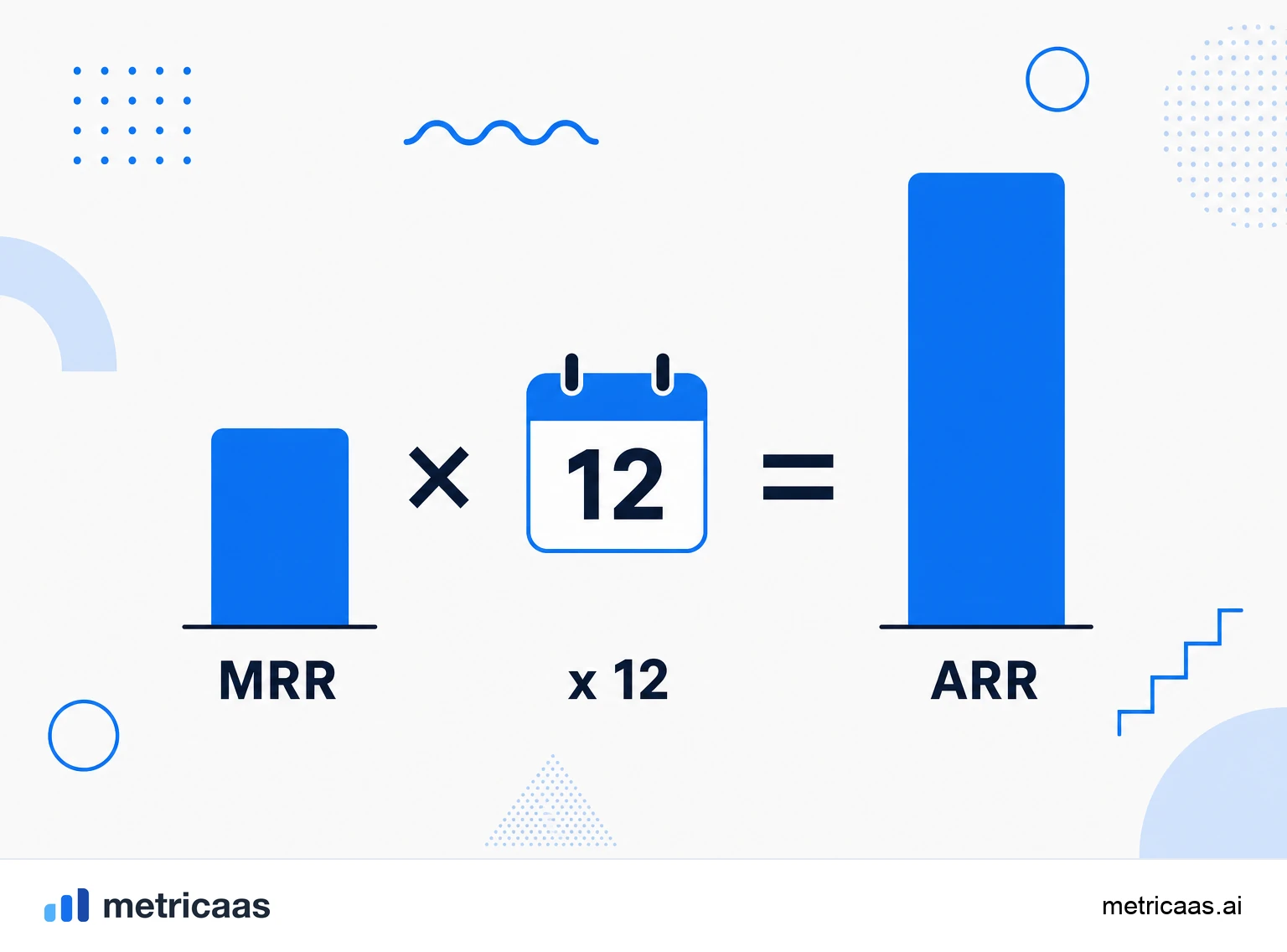
ARR (Annual Recurring Revenue) is the annual recurring revenue of a SaaS: MRR multiplied by 12.
- Counts only recurring revenue, not one-off charges.
- It is annualized MRR, the same revenue seen over a year.
- Standard language of annual contracts and investors.
What ARR is
ARR measures the recurring revenue a SaaS generates over a year. It looks only at what repeats, ignoring setup fees, ad hoc services and any one-off charge, which is why it shows the predictable base the business stands on over an annual horizon.
In practice, ARR and MRR are the same recurring revenue seen over different windows: MRR looks at the month, ARR at the year. Companies selling monthly plans tend to talk in MRR; those selling annual contracts, in ARR.
How to calculate ARR
The simplest and most reliable way is to annualize MRR: take the normalized MRR and multiply by 12.
- ARR = MRR x 12.
- Sum the recurring value of all active contracts, normalized per month, and multiply by twelve.
- Exclude one-time fees, taxes and ad hoc usage charges, which are not recurring.
Example: if MRR is $50k, ARR is $600k. The care is the same as with MRR: contracts on different cadences must be normalized before annualizing, or the number inflates or shrinks for no real reason.
ARR and MRR: when to use each
Both measure the same recurring revenue, so the choice is convenience, not concept.
- MRR: best for the day-to-day of self-serve products and monthly plans, where revenue changes every week.
- ARR: best for annual contracts and for talking to investors, who think in multiples of ARR.
The common mistake is mixing the two in the same sentence without normalizing. If you add the full value of an annual contract to a month of MRR, the number stops making sense. Keep one base (normalized MRR) and derive ARR from it.
What "$1 million ARR" means
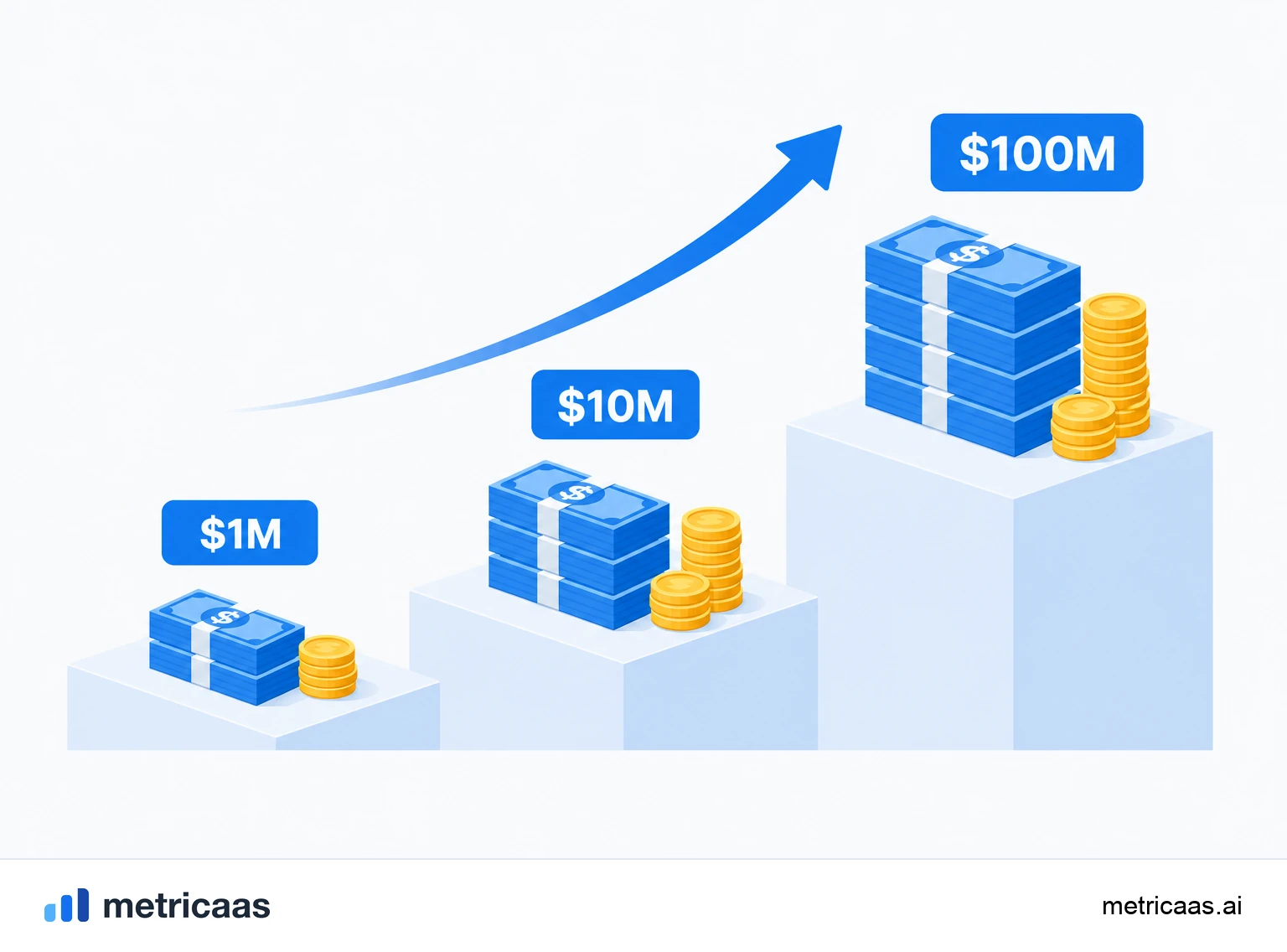
ARR milestones have become the informal ruler of the SaaS world. Reaching $1 million ARR means the company generates, on a recurring basis, about $83k of MRR per month. It is the level at which many businesses prove they have a sellable, repeatable product.
Then come $10 million, $100 million, and so on. These numbers are not just vanity: because ARR is recurring and predictable, it is the base on which investors value the company, usually as a multiple of ARR.
ARR and run rate: mind the trap
There is a subtle but important difference between ARR and run rate. A well-built ARR starts from contracted recurring revenue. Run rate annualizes a recent result (for example, last month revenue times 12), and not everything that came in during a month is recurring.
Annualizing a strong month that included one-off charges or a seasonal spike inflates the number and sets an expectation that will not hold. The golden rule: only what will repeat belongs in ARR. Rebuilding ARR from real subscriptions, rather than from a revenue average, avoids this trap.
Why ARR guides the business
The predictability of ARR is what makes it so useful for planning. Because it repeats, you can forecast cash, size hiring and measure year-over-year growth on a stable base.
This model is no longer a niche: according to Gartner, worldwide spending on SaaS applications is set to approach $300 billion in 2025. And ARR does not live alone: it grows with MRR movements and is sustained by retention, so much so that the private SaaS survey by KeyBanc Capital Markets shows net revenue retention above 100%. A healthy ARR is the consequence of a healthy NRR.
Frequently asked questions
ARR is the annual recurring revenue of a SaaS, MRR multiplied by 12. It counts only recurring revenue, with no one-off charges.
By multiplying normalized MRR by 12. If MRR is $50k, ARR is $600k. One-time fees and taxes are left out.
They are the same recurring revenue seen over different windows: MRR looks at the month, ARR at the year. ARR = MRR x 12.
It means the company generates about $83k of MRR per month on a recurring basis. It is a common milestone for proving the product is sellable and repeatable.
Not exactly. ARR starts from contracted recurring revenue; run rate annualizes a recent result, which may include one-off charges and inflate the number.
Related concepts

MRR
MRR (Monthly Recurring Revenue) is the monthly recurring revenue of a SaaS: the sum of all active subscriptions normalized to a month. It is the core metric of a subscription business because it shows, predictably, how much the company earns on a recurring basis each month, without counting one-off charges.

MRR Movements
MRR movements are the breakdown of the monthly change in MRR into its causes: new, expansion, contraction, churn and reactivation MRR. Instead of watching only the final number, you separate every dollar that came in and every dollar that left, and see why recurring revenue grew, stalled or fell. The sum of all movements is the net new MRR for the period.

Net Revenue Retention (NRR)
Net Revenue Retention (NRR) measures how much of the recurring revenue from your current base you keep over time, already accounting for upgrades and expansion, minus downgrades and cancellations. Above 100% it means the base grows on its own, even without new customers.