
Gross MRR churn: what gross revenue churn is and how to calculate it
By Tiago Costa · Updated on July 9, 2026

Definition
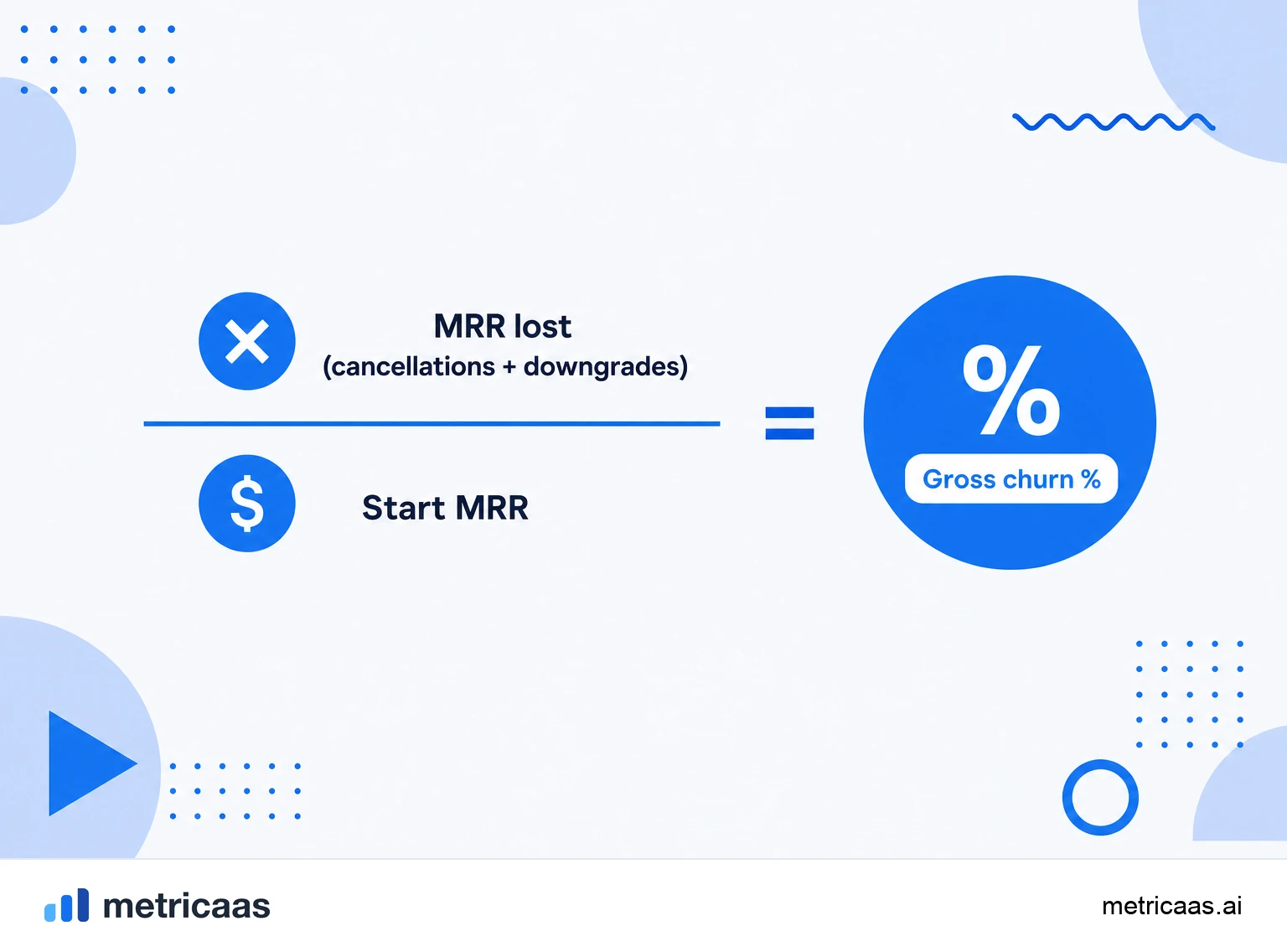
Gross MRR churn is the percentage of MRR lost to cancellations and downgrades in a period, with no expansion subtracted.
- Counts only revenue leaving: cancellations and plan downgrades.
- Always positive and never exceeds 100%.
- Shows the worst case of retention, before any gains from the base.
What gross MRR churn is
Gross MRR churn measures how much recurring revenue a company loses in a period because of customers who cancel or move to a smaller plan. The word gross is the key: the calculation adds up only what left and completely ignores any expansion, upsell or reactivation. That is why it is always positive and never exceeds 100%, since at most you lose the entire base you started with.
While generic churn can refer to customers who disappear, gross MRR churn is a revenue reading: it speaks in dollars of MRR that evaporated, not in number of logos. That makes it the most honest picture of the money leaking out, the worst case before counting any gain.
How to calculate gross MRR churn
The formula takes all the recurring revenue lost in the period and divides it by the base at the start of that same period.
- Gross MRR churn = (MRR from cancellations + MRR from downgrades) / MRR at the start of the period.
- The numerator holds only losses: cancelled contracts and plan downgrades.
- The denominator holds the MRR on the first day of the period, before any movement.
Example: you start the month with $100k of MRR, lose $4k to cancellations and $1k to downgrades. Gross MRR churn is 5%, even if expansion added $8k in the same month. Expansion does not enter the gross figure, it only shows up in the net calculation.
Gross MRR churn vs net MRR churn: the difference
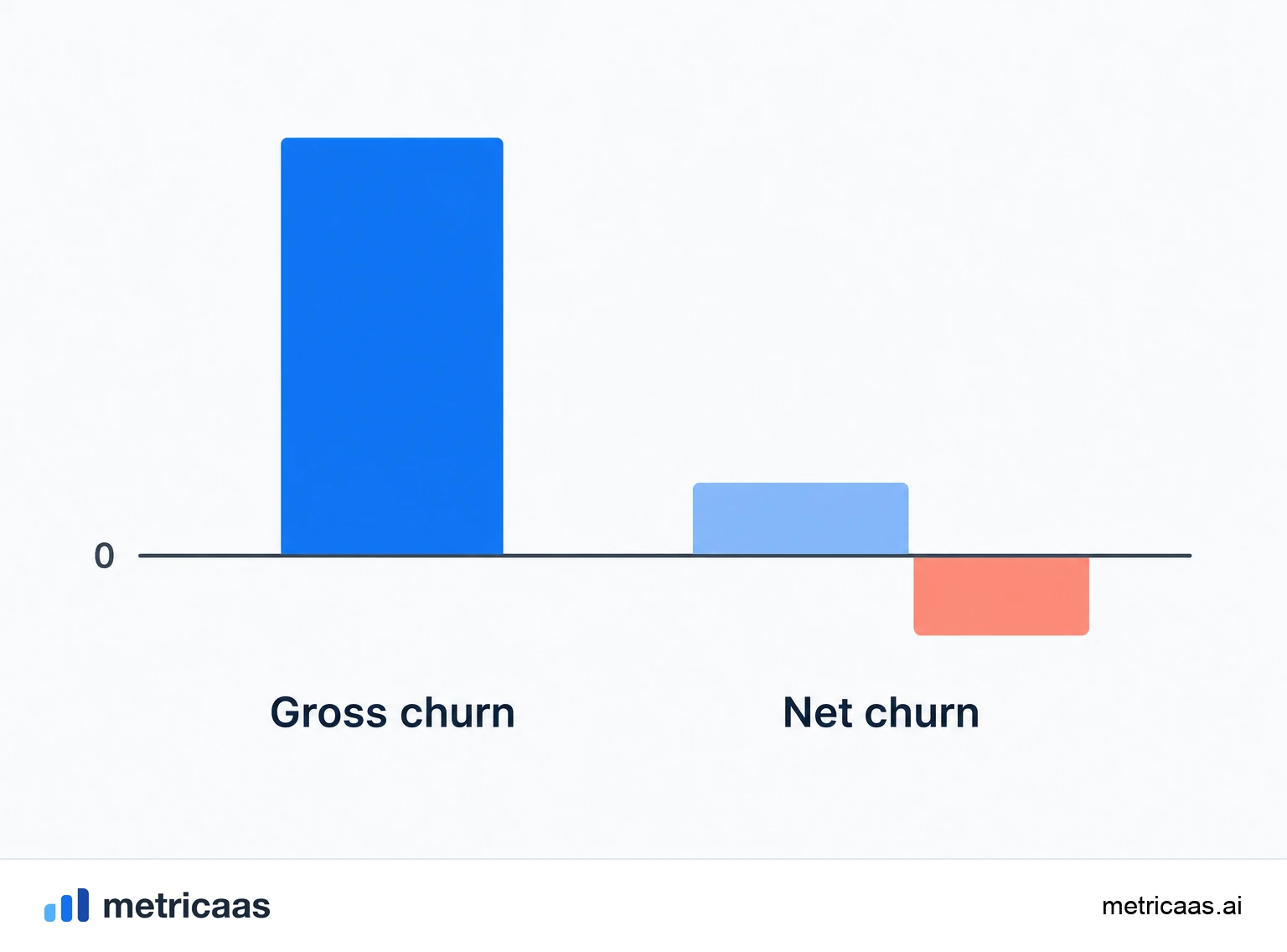
The difference between gross and net comes down to a single variable: expansion. Gross MRR churn ignores every gain from the existing base. Net MRR churn subtracts expansion revenue (upgrades, upsell, cross-sell) from the losses before dividing.
- Gross MRR churn: losses only. Always positive, capped at 100%.
- Net MRR churn: losses minus expansion. Can go negative when expansion beats losses, the famous negative churn.
Looking at net alone hides a common problem: a base that loses a lot but masks it with aggressive upsell on a few accounts. That is why gross and net travel together. Gross reveals the real size of the leak; net shows whether growth in the base covers that leak.
The three types of churn
When someone asks about the three types of churn, they usually mean three different lenses on the same loss. Understanding all three keeps you from mistaking context for a number.
- Customer churn: how many logos you lost, in units. It does not weigh the size of each account.
- Gross revenue churn: how much MRR left, with no expansion subtracted. This is the gross MRR churn of this entry.
- Net revenue churn: MRR losses already netted against expansion of the base.
A SaaS can have high customer churn and low gross revenue churn if the accounts leaving are small, or the reverse. Reading all three together avoids hasty conclusions about the health of retention.
What a good gross MRR churn is
There is no magic number, but there is a ruler. A rule of thumb repeated across the industry is to keep monthly gross MRR churn around 1% or below, which compounds to somewhere between 10% and 12% a year. Selling to larger companies tends to yield lower churn than selling to SMBs, which rotate faster.
The SaaS Capital research on private SaaS retention shows that healthy companies keep the large majority of their recurring revenue year over year, and that those serving larger accounts tend to lose less. Gross MRR churn is the other side of that coin: the lower it is, the more revenue survives the period.
Why gross MRR churn matters
Gross MRR churn is the direct mirror of Gross Revenue Retention (GRR): over a period, GRR and gross churn add up to 100%. If you retain 92% of revenue, your gross churn was 8%. That is why it is the metric customer success and product teams watch to know whether the leak is under control before any expansion effort.
It also gives context to the rest of the funnel. There is no point speeding up acquisition if the base drains through the same hole, and it is in MRR movements that this tug of war between loss and gain becomes visible. The annual private SaaS survey by KeyBanc Capital Markets reinforces that retention is the engine of efficient growth, with the net retention of the best companies above 100%. Controlling gross churn is the first step to getting there.
Frequently asked questions
It is the percentage of recurring MRR lost to cancellations and downgrades in a period, with no expansion subtracted. Always positive, never above 100%.
Divide the MRR lost in the period (cancellations plus downgrades) by the MRR at the start of the period. Start with $100k and lose $5k, and gross churn is 5%.
Gross churn counts only losses. Net MRR churn subtracts expansion revenue before dividing, so it can even go negative when expansion beats losses.
Customer churn (logos lost), gross revenue churn (MRR lost with no expansion subtracted) and net revenue churn (losses already netted against expansion of the base).
A common benchmark is to keep monthly gross churn around 1% or less. Companies serving larger accounts usually sit well below that.
Related concepts

Churn
Churn is the loss of customers or revenue in a period. In a SaaS, it measures how many customers cancel (customer churn) or how much recurring revenue disappears (revenue churn). It is the metric that reveals whether growth is sustainable: the higher the churn, the more new sales you need just to avoid shrinking.

Net MRR churn
Net MRR churn is the recurring revenue lost to cancellations and downgrades, minus the expansion generated by the same base in the same period, all over the MRR at the start of the period. Unlike gross churn, it subtracts expansion, so it can go negative when the customers who stay grow more than the ones who leave, what is called negative churn.

Gross Revenue Retention (GRR)
Gross Revenue Retention (GRR) measures how much of the recurring revenue from your current base you keep over time counting only the losses, contraction and cancellations, and ignoring any expansion. That is why it never goes above 100%: it shows the pure leakage of the base.