
Upsell: what it is, how it works and why it drives expansion
By Tiago Costa · Updated on July 9, 2026

Definition
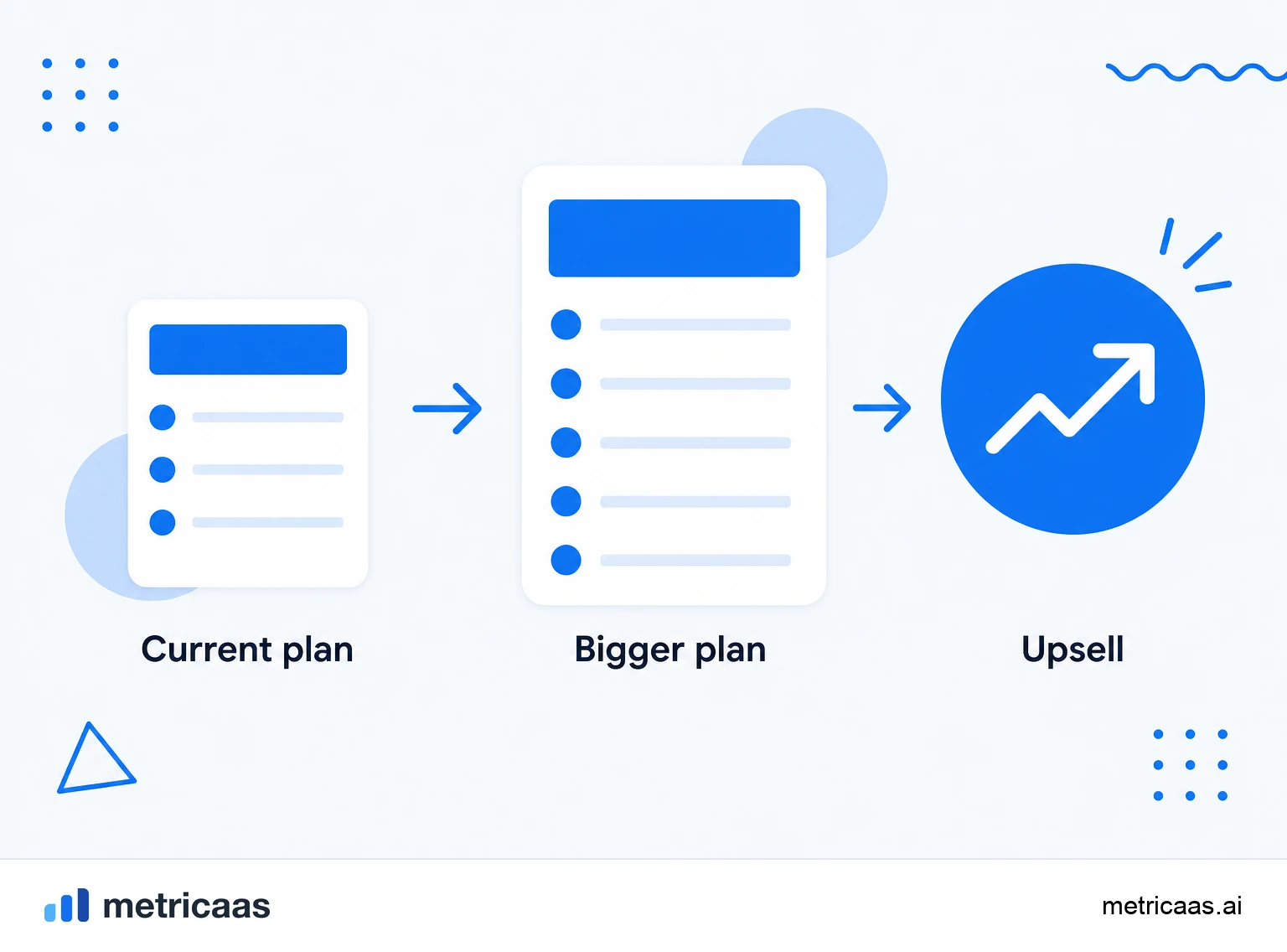
Upsell means moving a current customer to a higher plan or more of the same product: more seats, a higher tier, a larger limit.
- Grows revenue from existing customers, with no cost to acquire a new logo.
- It is a driver of expansion and sustains NRR above 100%.
- Different from cross-sell, which sells a complementary product.
What upsell is
Upsell happens when a customer who already pays for your product starts paying more for the same solution, whether by moving up to a higher plan or by buying more volume: more seats, a tier with advanced features, a larger usage limit. Instead of winning a brand-new company, you expand the value of an account that already trusts the product.
In a subscription SaaS, upsell is one of the most efficient ways to grow, because the extra revenue comes from a relationship that already exists. The customer has already been acquired, gone through onboarding and started seeing results. Selling more to them costs a fraction of bringing in a customer from scratch.
Upsell and cross-sell: what is the difference
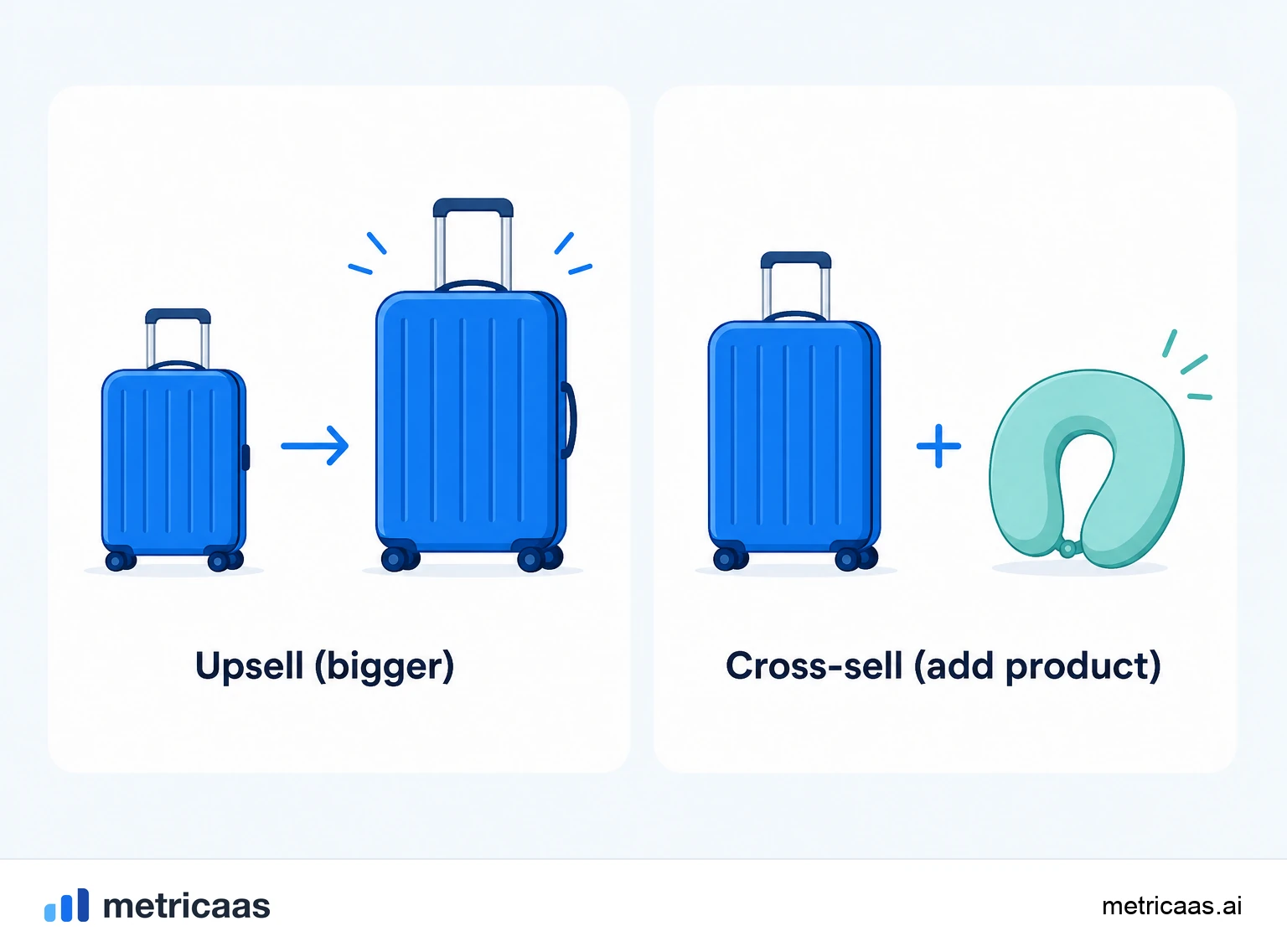
Both expand the account, but along different paths. In upsell, the customer buys more of the same product or a higher version of it. In cross-sell, they buy a complementary product, something adjacent to what they already use.
- Upsell: moving from the Pro plan to Enterprise, doubling the number of seats, raising the limit on contacts or API calls.
- Cross-sell: someone using the email tool also starts paying for the automation or analytics module.
In practice the two plays coexist and often reinforce each other, but separating them helps you understand where growth comes from and design the right offers for each moment of the customer journey.
The ideal upsell trigger
The best upsell is not pushed, it is pulled by usage itself. The ideal trigger is the customer hitting a limit exactly when they are already getting value from the product: the growing team runs out of seats, the contact volume crosses the plan ceiling, an advanced feature becomes a must. At that point, upgrading stops being a cost and becomes the removal of an obstacle.
That is why the best upsell moments tend to be signaled by the product, not the sales calendar. Watching usage indicators, warning the customer as they approach a limit and offering the next tier at the right instant turns a sales ask into a welcome solution. Forcing upsell before the customer sees value, on the contrary, erodes trust and pulls churn forward.
Upsell, expansion and NRR
Upsell is one of the main drivers of expansion, the extra revenue that comes from the existing base. When that expansion outweighs what is lost to cancellations and downgrades, Net Revenue Retention (NRR) rises above 100%, the sign that the base grows on its own even with no new customers.
This is the pattern of the healthiest SaaS companies. The private SaaS survey by KeyBanc Capital Markets shows net revenue retention hovering around 100% or higher among the best performers, and much of that expansion comes from upsell. According to SaaS Capital, net revenue retention is among the metrics most closely tied to the value and growth of a software company.
The economics of upsell versus a new customer
Compared with closing a new customer, upsell has far more favorable economics. There is no cost to acquire a new logo, the sales cycle is shorter and the conversion rate is higher, because you are talking to someone who already knows and trusts the product. Every dollar of upsell revenue tends to arrive at a better margin than a dollar of acquisition revenue.
This does not mean stopping new customer acquisition: acquisition feeds the base that will later be expanded. It means recognizing that businesses relying only on new logos to grow are stuck on an expensive treadmill, while those that build a consistent upsell engine grow revenue per account (ARPA) over time, with decreasing marginal effort.
How to measure and track upsell
To treat upsell as an engine rather than luck, it helps to track a few numbers. The upsell rate measures the share of customers (or revenue) that moves to a higher plan in a period. ARPA shows whether revenue per account is rising over time. And the upsell contribution to NRR reveals how much expansion comes from growing customers, rather than from selling other products.
- Upsell rate: percentage of accounts that migrate to a higher plan in the period.
- Upsell expansion MRR: additional recurring revenue generated by plan upgrades and more volume.
- ARPA over time: if it grows, upsell is working across the base.
Measuring this separately from cross-sell and acquisition makes clear which lever is moving revenue and where to invest next.
Frequently asked questions
An upsell is moving a current customer to pay more for the same product, by upgrading their plan or buying more volume: more seats, a higher tier, a larger limit.
In upsell the customer buys more of the same product or a higher version. In cross-sell they buy a complementary product, adjacent to what they already use.
It is the share of customers or revenue that moves to a higher plan in a period. It tracks how well the base is being expanded.
It is offering the next tier of the product at the moment the customer hits a limit and is already getting value, turning the sale into the removal of an obstacle.
Upsell generates expansion revenue. When that expansion outweighs cancellations and downgrades, NRR rises above 100% and the base grows even without new customers.
Yes. Upsell moves the customer to a higher plan; downsell moves them to a smaller one, usually to avoid losing them entirely.
Related concepts

Cross-sell
Cross-sell (cross-selling) is selling a customer who already uses one product a second, complementary product, module or add-on. It grows revenue per account and stickiness, because the more products a customer uses the more expensive it is to leave, all without a plan change. Together with upsell, it is one of the two levers of base expansion.

Expansion
Expansion (expansion revenue or expansion MRR) is the additional recurring revenue that comes from customers you already have, without relying on new sales. It comes from upsell (higher plan), cross-sell (more products), add-ons and usage growth. It is the force that pushes net revenue retention above 100% and makes the base grow on its own.

ARPA
ARPA (Average Revenue Per Account) is a SaaS recurring revenue divided by the number of active accounts. It shows how much each account generates, on average, per month or year. It is the metric that reveals the typical value of a customer and one of the main levers for growing revenue without relying only on new sales.