
Trial-to-paid conversion: what it is and how to improve the rate
By Tiago Costa · Updated on July 9, 2026

Definition
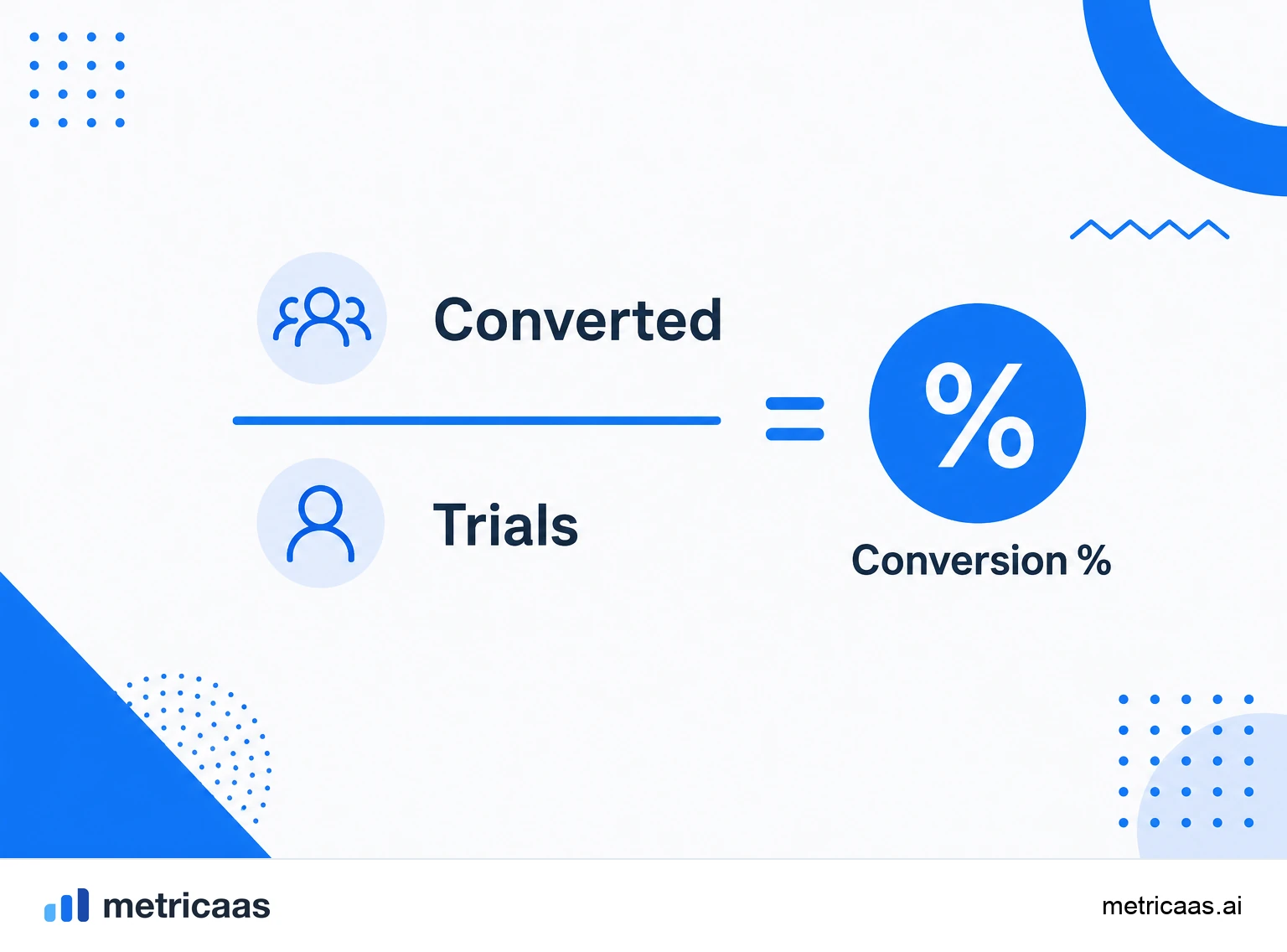
Trial-to-paid conversion is the share of free trials that become paying customers: paid conversions divided by trials started.
- Central metric of self-serve and product-led products.
- Card-required trials (opt-out) convert far more than no-card ones (opt-in).
- Activation during the trial is the strongest predictor of conversion.
What trial-to-paid conversion is
Trial-to-paid conversion measures the share of people who start a free trial and end up as paying customers. It is the central metric of self-serve and product-led products, because in those models the product itself, not a salesperson, has to convince the user to pay within a short window.
Unlike a website conversion rate, which looks at visitor to signup, trial-to-paid conversion looks at the most expensive step of the funnel: signup to revenue. That is why it ties directly to CAC: when more trials become payers, every dollar spent on acquisition yields more customers, and the cost of acquiring each one falls.
How to calculate trial-to-paid conversion
The formula is a simple division: paid conversions divided by trials started in the same period, as a percentage.
- Trial-to-paid conversion = (trials that became paying / trials started) x 100.
- The denominator is the trials started within a window (for example, one month of trials), not every trial in history.
- The numerator counts those who paid the first invoice within a defined attribution window, so cohorts do not blend together.
The detail that fools most teams is the window. A 30-day trial only shows its real result weeks after it starts, so measuring a cohort before it matures understates the number. The right way is by cohort: group trials by start date and measure how many converted by the end of the trial period plus a short buffer.
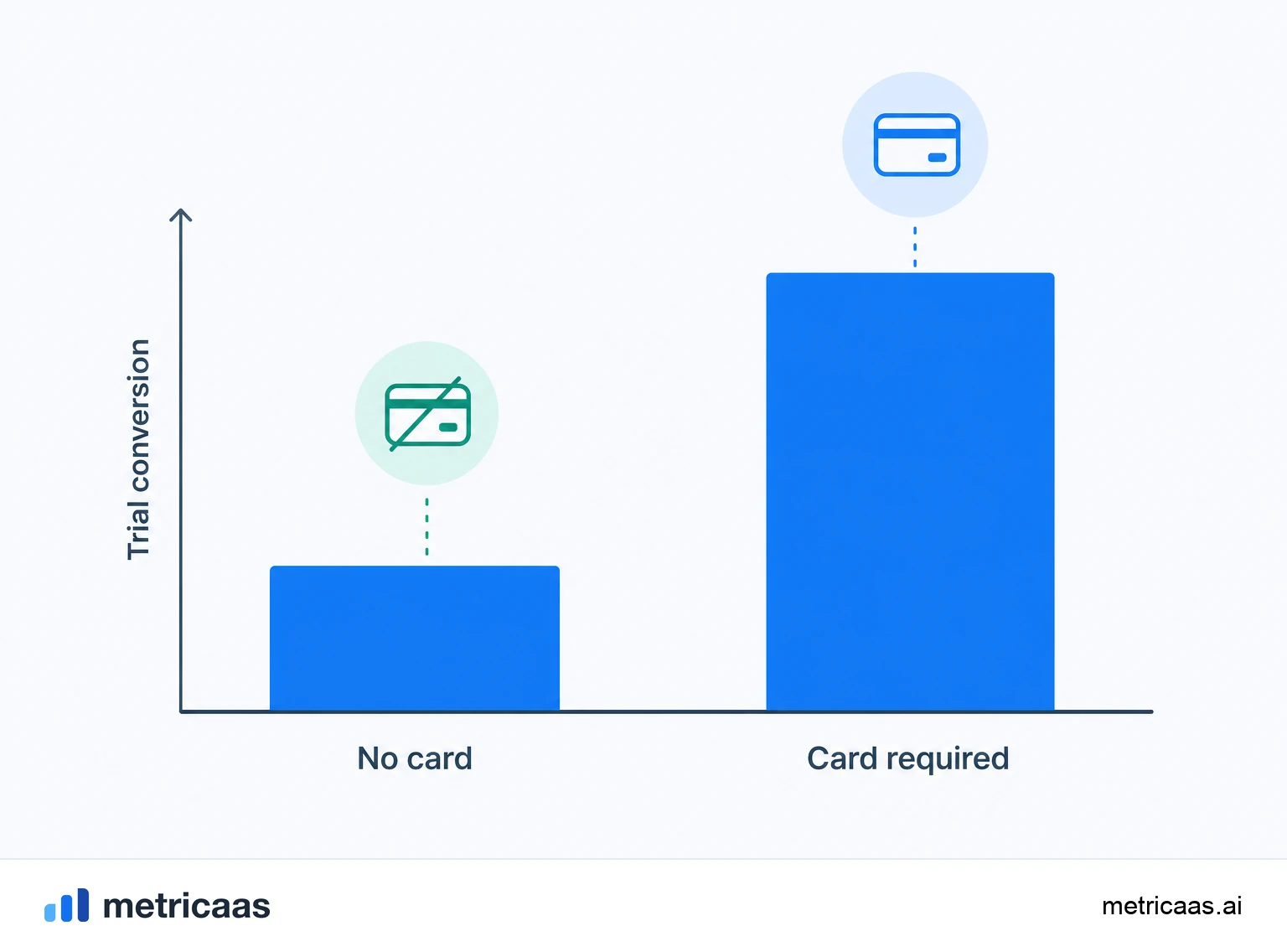
Card-required vs no-card trials (opt-out vs opt-in)
The biggest lever on trial conversion is not the product, it is the design of the trial. Asking for a card up front (the opt-out model, where the charge happens automatically unless the user cancels) tends to convert in the 40% to 60% range. Not asking for a card (the opt-in model, where the user has to actively decide to pay) tends to convert in the 10% to 25% range.
The gap does not mean one model is better. Opt-out converts higher in percentage terms, but it draws fewer signups at the top and creates more refunds and early churn from people who forgot to cancel. Opt-in brings far more signups and a more qualified base of payers, at the cost of a lower rate. Comparing the conversion of two products without knowing which model each uses leads to wrong conclusions.
Time-limited vs usage-limited trials
Beyond the card, the way you cap the trial shapes conversion. In a time-limited trial (the classic 14 or 30 days), the clock is the pressure: the user has a fixed deadline to see value. In a usage-limited trial, the cap is a quota (credits, actions, volume) and the trial lasts until the quota runs out, which fits products used only now and then.
- Time-limited: predictable to measure, but it punishes users who only come back occasionally.
- Usage-limited: it tracks the real pace of adoption, but it requires defining the quota that represents value.
Short trials create urgency and speed up the decision; long trials give time to build a habit but dilute urgency. There is no universal optimal length: the best window is the one that covers the time a typical user needs to reach the first moment of value.
Activation: the strongest predictor
If there is a single number that predicts trial conversion, it is the activation rate. Users who perform the core action of the product during the trial (the aha moment) convert at a far higher rate than those who sign up and never get there. Conversion is, at heart, the visible tip of an activation funnel.
That is why moving trial conversion is almost never about the price or the checkout button. It is about shortening the path to value: cutting friction in onboarding, guiding the user to the action that matters, and triggering the invitation to pay at the moment they have already felt the benefit. Optimizing the checkout of users who never activated is optimizing the wrong exit of the funnel.
Benchmarks and how to use the number
There is no single benchmark for trial conversion, because the number depends on the model (card or not), the duration and the type of product. Annual SaaS benchmark studies, such as the ones published by Benchmarkit, show that conversion varies widely by go-to-market motion, a reminder to always compare against your own model rather than against a loose average.
It is also worth not confusing trial conversion with freemium conversion: in freemium the free plan is permanent and conversion to paid tends to sit in the single digits, while in a trial the deadline forces the decision. And the number does not live alone: a high conversion paired with high churn is a hollow win. As the retention analyses from SaaS Capital point out, what sustains a SaaS is retaining and expanding revenue after the first purchase, not just closing the initial sale.
Frequently asked questions
It is (paid conversions / trials started) x 100, measured by cohort. Group trials by start date and count how many paid by the end of the trial plus a short buffer.
It depends on the model. Card-required trials (opt-out) tend to land between 40% and 60%; no-card trials (opt-in) between 10% and 25%. Compare against your own model, not a loose average.
Yes, in percentage terms. But requiring a card brings fewer signups at the top and more refunds and early cancellations from people who forgot to cancel. No card brings more signups and more qualified payers.
Long enough for the user to reach the first moment of value. 14 and 30 days are common, but the ideal window is the one that covers the time a typical user needs to activate.
A trial has a deadline that forces the decision, so it converts higher. Freemium is permanently free and its conversion to paid usually sits in the single digits.
Activation during the trial. Getting the user to the core action of the product before the deadline predicts conversion better than any pricing or checkout tweak.
Related concepts
CAC
CAC (Customer Acquisition Cost) is how much, on average, you spend to win a new customer. Add up everything invested in marketing and sales over a period and divide by the number of new customers who came in during that period. It is the metric that tells you whether your growth is economically healthy.

Activation rate
Activation rate is the share of new users who reach the product first real value (the aha moment or setup milestone) within a defined time frame. It is the bridge between acquisition and retention: those who activate tend to stay, those who do not tend to churn. That makes it one of the strongest predictors of retention and the silent bottleneck of trial conversion in SaaS.

Freemium conversion
Freemium conversion is the percentage of users on a permanent free plan who become paying customers. It tends to be low, typically between 2% and 5%, because free attracts many people with no intent to pay. The model pays off on volume and expansion, not on a high rate.