
Freemium conversion: what it is and why it sits between 2% and 5%
By Tiago Costa · Updated on July 9, 2026
Definition
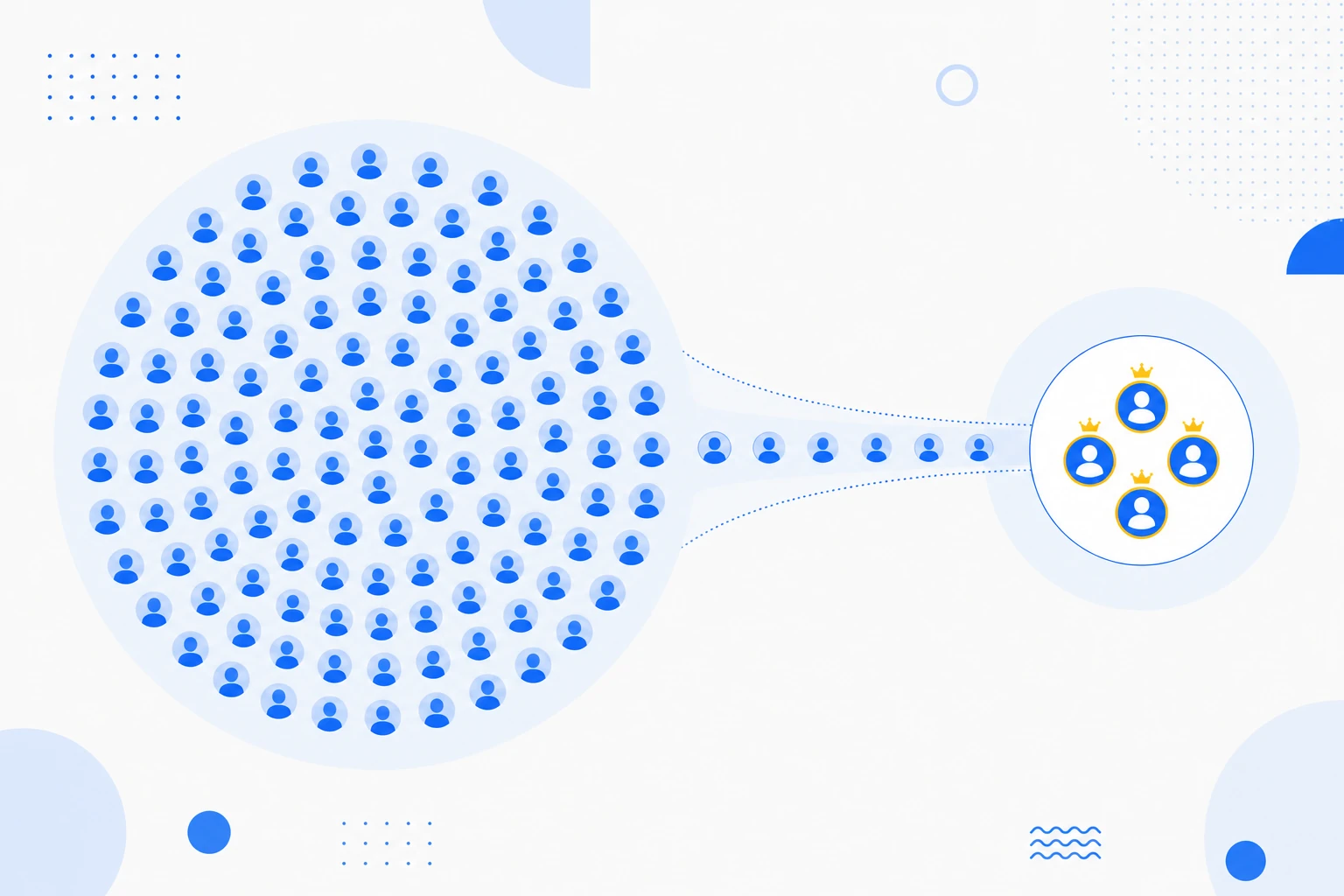
Freemium conversion is the percentage of users on a permanent free plan who become paying customers: paying users divided by total free users.
- It tends to be low, typically between 2% and 5%.
- It differs from trial-to-paid conversion, which expires and converts far more.
- The model pays off on volume and expansion, not on a high rate.
What freemium conversion is
Freemium conversion measures the share of users on a permanent free plan who become paying customers. Unlike a temporary promotion, a freemium plan does not expire: people can use the product for free forever, and conversion happens when they decide to pay for more features, a higher limit or more value.
It is an acquisition metric, not a revenue one: it tells you how well the product turns free usage into willingness to pay. Because free attracts a lot of people who never intended to pay, the rate tends to be low, and that is expected, not a flaw. What matters is the absolute number of converts the funnel produces.
How to calculate freemium conversion
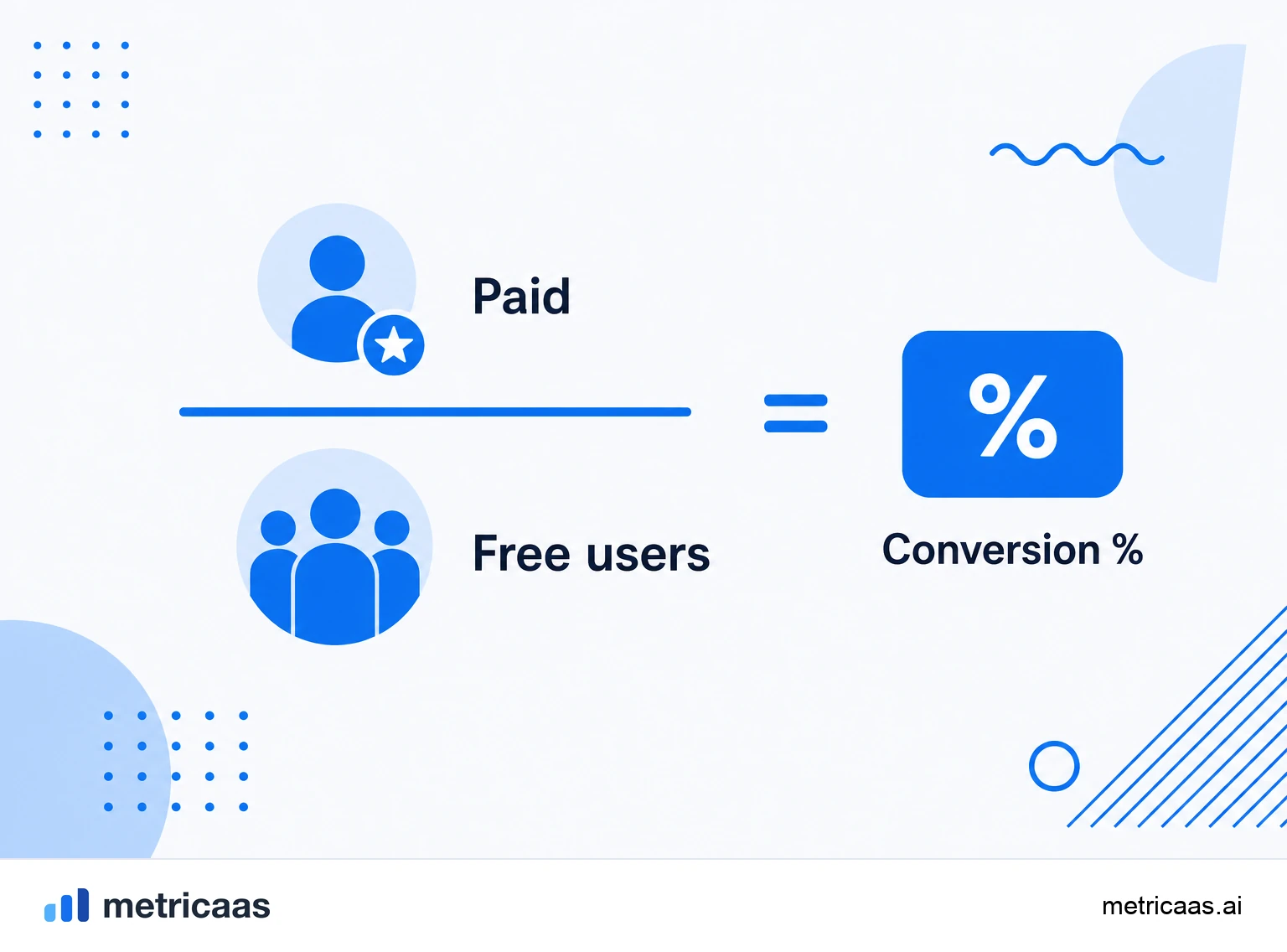
The formula is direct: divide the users who became paying customers by the total number of free users in the same cut, then multiply by 100.
- Freemium conversion = paying users / total free users x 100.
- Define the window: conversion within a period (for example, 90 days after signup) or cumulative for a cohort.
- Decide the denominator: all signups, or only those who activated the product.
The tricky part is the denominator. Measuring over all signups mixes tire-kickers, bots and throwaway emails with real users, and drags the rate down. Measuring by cohort, following everyone who joined in the same month, gives a more honest read of how long freemium takes to mature into revenue. Tying conversion to the activation rate helps separate people who actually experienced the value from those who only created an account.
Freemium vs trial: why the rates differ so much
Freemium and trials solve the same problem (letting the user prove the product) in opposite ways, which is why they convert at very different levels. In a trial, access is temporary and creates urgency: pay or lose it. In freemium, access is permanent and there is no deadline, so the decision to pay has to come from a real need for more.
- Trial: much higher conversion rate, because it attracts people already evaluating a purchase and imposes a deadline.
- Freemium: much lower rate, because it attracts a huge audience with no immediate intent to pay.
That is why comparing trial-to-paid conversion with freemium conversion side by side, without context, is misleading. A trial that converts 20% and a freemium that converts 3% can produce the same number of customers, if the freemium has far more people at the top.
Why the rate usually sits between 2% and 5%
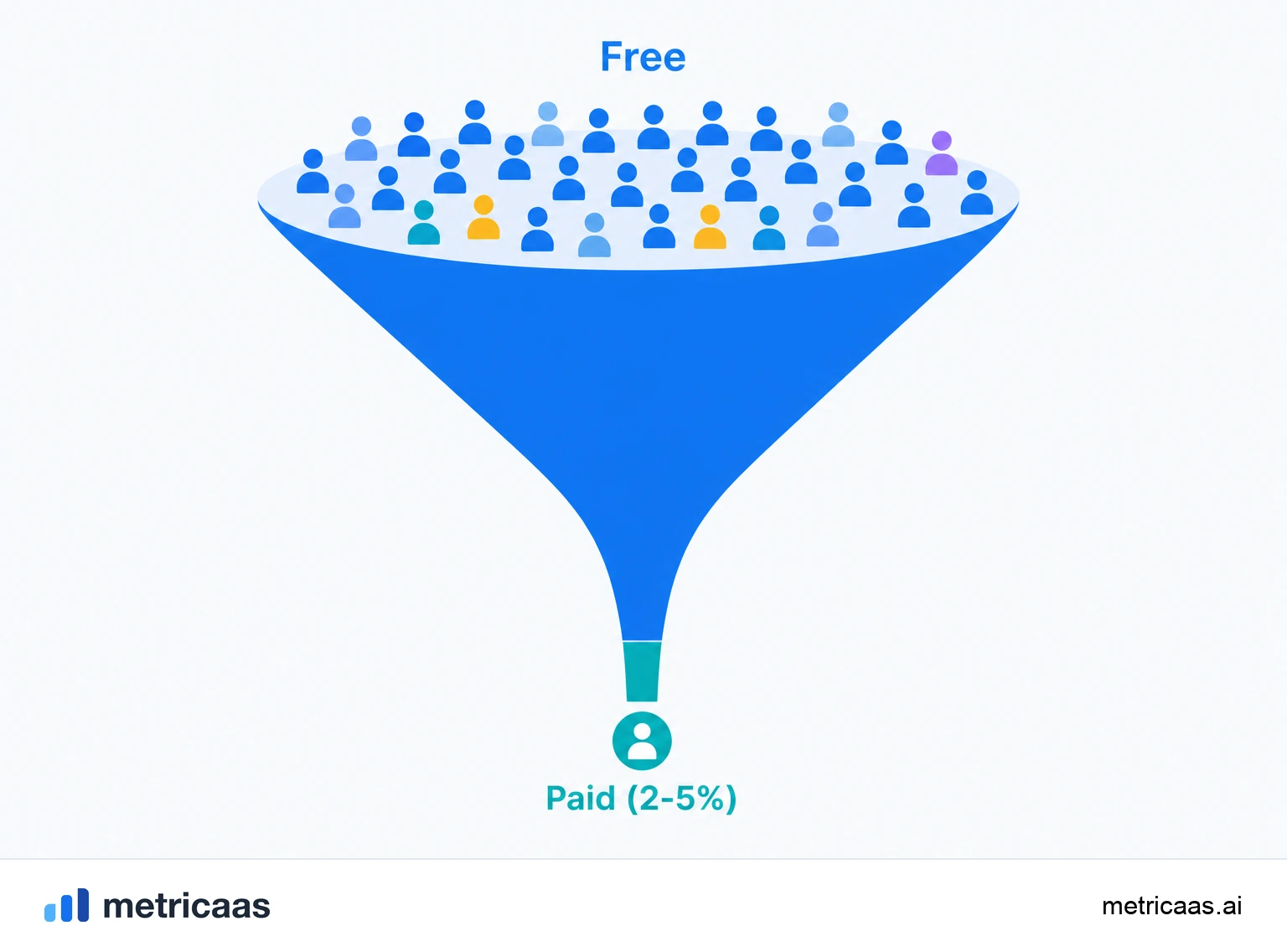
In practice, freemium conversion usually lands in single digits, typically between 2% and 5%, and pure self-serve businesses often sit below that. The reason is structural: free is designed to remove friction and attract volume, so it naturally pulls in many people who solve their problem on the free plan and never need to pay.
Benchmark studies of product-led SaaS, such as those from Benchmarkit, show that free-to-paid conversion in product-led motions lives in low single digits, not the tens of percent many expect. A 3% rate that would look weak in a trial can be perfectly healthy in freemium, as long as the top of the funnel is large enough.
Usage limits and value gating: the conversion levers
Freemium conversion is, at its core, a design decision: what stays free and what sits behind the paywall. Value gating (placing the value in the right spot) is the main lever. If the free plan solves the problem completely, no one pays; if it barely lets you use anything, no one signs up.
- Usage limits: open the product up to a volume (rows, projects, seats, API calls) and charge when usage grows.
- Feature gating: keep the core free and reserve advanced features for the paid plan.
- Value gating: give away enough for the user to feel the result, and charge exactly where the value increases.
A good limit is one the engaged user reaches just as the product has become a habit. Raising the activation rate tends to move conversion more than any discount, because someone who never reached the value moment will never pay.
The volume economics of freemium
Freemium does not stand on a high rate, but on the arithmetic of volume plus expansion. A 3% conversion only becomes a good business when the free plan attracts hundreds of thousands of users at a low marginal cost, and when those who convert grow their accounts over time.
That is why freemium is, first of all, a cheap acquisition channel. It can lower CAC by turning the product itself into a marketing tool, but it is not free: hosting, supporting and maintaining a giant free base costs money. The math works when the value from converts, plus expansion of the paid base, comfortably outweighs the cost of serving everyone who will never pay.
Frequently asked questions
It is the percentage of users on a permanent free plan who become paying customers: paying users divided by total free users, times 100. It measures how well the product turns free usage into revenue.
It depends on the funnel, but the common range is 2% to 5%, and pure self-serve products often sit below that. What sustains the model is volume, not a high rate.
Divide the users who became paying customers by the total free users and multiply by 100. Define the window and the denominator (all signups or only activated ones) clearly to avoid skewing the number.
In freemium, yes, it can be perfectly healthy, as long as the top of the funnel is large. The same rate would look weak in a trial, which attracts a far more purchase-ready audience.
A free trial gives temporary access and creates urgency to pay; freemium gives permanent free access. That is why trials convert much higher in percentage, while freemium bets on volume.
Through volume plus expansion. A free plan that is cheap to serve attracts many people, and the few who convert, together with growth in paid accounts, cover the cost of keeping the whole free base.
Related concepts

Trial-to-paid conversion
Trial-to-paid conversion is the share of free trials that become paying customers: paid conversions divided by trials started. It is the central metric of self-serve products and it varies widely depending on whether the trial requires a card (opt-out, roughly 40% to 60%) or not (opt-in, roughly 10% to 25%). Activation during the trial is the strongest predictor of who converts.
CAC
CAC (Customer Acquisition Cost) is how much, on average, you spend to win a new customer. Add up everything invested in marketing and sales over a period and divide by the number of new customers who came in during that period. It is the metric that tells you whether your growth is economically healthy.

Activation rate
Activation rate is the share of new users who reach the product first real value (the aha moment or setup milestone) within a defined time frame. It is the bridge between acquisition and retention: those who activate tend to stay, those who do not tend to churn. That makes it one of the strongest predictors of retention and the silent bottleneck of trial conversion in SaaS.