
Activation rate: what it is and how to calculate this retention predictor
By Tiago Costa · Updated on July 9, 2026

Definition
The activation rate is the share of new users who reach the product first real value (the aha moment) within a time window.
- It is the bridge between acquisition and retention in the funnel.
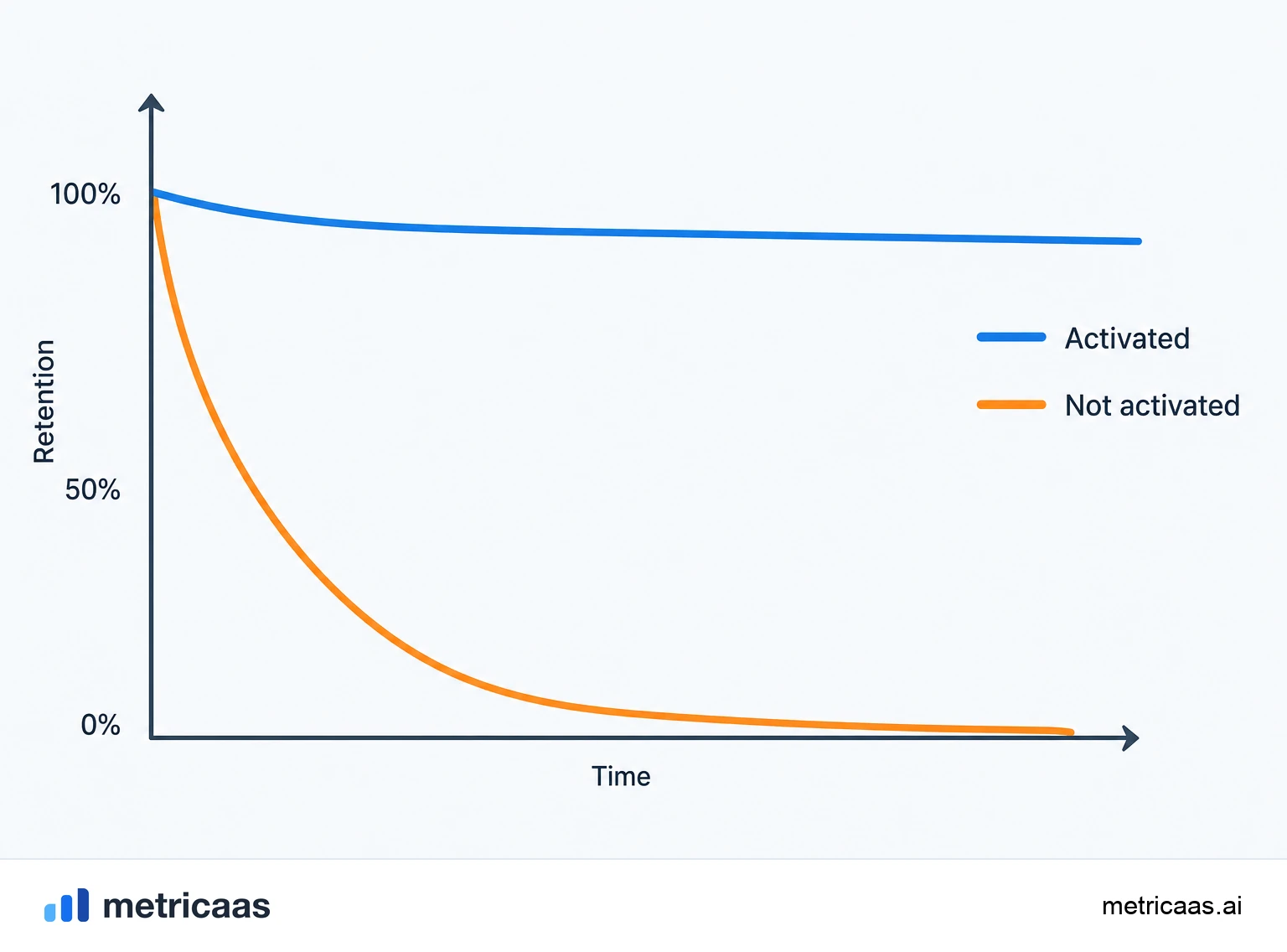
- The strongest predictor of retention: those who activate stay, those who do not churn.
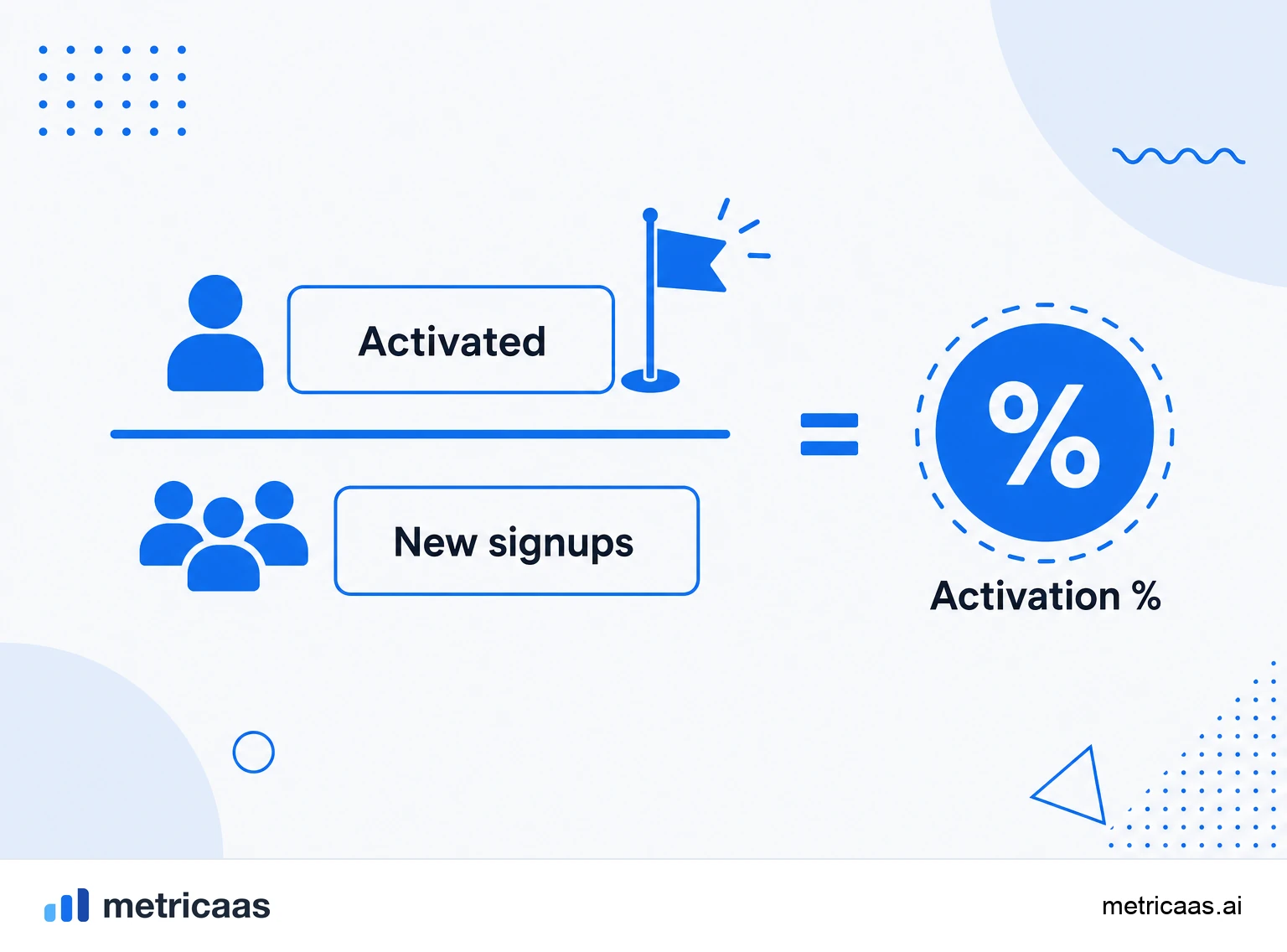
- Formula: activated users divided by new signups.
What activation rate is
The activation rate measures how many new users reach the first moment the product delivers real value, within a defined time window. It answers a simple question: of the people who signed up, how many actually got to experience the reason the product exists?
The metric sits at a specific point in the funnel, between acquisition (bringing people in) and retention (keeping them). An activated user has already seen value and has a reason to come back; a user who signed up but never activated is almost indistinguishable from someone who never arrived. That is why activation is the real bottleneck for products that attract many signups but retain few.
How to calculate activation rate
The formula is a simple division, but the rigor lives in the numerator and the window.
- Activation rate = activated users / new signups in the period.
- Activated users: those who fired the activation event (the value milestone) within the window.
- Window: the time frame in which activation still "counts", for example 7 or 14 days after signup.
Example: if 1,000 people signed up in the month and 320 hit the activation milestone within 14 days, the activation rate is 32%. Two choices change the number completely: what you define as "activated" and the size of the window. Without fixing both, the metric becomes an opinion.
What the aha moment is
The aha moment is the instant a user grasps, in practice, why the product is worth it. It is not opening an account or finishing signup: it is the first time the product promise is fulfilled tangibly for that person.
Classic examples make the idea stick: in a team messaging tool, value shows up when a team exchanges a certain number of messages; in a social network, when the user connects a minimum number of contacts; in a finance app, when the first bank account is synced. The pattern is always the same: an action (or set of actions) that correlates strongly with long-term retention.
How to define the activation event
Defining the activation event is part science, part product decision. The analytical path is to look backward: take the users who stayed (retained for months) and find which early behavior set them apart from those who left. That behavior, reached early, is a strong candidate for the activation event.
- Start from correlation with retention, not from what is easy to measure.
- Prefer a milestone reachable in the first days, or the metric takes too long to react.
- Avoid confusing activation with plain signup or a vanity click count.
- Revisit the event as the product changes; it is not fixed forever.
A good activation event is specific, measurable and causally tied to value. "Created the first project and invited a teammate" says far more than "logged in twice".
Activation, retention and trial conversion
Activation matters because it is the strongest predictor of retention. Users who reach the aha moment early retain at much higher rates; those who do not quietly feed churn, canceling or simply vanishing before they ever become revenue. That is why a low activation rate is a leak no marketing budget can patch.
In trials and freemium, activation is the step that precedes payment: a user who never saw value rarely turns into a trial-to-paid conversion. And because retention is what sustains customer value, activating better directly lifts LTV / CLV and Net Revenue Retention (NRR) over time. The retention research from SaaS Capital shows that net revenue retention at healthy private SaaS companies tends to hover around 100%, and that retention starts far upstream, at activation.
Time-to-value: speeding up activation
Time-to-value (TTV) is the time between signup and the aha moment. The shorter it is, the higher activation climbs: every step, form and loading screen between "I want it" and "I got it" is a chance for the user to drop off. Cutting TTV is usually the cheapest lever to raise activation.
- Shorten onboarding to value: remove steps that do not lead to the aha moment.
- Use sample data or templates so users see the product working before configuring everything.
- Guide with checklists and contextual tips instead of leaving a blank screen.
Activation benchmarks vary so much across products and definitions that comparing your absolute number with another company misleads more than it helps. What is useful is tracking your own series over time and crossing it with retention. Market surveys such as the one from Benchmarkit reinforce that top-of-funnel performance only becomes revenue when retention sustains growth, and activation is the first link in that chain.
Frequently asked questions
Activation rate is the share of new users who reach the product first real value (the aha moment) within a set time window. It is the bridge between acquisition and retention.
Divide activated users by new signups in a period: activation rate = activated users / new signups. Fix the activation event and the time window first.
It depends heavily on the product and how activation is defined, so absolute benchmarks mislead. Track your own trend over time and correlate it with retention instead of copying another company number.
It is the first time a user tangibly experiences the product core value, not just signing up. It is the behavior that correlates most strongly with staying.
Users who reach value early have a reason to return, so they retain far better; those who never activate tend to churn quietly. Activation is where retention begins.
Activation is reaching product value; conversion is turning into a paying customer. Activation usually comes first and makes conversion far more likely.
Related concepts

Churn
Churn is the loss of customers or revenue in a period. In a SaaS, it measures how many customers cancel (customer churn) or how much recurring revenue disappears (revenue churn). It is the metric that reveals whether growth is sustainable: the higher the churn, the more new sales you need just to avoid shrinking.

Trial-to-paid conversion
Trial-to-paid conversion is the share of free trials that become paying customers: paid conversions divided by trials started. It is the central metric of self-serve products and it varies widely depending on whether the trial requires a card (opt-out, roughly 40% to 60%) or not (opt-in, roughly 10% to 25%). Activation during the trial is the strongest predictor of who converts.

LTV / CLV
LTV (Lifetime Value), also called CLV or CLTV, is the total value a customer generates while they stay in your base. In a simple form, it is the recurring average revenue times margin times the customer lifetime. It is the metric that shows how much it is worth investing to win and keep each customer.