
SaaS quick ratio: what it is and how to measure growth efficiency
By Tiago Costa · Updated on July 9, 2026

Definition
The SaaS quick ratio measures growth efficiency: recurring revenue gained divided by recurring revenue lost over the same period.
- Formula: (new MRR + expansion) / (churn + contraction).
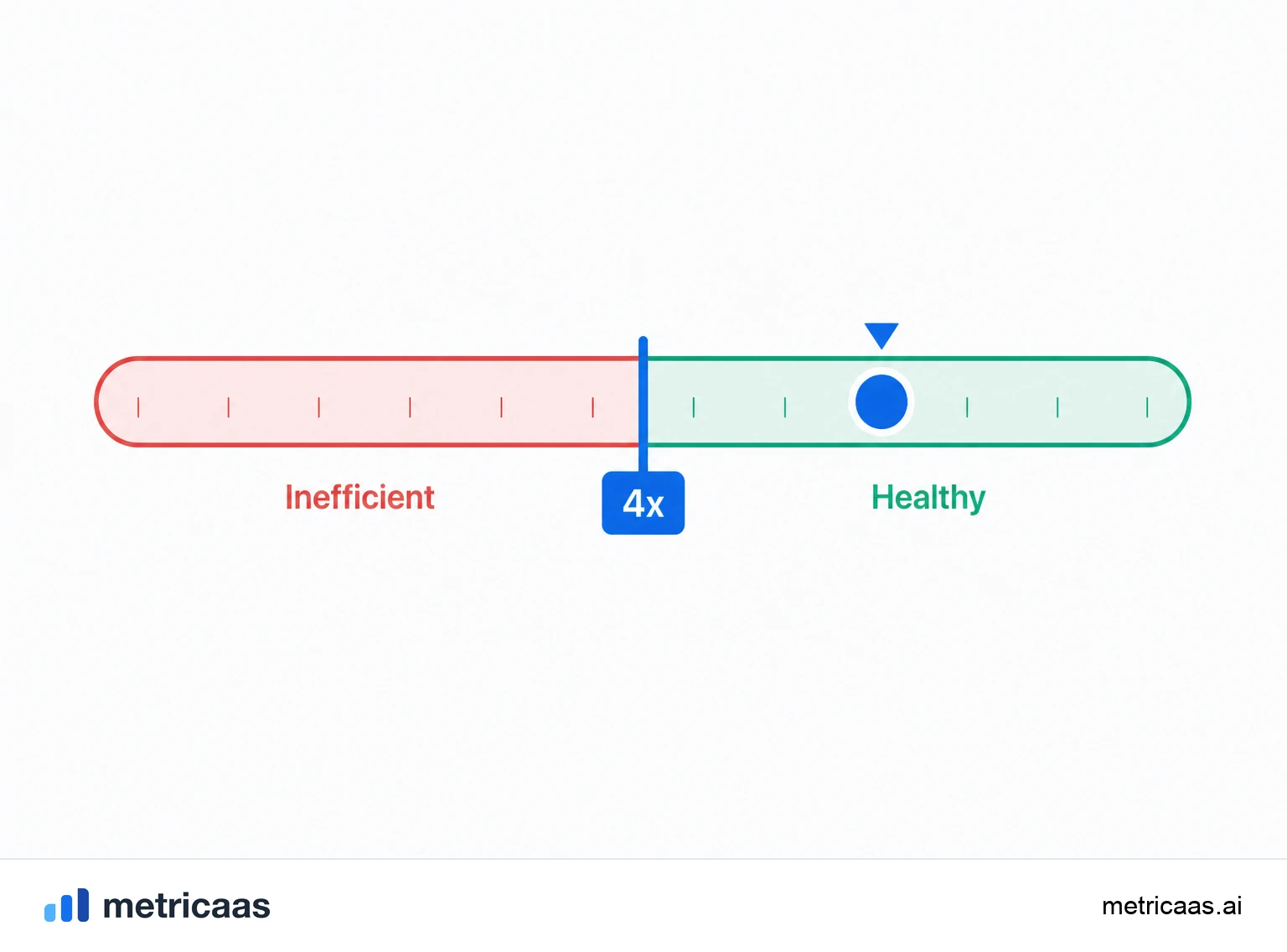
- Above 4 is efficient growth; near 1, the company merely holds its ground.
- Do not confuse it with the accounting quick ratio, which measures liquidity.
What the SaaS quick ratio is
The SaaS quick ratio is a growth-efficiency indicator. It answers a blunt question: for every dollar of recurring revenue the company loses, how much does it gain? Instead of looking only at net growth, the quick ratio separates what comes in from what goes out and reveals the quality of that growth.
The calculation is built on changes in MRR over a period. The numerator holds everything that increases recurring revenue; the denominator, everything that reduces it. The result is a single number showing whether the growth engine is truly ahead of the losses or just running to replace what leaks out.
How to calculate the SaaS quick ratio
The SaaS quick ratio formula sums the recurring-revenue gains and divides by the losses over the same interval:
- Numerator: new MRR plus expansion MRR.
- Denominator: churned MRR plus contraction MRR.
- Quick ratio = (new + expansion) / (churned + contraction).
These four components are exactly the MRR movements. Example: if in a month the company added $100k of new MRR and $50k of expansion, and lost $20k to churn and $10k to contraction, the quick ratio is (100 + 50) / (20 + 10) = 150 / 30 = 5. For every dollar lost, the company gained five.

What a good SaaS quick ratio is
The most cited benchmark comes from the venture world: a SaaS quick ratio above 4 usually signals efficient, healthy growth, where the company gains four times more recurring revenue than it loses. Between 2 and 4, growth is solid but there is room to cut losses. Near 1, the company gains about as much as it loses and grows slowly; below 1, it shrinks.
That level of 4 is a rule of thumb, not a law. Early-stage companies with a small base swing a lot from month to month, so the trend matters more than any single value. Firms like Bessemer treat growth efficiency as a pillar for evaluating SaaS, and retention is the other side of that coin: according to SaaS Capital, the median net revenue retention of private SaaS companies tends to sit near 100%.
The SaaS quick ratio and the accounting quick ratio
Despite the identical name, the SaaS quick ratio does not measure liquidity. The accounting quick ratio compares short-term assets with short-term liabilities to judge whether a company can pay its immediate bills. The SaaS quick ratio borrows only the name and the idea of a ratio: it compares recurring revenue gained with recurring revenue lost.
So the two metrics do not talk to each other. One is about cash and solvency; the other, about the efficiency of the subscription engine. When reading a report, it is worth confirming which quick ratio is meant, because a result of 1.5 means very different things in each context.
The SaaS quick ratio and the Rule of 40
The SaaS quick ratio often travels alongside the Rule of 40, another efficiency lens investors lean on. The Rule of 40 says the sum of the growth rate and the profit margin should be 40% or more: a company growing 30% with a 10% margin sits right at the healthy line.
The two complement each other. The quick ratio looks at the quality of recurring-revenue growth, splitting gains from losses; the Rule of 40 balances growth and profitability. A high quick ratio paired with a weak Rule of 40 can point to expensive growth; together they give a fuller read than either alone.
How to use the SaaS quick ratio day to day
Day to day, the SaaS quick ratio is useful because it sums up growth health in one number without hiding the losses. Pretty net growth can mask high churn offset by heavy new sales, which is expensive and fragile. The quick ratio exposes that dynamic.
To use it well, always calculate over the same period (usually monthly), normalize MRR before summing the movements, and follow the trend rather than a single month. If the quick ratio drops, investigate which component moved: more churn, less expansion, shrinking contracts? The answer points to where to act, whether in retention or in expanding the current base.
Frequently asked questions
The SaaS quick ratio measures growth efficiency: it divides recurring revenue gained (new plus expansion MRR) by recurring revenue lost (churn plus contraction) over a period. It shows how much a SaaS gains for every dollar it loses.
Quick ratio = (new MRR + expansion MRR) / (churned MRR + contraction MRR). If a company gains $150k and loses $30k in a month, the quick ratio is 5.
Above 4 is generally seen as efficient, healthy growth. Between 2 and 4 is solid; near 1 the company merely treads water; below 1 it shrinks.
No. The accounting quick ratio measures liquidity, comparing short-term assets and liabilities. The SaaS quick ratio measures growth efficiency and only borrows the name.
It says the growth rate plus the profit margin should total 40% or more. It complements the quick ratio by balancing growth and profitability.
It means the company gains 1.5 times more recurring revenue than it loses, just above break-even, with modest net growth. Efficient SaaS growth usually sits well above that.
Related concepts

MRR
MRR (Monthly Recurring Revenue) is the monthly recurring revenue of a SaaS: the sum of all active subscriptions normalized to a month. It is the core metric of a subscription business because it shows, predictably, how much the company earns on a recurring basis each month, without counting one-off charges.

MRR Movements
MRR movements are the breakdown of the monthly change in MRR into its causes: new, expansion, contraction, churn and reactivation MRR. Instead of watching only the final number, you separate every dollar that came in and every dollar that left, and see why recurring revenue grew, stalled or fell. The sum of all movements is the net new MRR for the period.

Churn
Churn is the loss of customers or revenue in a period. In a SaaS, it measures how many customers cancel (customer churn) or how much recurring revenue disappears (revenue churn). It is the metric that reveals whether growth is sustainable: the higher the churn, the more new sales you need just to avoid shrinking.