
SaaS magic number: what it is and how to calculate sales efficiency
By Tiago Costa · Updated on July 9, 2026

Definition
The SaaS magic number measures sales efficiency: how much annualized new MRR the company generates for every dollar spent on sales and marketing.
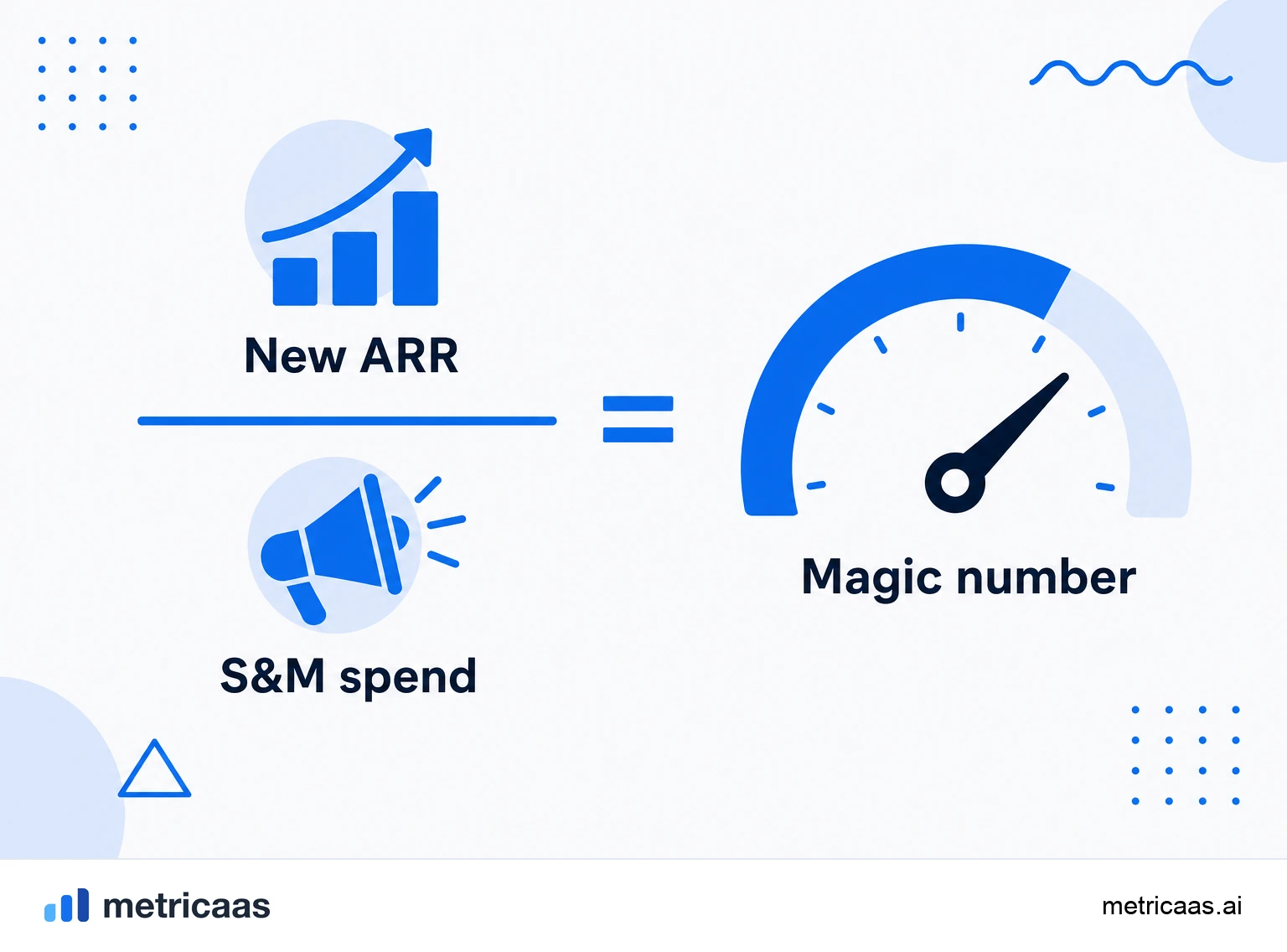
- Formula: new ARR of the period divided by S&M of the prior period.
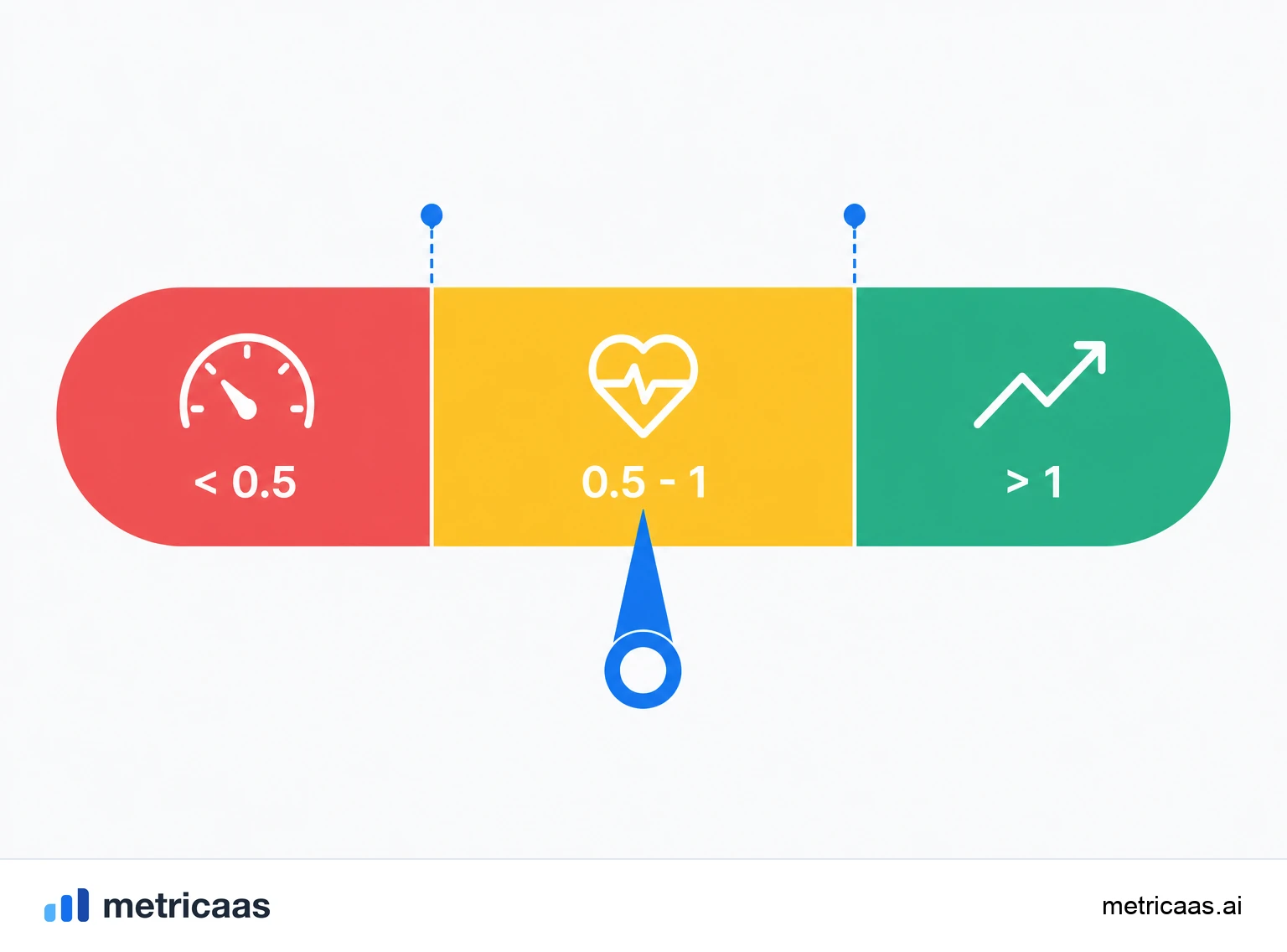
- Above 1 is excellent, 0.5 to 1 is healthy, below 0.5 is a warning.
- It is used to calibrate the pace of sales investment.
What the SaaS magic number is
The SaaS magic number is a sales efficiency indicator: it measures how much new recurring revenue the company generates for every dollar invested in sales and marketing. Instead of looking only at growth, it answers a return question: is the money that went to the sales team and to campaigns turning into revenue at the right pace?
The idea was born in the venture capital world as a fast way to compare the acquisition engine of different SaaS companies. A high magic number signals that each dollar of S&M yields plenty of new ARR, which is a license to accelerate investment. A low number suggests that pushing harder on sales spend would only burn cash without proportional return.
How to calculate the SaaS magic number
The formula compares the new ARR of a period with the sales and marketing spend of the prior period:
- Magic number = new ARR of the period / S&M spend of the prior period.
- New ARR is how much recurring revenue grew: take the new MRR won in the period and annualize it (x12 for monthly data, x4 for the quarterly revenue delta).
- S&M spend sums salaries, commissions, media and sales and marketing tools.
The prior period goes in the denominator because of the lag: what you invest in acquisition today only turns into revenue the following quarter. Example: if ARR rose from $4 million to $4.4 million ($400k of new ARR) and S&M in the prior quarter was $500k, the magic number is 400 / 500 = 0.8.
How to read the result
Reading the number follows bands well known in the industry:
- Above 1.0: excellent. Each dollar of S&M returned more than one dollar of new ARR, with a sales payback of about one year. It is a green light to invest more.
- 0.75 to 1.0: efficient and healthy, with room to keep investing.
- 0.5 to 0.75: acceptable, but payback already exceeds a year; it is worth optimizing before accelerating.
- Below 0.5: a warning. Spending more on S&M tends to burn cash without proportional return.
A magic number of 1 is roughly equivalent to recovering acquisition spend in about twelve months (before gross margin). That is why it is read alongside the growth rate: growing fast with a high magic number is the ideal scenario; growing fast with a low number means growth is being bought expensively.
The magic number and the decision to invest in sales
The most practical use of the magic number is to calibrate the pace of sales investment. When the number is above 0.75, the acquisition engine is paying off well, and it makes sense to hire more reps, expand media and step on the gas, because each additional dollar tends to pay for itself.
When the number falls below 0.5, the message is the opposite: before spending more, it is time to improve conversion, shorten the sales cycle or revisit the market focus. Investing on top of an inefficient engine only widens the loss. SaaS funds, such as Bessemer Venture Partners, use this kind of efficiency read to decide when a business is ready to scale spend.
Cautions and limitations
The magic number is a snapshot of aggregate efficiency and has traps. It mixes revenue from new customers with expansion, so a base that expands a lot can mask weak acquisition. Seasonal quarters and long sales cycles also distort the reading of a single period, which is why it is worth tracking a moving average over several quarters instead of reacting to an isolated number.
- Use the new ARR of the period, not gross revenue; one-off charges do not count.
- Keep the right denominator: S&M of the prior period, to respect the lag.
- Separate acquisition from expansion when you want to understand only the efficiency of winning new customers.
Magic number and other efficiency metrics
The magic number does not live alone. It is the aggregate portrait of what CAC shows at the customer level: while CAC says how much it costs to win one customer, the magic number sums up the efficiency of the whole acquisition engine in a single index. And it only makes sense if the revenue you win sticks, which points to LTV / CLV and retention.
It is also worth crossing it with the Rule of 40 (growth plus margin adding up to at least 40%), popular among funds and cited by McKinsey and Bain. According to SaaS Capital, healthy retention in a private SaaS is what sustains efficient growth, and the private SaaS survey by KeyBanc Capital Markets tracks these sales efficiency measures year after year.
Frequently asked questions
It is a sales and marketing efficiency indicator. It divides the new ARR generated in a period by the S&M spend of the prior period, showing how much recurring revenue each dollar of acquisition generates.
Above 1.0 is excellent and lets you accelerate investment; 0.75 to 1.0 is efficient and healthy; 0.5 to 0.75 is acceptable; below 0.5 is an efficiency warning.
New ARR of the period divided by S&M of the prior period. If ARR grew by $400k and prior-quarter S&M was $500k, the magic number is 0.8.
It is the T2D3 growth path (triple, triple, double, double, double): tripling ARR for two years, then doubling for three. It is a growth benchmark, not the same as the magic number, which measures efficiency.
It is the idea that growth rate plus profit margin should add up to at least 40%. It complements the magic number: one balances growth and profit, the other measures the efficiency of sales spend.
Because of the lag between spend and revenue. The acquisition investment made today usually turns into recurring revenue only in the following period, so the right denominator is the prior spend.
Related concepts

MRR
MRR (Monthly Recurring Revenue) is the monthly recurring revenue of a SaaS: the sum of all active subscriptions normalized to a month. It is the core metric of a subscription business because it shows, predictably, how much the company earns on a recurring basis each month, without counting one-off charges.

CAC
CAC (Customer Acquisition Cost) is how much, on average, you spend to win a new customer. Add up everything invested in marketing and sales over a period and divide by the number of new customers who came in during that period. It is the metric that tells you whether your growth is economically healthy.

LTV / CLV
LTV (Lifetime Value), also called CLV or CLTV, is the total value a customer generates while they stay in your base. In a simple form, it is the recurring average revenue times margin times the customer lifetime. It is the metric that shows how much it is worth investing to win and keep each customer.