
Revenue retention: what it is, GRR, NRR and how to calculate it
By Tiago Costa · Updated on July 9, 2026

Definition
Revenue retention is how much of the recurring revenue from an existing customer base a SaaS keeps over time, without new sales.
- Gross retention (GRR) counts only losses and caps at 100%.
- Net retention (NRR) adds expansion and can exceed 100%.
- It measures revenue in money, not customers in logos.
What revenue retention is
Revenue retention measures how much of the recurring revenue an existing customer base already generated keeps coming in over time, without counting new sales. Instead of asking how many customers stayed, it asks how much of the recurring revenue the company managed to keep, which makes it one of the most direct reads on the health of a SaaS.
It is an umbrella concept, not a single number. The same base can be read two ways: by what was lost alone, or already net of what grew inside it. That is why talking about revenue retention without saying which of the two you mean tends to cause confusion. It is also the flip side of churn: where churn counts what left, retention counts what stayed.
Gross and net retention (GRR and NRR)
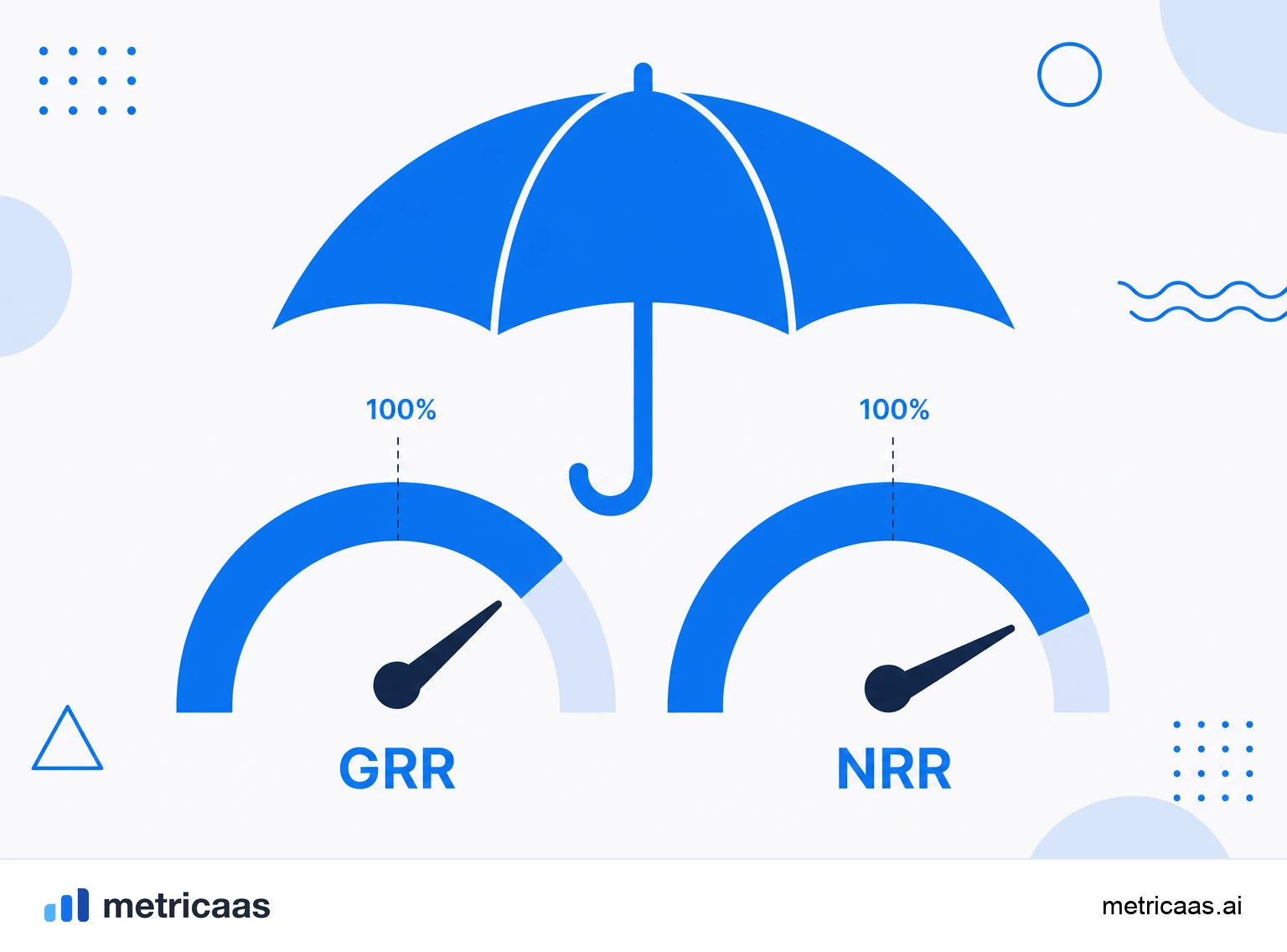
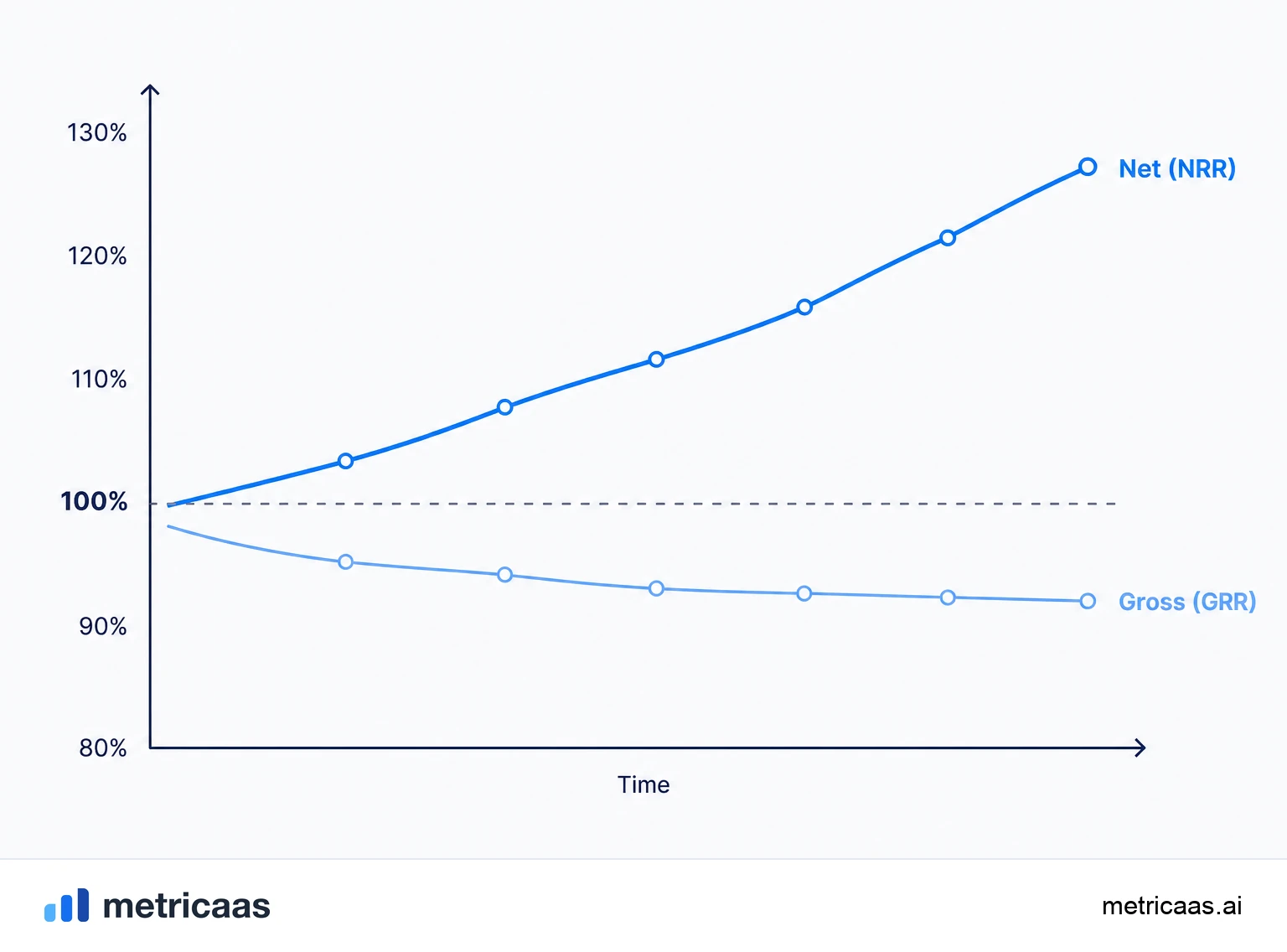
Revenue retention splits into two complementary measures. The gross version, or Gross Revenue Retention (GRR), counts only the losses: cancellations and downgrades. It never goes above 100%, because it ignores any growth and shows the floor of revenue the base holds on its own.
The net version, or Net Revenue Retention (NRR), starts from the same base but adds expansion, upgrades and cross-sells to the customers who stayed. That is why it can exceed 100%: when expansion beats losses, the base grows in revenue without a single new customer.
- GRR: losses only, capped at 100%, measures how solid the base is.
- NRR: losses minus expansion, can go past 100%, measures the potential to grow from within.
How to calculate revenue retention
Both versions start from the recurring revenue of the base at the beginning of the period, usually the MRR of one month or the ARR of a year ago, and compare it with what that same base generates at the end, excluding new customers.
- GRR = (starting revenue minus churn minus contractions) divided by starting revenue.
- NRR = (starting revenue minus churn minus contractions plus expansion) divided by starting revenue.
Example: a base with $100k of MRR that loses $8k to cancellations and downgrades but gains $15k in expansion has a GRR of 92% and an NRR of 107%. The same group of customers, two different reads.
Revenue retention vs. customer retention
It is easy to confuse the two, but they answer different questions. Customer retention counts logos: of every hundred customers, how many stayed. Revenue retention counts money: of every hundred recurring dollars, how many stayed.
The difference matters because not every customer weighs the same. A company can retain 90% of its customers and still keep only 80% of its revenue if the ones who left were the largest. Or keep 85% of logos and 105% of revenue if the ones who stayed expanded a lot. For the business, money is what sustains cash, which is why revenue retention is usually the truest read on recurring health.
What good revenue retention looks like
There is no magic number, but there are reference ranges the market uses. The private SaaS survey by KeyBanc Capital Markets shows median net revenue retention above 100%, a sign that a healthy base grows from within. Gross retention, by definition below 100%, has its own benchmarks.
According to SaaS Capital, the median gross revenue retention in private SaaS tends to sit around 90% a year, meaning a base loses close to 10% of its revenue to churn and contractions even before any expansion. The higher the ticket and the more strategic the product, the higher retention tends to be. What counts as good, in the end, depends on the segment and the stage of the company.
How to improve revenue retention
Improving revenue retention means working both ends: shrinking what leaves and growing what stays. On the loss side, that means reducing churn with clear onboarding, close support for your highest-value customers and attention to risk signals before a cancellation.
- Reinforce perceived value in the first months, when cancellation is most likely.
- Build natural expansion paths: more seats, more usage, higher tiers.
- Track retention by cohort and by customer band, not just the average.
On the growth side, expansion within the base is usually the cheapest lever there is, since selling more to people who already trust the product costs a fraction of winning a new customer. That is how net retention passes 100% and the business grows even with steady acquisition.
Frequently asked questions
It is how much of the recurring revenue from an existing customer base keeps coming in over time, without counting new sales. It measures revenue in money, not customers in logos.
Gross retention (GRR) counts only losses from churn and downgrades and caps at 100%. Net retention (NRR) adds the base expansion and can exceed 100%.
Start from the recurring revenue of the base at the beginning of the period and compare it with what it generates at the end, excluding new customers. GRR subtracts only losses; NRR subtracts losses and adds expansion.
It depends on the segment, but median net retention in private SaaS tends to sit above 100%, and gross retention around 90% a year. The more strategic the product, the higher it tends to be.
Customer retention counts logos: of every hundred customers, how many stayed. Revenue retention counts money, so it weighs larger customers more and is the truest read on recurring health.
They are two sides of the same coin. Churn counts the revenue that left; retention counts what stayed. A 92% gross retention equals an 8% revenue churn.
Related concepts

Net Revenue Retention (NRR)
Net Revenue Retention (NRR) measures how much of the recurring revenue from your current base you keep over time, already accounting for upgrades and expansion, minus downgrades and cancellations. Above 100% it means the base grows on its own, even without new customers.

Gross Revenue Retention (GRR)
Gross Revenue Retention (GRR) measures how much of the recurring revenue from your current base you keep over time counting only the losses, contraction and cancellations, and ignoring any expansion. That is why it never goes above 100%: it shows the pure leakage of the base.

Churn
Churn is the loss of customers or revenue in a period. In a SaaS, it measures how many customers cancel (customer churn) or how much recurring revenue disappears (revenue churn). It is the metric that reveals whether growth is sustainable: the higher the churn, the more new sales you need just to avoid shrinking.