
Payback period: what it is and how to calculate it
By Tiago Costa · Updated on July 9, 2026
Definition
The payback period is the time an investment takes to pay for itself. In SaaS, it is the CAC payback: the months of recurring margin needed to recover the cost of acquiring the customer.
- General formula: the investment divided by the cash return per period.
- In SaaS, always adjust for gross margin, never use full revenue.
- The rule of thumb is to stay under 12 months.
What the payback period is
The payback period is the time an investment takes to pay for itself, that is, to return in cash what it cost. It is one of the oldest ideas in finance: you spend money today and count how many periods it takes until the cash the investment generates covers the amount you put in.
In SaaS, payback took on a specific use. Because the business lives on acquiring customers who pay over time, the most analyzed investment is the acquisition cost, and the return it generates is the recurring margin of the subscription. So when someone says "payback" in a SaaS, they almost always mean the CAC payback: how many months of recurring margin it takes to recover the cost of winning the customer. The shorter that time, the faster cash comes back and the more efficient growth is.
Payback period and CAC payback
It helps to separate two names that often get confused. The payback period is the general concept: it works for any investment, whether a marketing campaign, the development of a feature or the acquisition of a whole cohort of customers. CAC payback is the best-known application of that concept to SaaS: the payback period measured specifically on the cost of acquiring a customer.
In practice, both use the same logic and almost always the same formula. The difference is scope: the payback period is the ruler; CAC payback is what you measure with it when the investment in question is acquisition. You can compute the payback of a single channel, a cohort, a segment or the whole company, and in every case you are applying the same period-of-return reasoning.
How to calculate the payback period
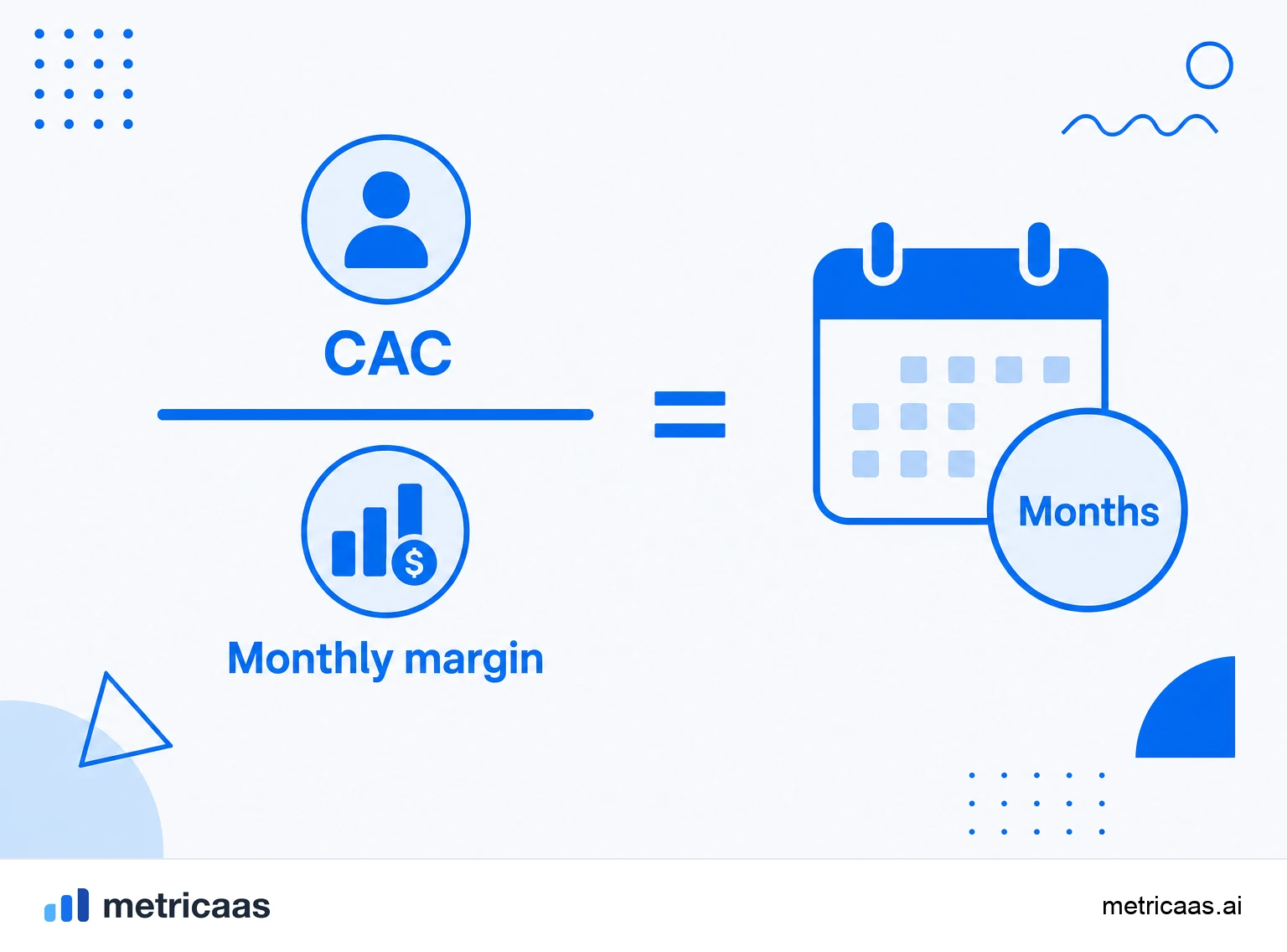
The general form is simple: divide the amount invested by the cash return it generates per period. The result is the number of periods until the investment pays for itself.
- Payback period = investment / cash return per period.
- In SaaS, the investment is the CAC and the return per period is the recurring gross margin the customer generates per month.
- CAC payback = CAC / (MRR per customer x gross margin).
Example: a customer paying $300 a month at 75% gross margin generates $225 of monthly margin. If it cost $2,700 to acquire them, payback is 2,700 divided by 225, or 12 months. The detail that changes everything is in the denominator: using full revenue instead of margin shortens the number artificially and hides the real cost of serving the customer.
Why gross margin matters
The most common mistake in the payback calculation is dividing CAC by revenue rather than by margin. It looks like a detail, but it distorts the conclusion. What actually comes back to cash and pays for the acquisition is not the price the customer pays, but what is left after the cost of delivering the service: hosting, support, payment fees, infrastructure. That leftover is gross margin.
Look at the difference. A $300-a-month customer with a $2,700 CAC shows an apparent payback of 9 months if you look at revenue alone. But if gross margin is 75%, the real margin is $225 a month, and the true payback is 12 months. Ignoring margin makes the business look 3 months more efficient than it is, and the error grows the thinner the margin. That is why a correct payback is always adjusted for gross margin.
The 12-month rule of thumb
There is a classic benchmark: payback should stay under 12 months for a healthy SaaS. The rule was popularized by David Skok and became a simple compass: if the customer returns the acquisition cost in less than a year, growth tends to fund itself.
Like any rule of thumb, it is a starting point, not a law. The healthy number varies a lot with contract size. According to Benchmarkit, the industry median payback was around 18 months in 2024, from about 9 months in low-ticket products to more than 20 months in large contracts. A bigger deal justifies a longer payback, as long as the customer stays long enough and the LTV makes the wait worthwhile. For a deep dive into the acquisition metric, see the CAC payback entry.
Payback period and cash flow
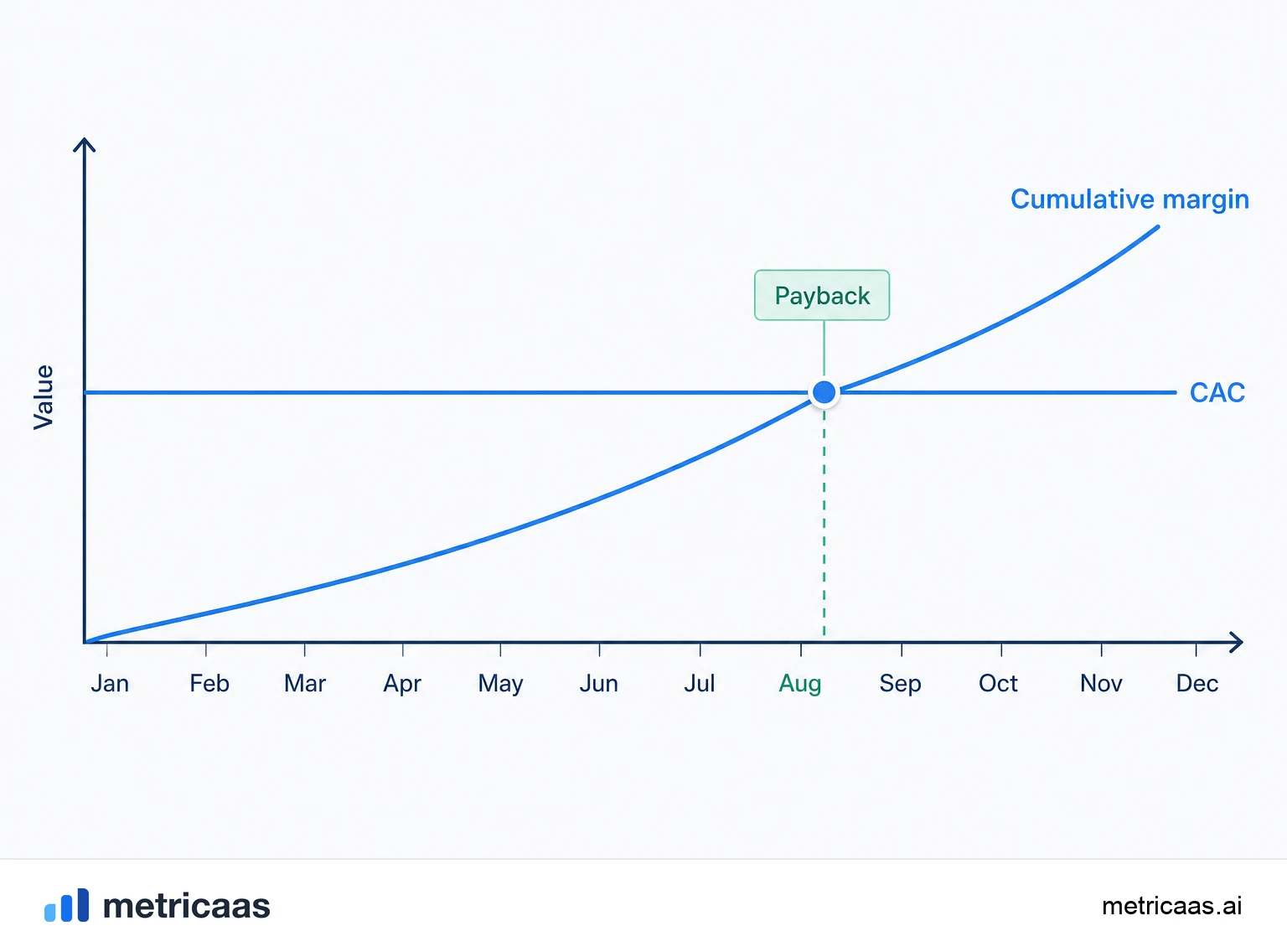
At heart, payback is a cash metric. Every new customer is born in the red: you have already paid the CAC before receiving any margin back, and that margin only trickles in, month by month. Payback is exactly the time that customer spends owing before turning into profit.
This has a huge practical consequence for growth. A short payback funds itself: when margin returns the CAC in a few months, that money can already pay to acquire the next customer, and the company grows while burning less cash. A long payback does the opposite, it forces you to front cash on every sale and shortens the runway, even in a business that is profitable on paper. That is why many companies also look at discounted payback, which accounts for the time value of money and recognizes that margin returning two years from now is worth less than margin returning tomorrow.
Frequently asked questions
It is the time an investment takes to pay for itself. In SaaS it almost always refers to CAC payback: how many months of recurring margin a customer takes to return the cost of acquiring them.
By dividing the investment by the cash return per period. In SaaS, it is the CAC divided by the monthly gross margin per customer (MRR per customer times gross margin).
The classic benchmark is under 12 months, but it varies with deal size: the industry median was around 18 months in 2024, from about 9 months at low tickets to more than 20 months on large contracts.
For most SaaS, 36 months is long and weighs on cash. It is only justified in large contracts with high retention and an LTV that rewards the wait; for self-serve products it signals inefficient acquisition.
Because what pays back the CAC is what is left after the cost of serving the customer, not the full price. Using revenue shortens the payback artificially and hides the real cost.
The payback period is the general concept, applicable to any investment; CAC payback is that concept applied to the cost of acquiring a customer. Same logic, different scope.
Related concepts
CAC payback
CAC payback is the time, in months, a customer takes to return the CAC in recurring margin. Divide the CAC by the monthly gross margin each customer generates (recurring revenue per customer times gross margin). It is the metric that shows how fast the acquisition investment comes back to cash.
CAC
CAC (Customer Acquisition Cost) is how much, on average, you spend to win a new customer. Add up everything invested in marketing and sales over a period and divide by the number of new customers who came in during that period. It is the metric that tells you whether your growth is economically healthy.
LTV / CLV
LTV (Lifetime Value), also called CLV or CLTV, is the total value a customer generates while they stay in your base. In a simple form, it is the recurring average revenue times margin times the customer lifetime. It is the metric that shows how much it is worth investing to win and keep each customer.