
Logo retention: what it is and how to calculate customer retention
By Tiago Costa · Updated on July 9, 2026

Definition
Logo retention is the percentage of accounts (logos) a company keeps over a period, counting each customer as one unit, regardless of what they pay.
- It is the mirror of customer churn: an account that stays is a retained logo.
- It counts heads, not revenue, so it treats a $100 customer and a $10k customer the same.
- It can diverge sharply from revenue retention when a few large customers dominate the MRR.
What logo retention is
Logo retention measures how many of the accounts a SaaS company had at the start of a period are still customers at the end. Each customer counts as one "logo", one unit, with no weight for size: the customer paying $100 a month and the one paying $10k count exactly the same. That is why it is also called customer retention by count.
It is the flip side of customer churn: if you lose 10% of your accounts in a year, your logo retention is 90%. Where revenue retention asks "how much of the money stayed", logo retention asks "how many customers stayed", and the two answers are rarely the same.
How to calculate logo retention
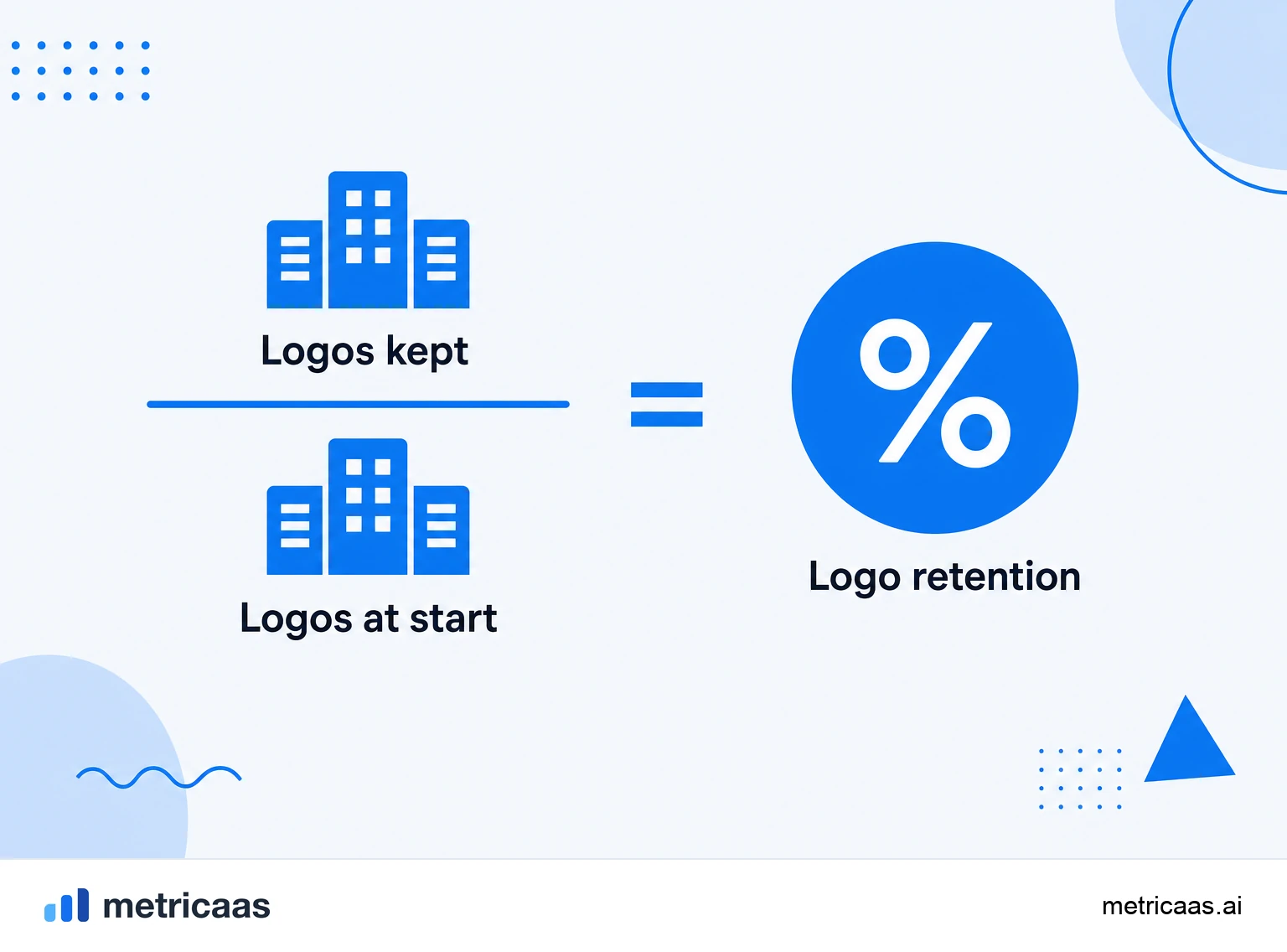
The formula starts from a fixed window, usually a year, and looks only at the accounts that existed at the start. Count how many of those accounts are still active at the end and divide by the starting total.
- Logo retention = starting accounts still active at the end / accounts at the start.
- Do not count new customers acquired during the window: they belong to the next period calculation.
- If a customer cancels and returns within the same window, pick a rule and apply it consistently.
Example: you started the year with 200 customers and, of those, 176 are still active in December. Logo retention is 176 / 200 = 88%. Note that the 24 lost customers could all be tiny or include one huge account, and the number does not change: that is both the strength and the limit of the metric.
Logo retention vs. revenue retention
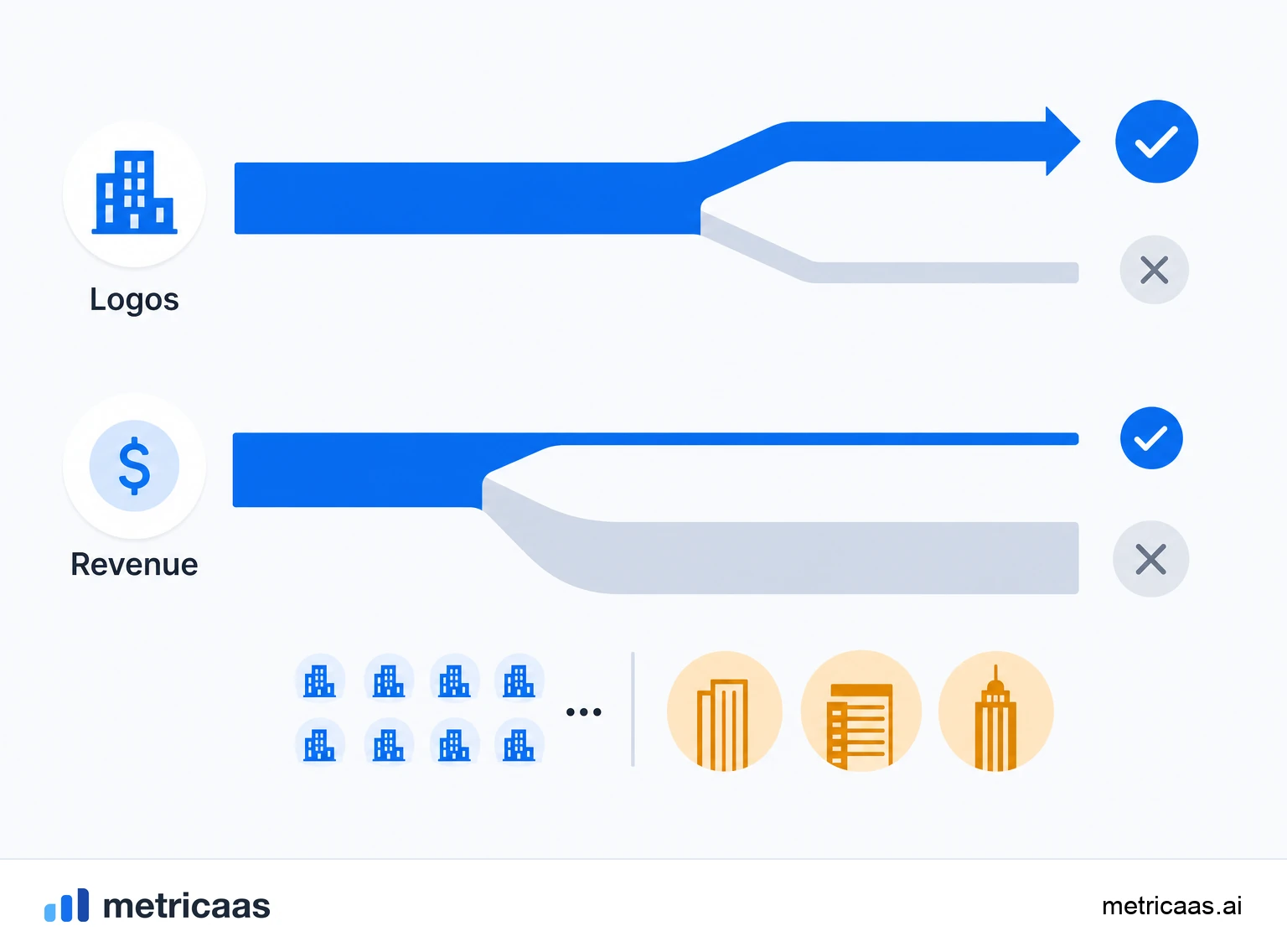
This is where the most useful insight lives. Logo retention counts customers; net revenue retention counts dollars. When the two diverge, they reveal the shape of your business.
If logo retention is low but revenue retention is high, you are losing many small accounts while expanding the large ones, a common profile for companies moving upmarket. If logo retention is high but revenue retention is low, you keep almost everyone, yet downgrades and partial cancellations are eroding the ticket. Cross-checking logo retention against the revenue retention rate separates an acquisition problem from a delivered-value problem.
Can logo retention exceed 100%?
No. Unlike net revenue retention, which goes above 100% when expansion outweighs losses, logo retention is capped at 100%. The reason is simple: a logo either stays or leaves, there is no "expansion" of a single account in a headcount. At most you keep every customer you had.
That is why the phrase "net logo retention" tends to cause confusion. Winning new customers grows the total base, but it does not enter the retention calculation, which looks only at the starting cohort. If someone reports logo retention above 100%, they are probably mixing new acquisitions with retention, and the number stops measuring what it should.
What a good logo retention is
There is no universal number, because logo retention depends heavily on the segment. Products sold to small businesses live with accounts that open and close, so an annual logo retention in the low 80s can already be healthy. Companies selling to large accounts on multi-year contracts tend to retain well above that.
As a reference on the revenue side, the private SaaS survey by KeyBanc Capital Markets shows net revenue retention above 100%, and research from SaaS Capital puts annual gross revenue retention near 90% at the median. Logo retention usually runs below revenue retention, because losses concentrate in the smaller accounts, which weigh little in MRR but still count as a full logo. Always benchmark against peers of your size and model, not against the overall average.
Why logo retention matters
Logo retention is the best thermometer of product-market fit. Because it treats every customer equally, it does not let one or two large accounts mask an exodus of smaller ones. A drop in logo retention usually shows up before revenue feels it, working as an early warning.
It also underpins bottom-up growth. Every retained logo is a base on which expansion can happen: without customer retention, there is no ground for revenue to grow inside the book. Tracking logo retention alongside churn and revenue retention gives the full picture of how many customers you keep and how much value they represent.
Frequently asked questions
Logo retention is the percentage of accounts (logos) a company keeps over a period, counting each customer as one unit, regardless of what they pay. It is the mirror of customer churn.
Divide the accounts that existed at the start of the period and are still active at the end by the total accounts at the start. New customers acquired during the window do not count.
Gross revenue retention (GRR) counts the revenue you keep before expansion; logo retention counts the customers you keep. GRR is measured in dollars, logo retention in accounts, so a business can hold most of its revenue while still losing many small logos.
No. A logo either stays or leaves, there is no expansion of a single account in a headcount, so the ceiling is 100%. Only revenue retention can exceed 100%, through expansion.
It depends on the segment. Companies selling to small businesses may consider the low 80s per year healthy; those selling to large accounts usually retain well above that. Benchmark against peers of your size.
Related concepts

Customer churn
Customer churn (or logo churn) is the percentage of customers or accounts that cancel in a period, counted by number of logos rather than by revenue. It tells you how many companies you lost, regardless of how much each one paid. It differs from revenue churn when those who cancel pay above or below your average deal.

Net Revenue Retention (NRR)
Net Revenue Retention (NRR) measures how much of the recurring revenue from your current base you keep over time, already accounting for upgrades and expansion, minus downgrades and cancellations. Above 100% it means the base grows on its own, even without new customers.

Retention rate
The retention rate is the percentage of customers or revenue that stays active at the end of a period. It is the direct complement of churn: if the annual customer churn rate is 8%, customer retention is 92%. It measures the loyalty of the base and helps forecast future recurring revenue.