
Cash flow: what it is, the three types and how to calculate it
By Tiago Costa · Updated on July 9, 2026

Definition
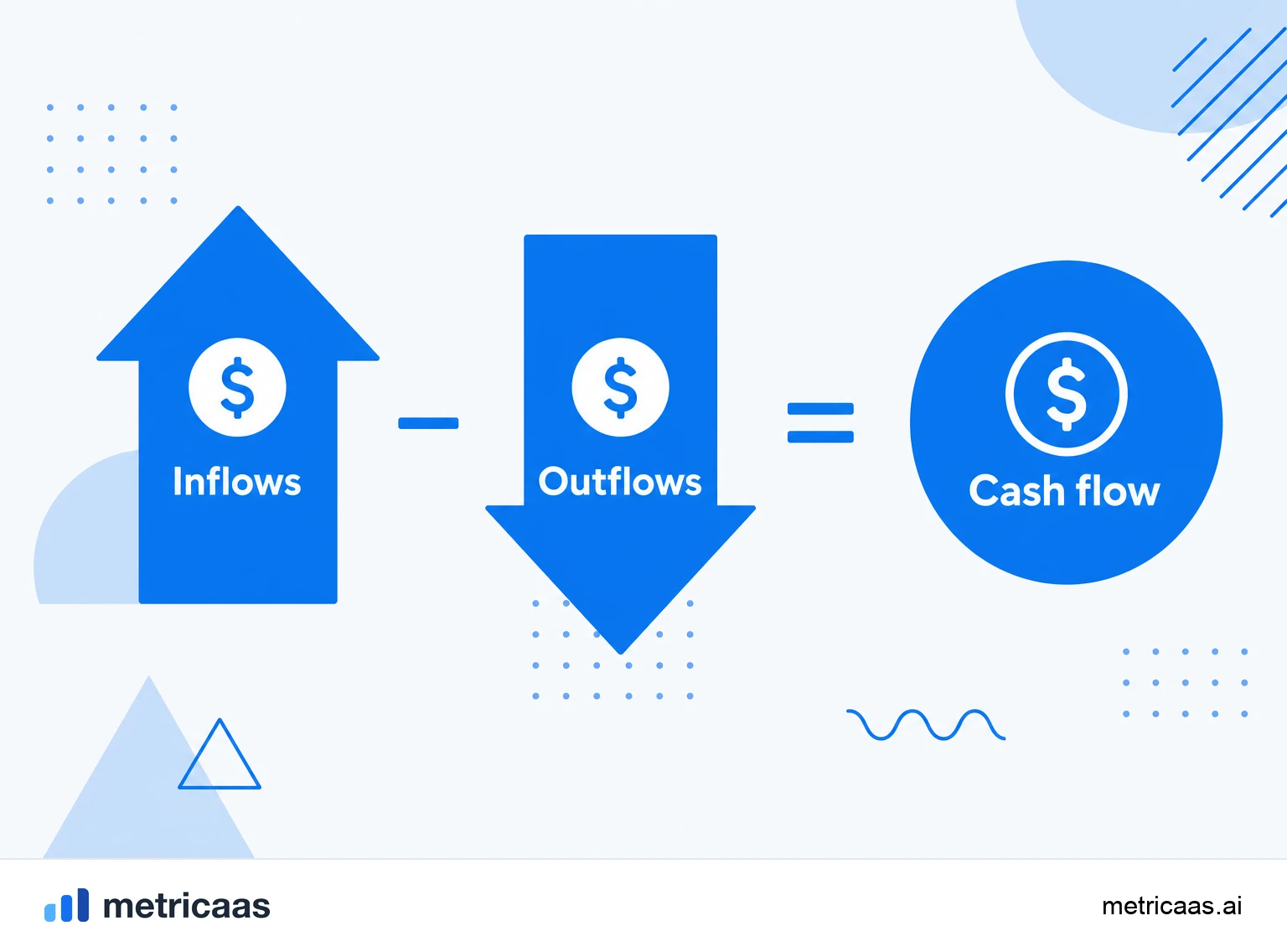
Cash flow is the difference between the money coming into a company and the money going out over a period.
- It splits into operating, investing and financing.
- It is not profit: it counts only cash that actually moves.
- In SaaS, annual upfront billing brings cash forward.
What cash flow is
Cash flow is the difference between the money coming into a company and the money going out over a period. It is a picture of cash in motion: how much was actually collected from customers and how much was paid to suppliers, salaries, taxes and investments, with no promises and no amounts that were merely recorded.
Unlike accounting figures, cash flow looks only at what passed through the bank account. That is why it is called the pulse of the business: a company can have signed contracts and issued invoices, but what pays this month bills is the cash that already arrived. Inflows larger than outflows produce positive cash flow; the reverse, negative cash flow.
The three types: operating, investing and financing
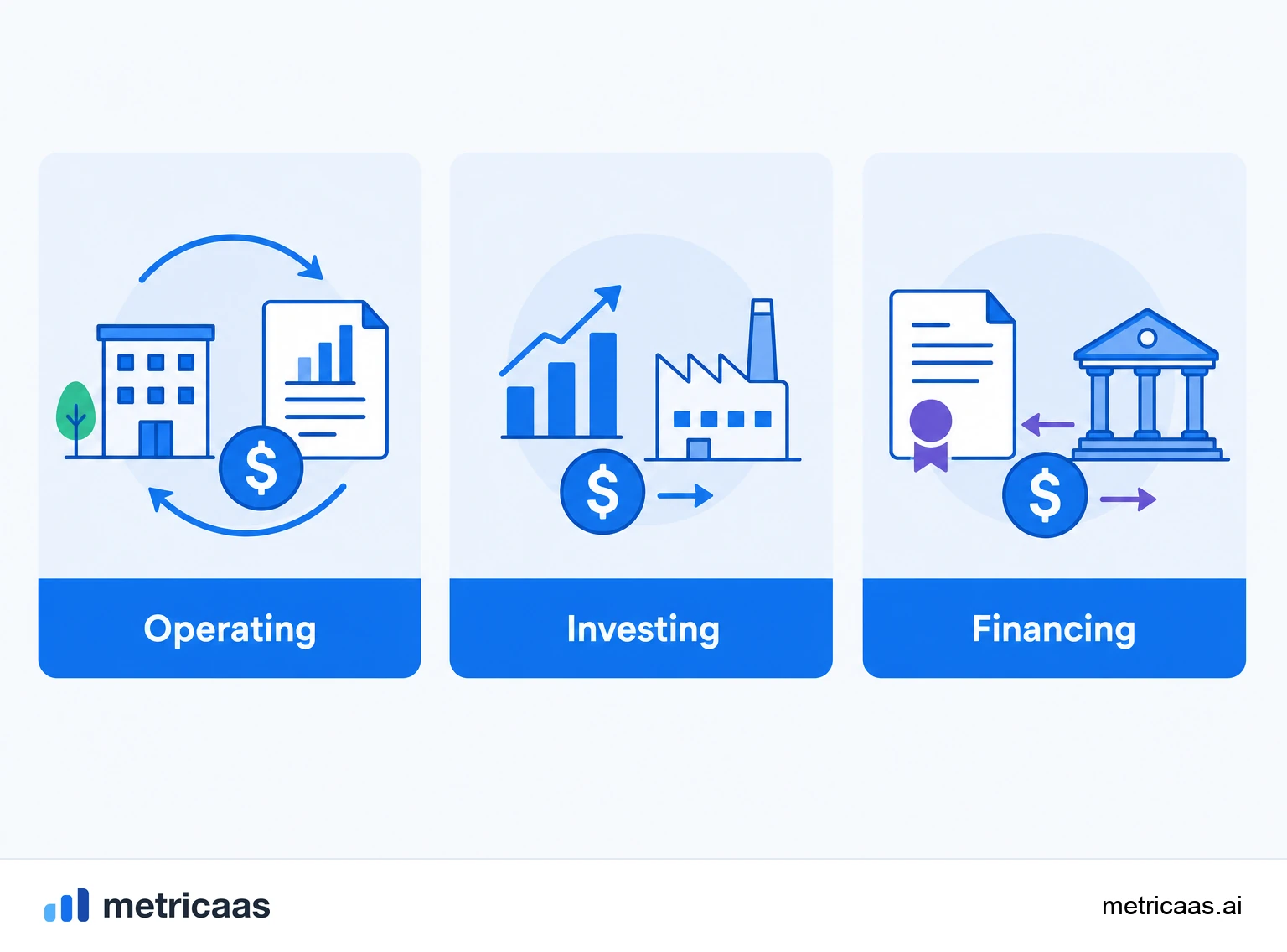
Cash flow splits into three blocks that, together, form the cash flow statement:
- Operating: cash generated or consumed by the core activity, such as collecting from subscribers and paying salaries, servers and commissions.
- Investing: inflows and outflows tied to long-term assets, such as buying equipment, acquiring a company or investing in securities.
- Financing: capital movements with owners and lenders, such as investor funding, loans, debt repayment and dividends.
Adding the three gives the total change in cash for the period. Operating cash minus investment in assets shows what truly remains, the basis of free cash flow.
Cash flow is not profit: cash vs accrual
Profit and cash look like the same thing, but they are not. Profit comes from accrual accounting, which recognizes revenue when it is earned and expense when it is incurred, regardless of when the money moves. Cash follows cash accounting: it counts only when the amount actually comes in or goes out.
That is why a company can be profitable on paper and still run out of money, if it sells on credit and collects late, or the opposite, sit on plenty of cash with little profit. The gap between recognized revenue and money received is what makes "profit is not cash" one of the warnings most repeated by firms like McKinsey.
Annual upfront billing: the SaaS cash advantage
In SaaS, an annual contract paid in advance brings in twelve months of cash at once, while revenue is recognized month by month. The money arrives today, but the revenue is booked over the year, and the part not yet recognized sits as deferred revenue on the liabilities side.
This mismatch is a working capital advantage: the company collects before it delivers and uses that cash to fund its own growth, without taking on debt. Billing annually instead of monthly improves cash even with the same recognized revenue, and it is one reason so many SaaS offer a discount on the annual plan.
How to calculate and read cash flow
The base calculation is direct: cash flow = inflows - outflows over the period. Add up everything that came in (customer payments, funding, loans) and subtract everything that went out (suppliers, payroll, taxes, investments).
- Positive cash flow: more came in than went out, cash grew.
- Negative cash flow: more went out than came in, cash shrank.
- Realized cash flow: what actually happened, as opposed to what was projected.
Example: if in one month $120k came in and $90k went out, cash flow for the period was $30k positive. Projecting that number for the coming months is what lets you spot a squeeze before it arrives.
Why cash flow is the pulse of the business
No company fails for lack of paper profit; it fails when the cash runs out. That is why cash flow is the basis of survival metrics: burn rate measures how fast cash is consumed, and runway tells how many months it will last.
Reading cash flow often reshapes decisions: when to hire, when to hold an investment, when to raise. Firms like McKinsey have long summed up the idea with the maxim that cash is king. For a SaaS, tracking cash side by side with recurring revenue is what separates growing with room to breathe from growing in the red.
Frequently asked questions
Cash flow is the difference between the money coming into a company and the money going out over a period. It counts only cash that actually moves, not amounts merely recorded.
Operating (from the core activity), investing (long-term assets) and financing (capital from owners and lenders). Together they form the cash flow statement.
No. Profit uses accrual accounting and recognizes revenue when it is earned; cash flow counts only money that actually comes in or goes out. A company can be profitable and still run out of cash.
Subtract outflows from inflows over the period: cash flow = inflows - outflows. If $120k came in and $90k went out, cash flow is $30k positive.
It is the cash that actually moved in the period, as opposed to projected cash flow, which estimates future inflows and outflows.
Because it collects twelve months of cash at once while revenue is recognized month by month, giving a working capital advantage that funds growth.
Related concepts
Free cash flow
Free cash flow (FCF) is the cash left from operations after paying for capital investments (capex). It is the money truly available to pay down debt, reward investors or reinvest in growth. A SaaS that generates positive FCF funds itself and depends less on raising rounds.

Working capital
Working capital is current assets minus current liabilities: the short-term resources a company has to run its day-to-day operation. It shows whether receivables, cash and inventory cover the obligations coming due in the next few months. In SaaS, billing upfront and paying suppliers later can produce negative working capital, and in that model it is usually a sign of health, not of strain.

Burn rate
Burn rate is the speed at which a company consumes its cash, almost always measured per month. Gross burn adds up all the money going out; net burn subtracts the revenue coming in and shows what actually drains the cash. It is the denominator of runway: the lower the burn, the more time a startup has before it needs new capital.