
Burn rate: what it is, how to calculate it and how it affects runway
By Tiago Costa · Updated on July 9, 2026

Definition
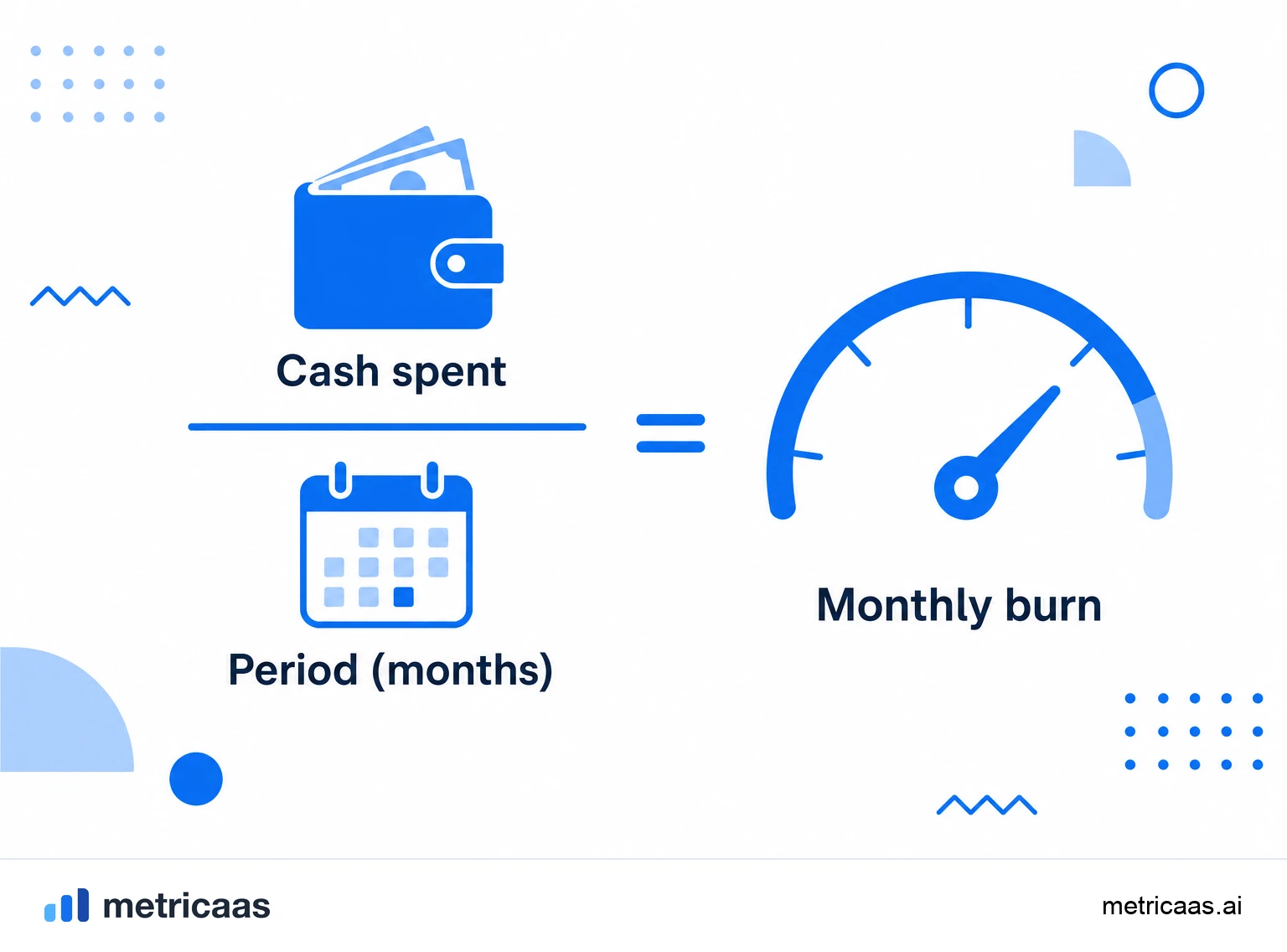
Burn rate is the speed at which a company consumes cash, almost always per month, and it is the denominator of runway.
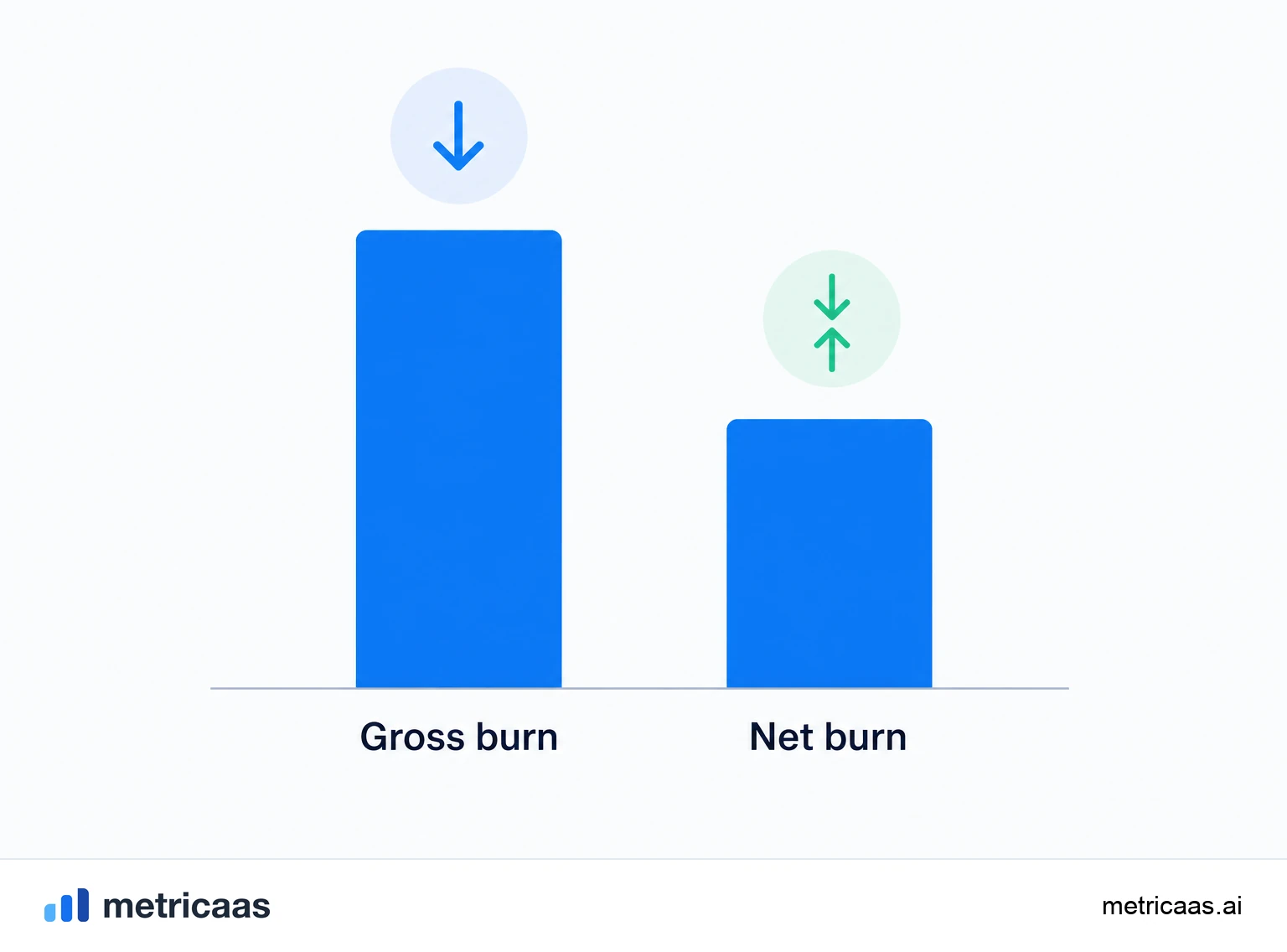
- Gross burn: all the money going out of the account.
- Net burn: cash out minus the revenue coming in.
- The lower the burn, the longer the runway.
What burn rate is
Burn rate is the speed at which a company consumes the cash it holds, almost always measured per month. It answers a direct question: how much does the business spend beyond what it earns in each period? In startups that are not yet profitable, this number defines how long the company can operate before it needs more capital.
It is a cash metric, not accounting profit. It looks at the money that actually leaves the account, which is why it speaks directly to the business cash flow. A burn rate under control is what gives the team room to grow without surprises, and an out-of-control burn is the first sign that cash is about to get tight.
Gross burn and net burn
There are two ways to look at the burn, and confusing them leads to wrong decisions.
- Gross burn: all the money leaving the account in the period, adding up salaries, rent, servers, marketing and any other expense. It ignores what comes in.
- Net burn: cash out minus revenue in. It is what actually disappears from the account after subtracting what customers paid.
Net burn is the number that matters for survival, because it is what erodes cash month after month. Gross burn helps you see the real size of the cost structure, regardless of revenue. A company can have high gross burn and low net burn when recurring revenue already covers a good part of the bills.
How to calculate burn rate
Calculating monthly net burn is straightforward: take the cash at the start of the period, subtract the cash at the end and divide by the number of months.
- Net burn = (starting cash - ending cash) / number of months.
- For gross burn, add only the expenses in the period, without netting out revenue.
- Use an average of a few months to smooth one-off outflows, such as quarterly taxes.
Example: the company spends $200k per month across all bills and takes in $120k of recurring revenue. Gross burn is $200k and net burn is $80k per month. It is that $80k that sets the pace of the cash.
Burn rate and runway
Burn rate is the denominator of runway, the time the company can still operate on the cash it has. The math is simple: divide the available cash by the monthly net burn.
In the earlier example, with $960k in cash and $80k of net burn, runway is twelve months. Cutting burn or growing revenue stretches that horizon; letting burn rise unchecked shortens it. That is why the two metrics are inseparable: tracking burn without watching runway, or the other way around, hides half the story.
How to reduce burn rate
There is no universal "right" burn: the healthy number depends on the stage, the cash on hand and the speed of growth. The better question is not "how much am I burning?" but "how much growth does each dollar burned buy?".
That is where the idea of the burn multiple comes from, comparing net burn with the new recurring revenue won in the period: the lower it is, the more efficient the growth. Firms like Bessemer and surveys such as the one from KeyBanc Capital Markets track this capital efficiency closely. To reduce burn without stalling the business, the usual paths are cutting costs that do not drive growth, improving retention and lowering CAC, since expensive acquisition is one of the biggest sources of cash burn.
Why burn rate matters
Running out of cash is one of the leading causes of startup death, and burn rate is the alarm that flags the risk early. Watching it closely lets you adjust hiring, marketing and investments before runway gets tight, instead of reacting when it is already too late.
In a large and competitive SaaS market, with Gartner forecasting worldwide public cloud end-user spending to total $723 billion in 2025, cash discipline has become a strategic advantage. When net burn turns negative, meaning revenue starts to exceed the cash going out, the company generates cash and begins building free cash flow, the goal of every sustainable business.
Frequently asked questions
It is the speed at which a company consumes its cash, almost always measured per month. It shows how much the business spends beyond what it earns in each period.
It measures the pace of cash consumption. Combined with the cash on hand, it indicates the runway, that is, how many months the company can still operate.
Gross burn adds up all the money leaving the account. Net burn subtracts the revenue coming in and shows what actually drains the cash each month.
Subtract the ending cash from the starting cash and divide by the number of months. For gross burn, add only the expenses in the period, without netting out revenue.
There is no universal number. What matters is efficiency: how much growth each dollar burned buys, and whether the resulting runway is enough to reach the next milestone.
Yes. A negative net burn means revenue exceeds the cash going out, so the company is generating cash instead of burning it.
Related concepts

Runway
Runway (cash runway) is how many months a company can keep operating on the cash it has, at its current burn rate. You calculate it by dividing available cash by the monthly net burn, and it sets the urgency to raise money or reach break-even. It is the financial breathing room that buys time to get the business right.

Cash flow
Cash flow is the difference between the money coming into a company and the money going out over a period. It splits into operating, investing and financing, and it is not profit: cash is what actually moves through the account. In SaaS, billing annual contracts upfront brings cash forward relative to recognized revenue.
Free cash flow
Free cash flow (FCF) is the cash left from operations after paying for capital investments (capex). It is the money truly available to pay down debt, reward investors or reinvest in growth. A SaaS that generates positive FCF funds itself and depends less on raising rounds.