
ARPU: what average revenue per user is and how to calculate it
By Tiago Costa · Updated on July 9, 2026

Definition
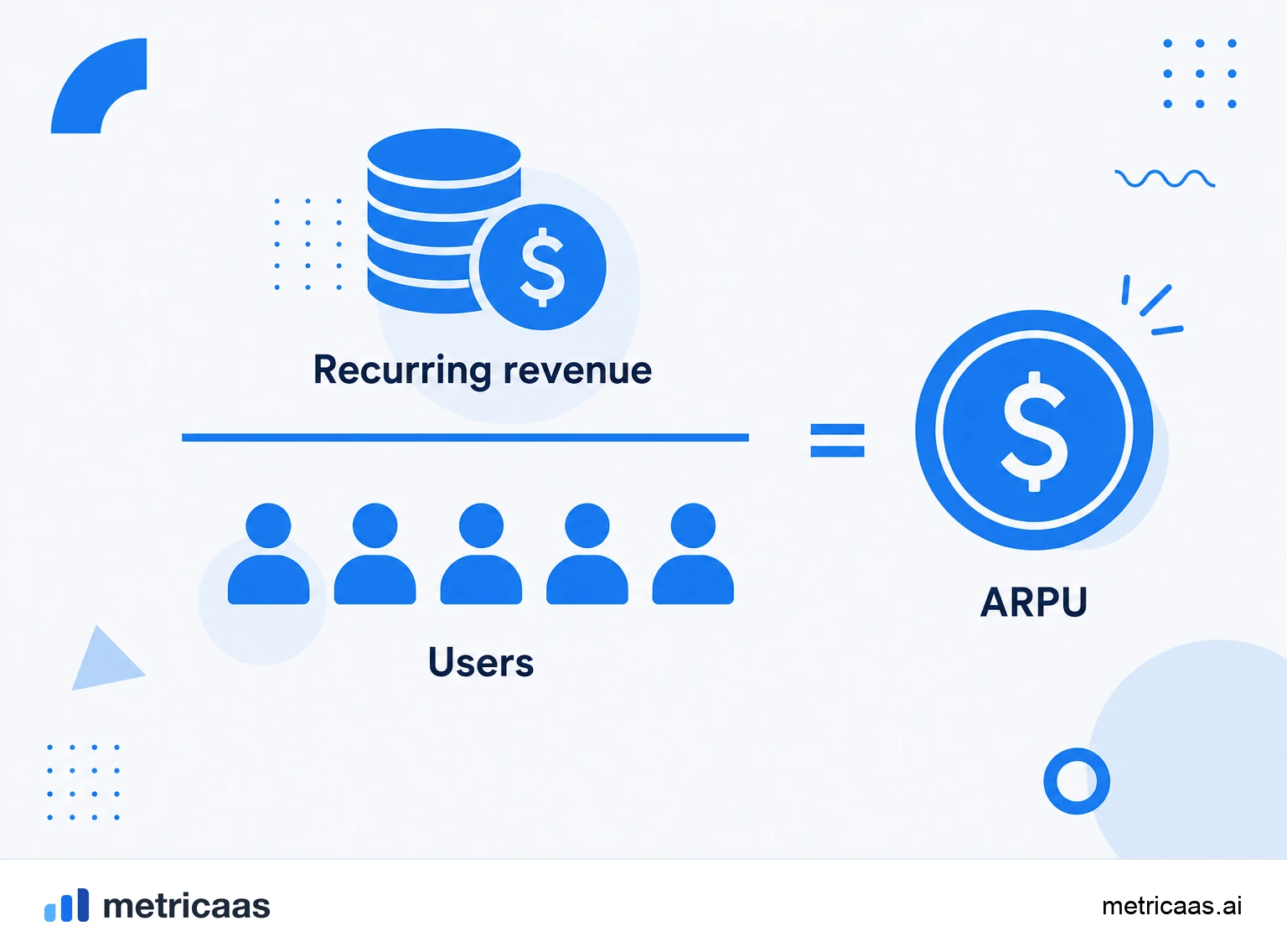
ARPU (Average Revenue Per User) is the average recurring revenue per user: recurring revenue divided by the number of active users.
- Measures revenue per person, not per account.
- Ideal for products priced per seat or user.
- Calculated on recurring revenue, over a defined period.
What ARPU is
ARPU measures how much a SaaS earns, on average, per active user in a period. It takes recurring revenue and divides it by the number of users, showing the average value each person generates. It is an efficiency read: two businesses with the same MRR can have very different ARPUs depending on how many users sit behind that revenue.
The word user is what sets ARPU apart. It counts people, not companies or contracts. That is why it is the natural metric for products whose price tracks the number of seats: the more paying users, the more directly ARPU reflects the billing model.
How to calculate ARPU
The formula is simple: divide the recurring revenue of a period by the number of active users in the same period.
- ARPU = recurring revenue / active users.
- For monthly ARPU, use the month MRR and the average of active users that month.
- Keep the numerator and denominator in the same window, or the number distorts.
Example: a SaaS with $100k of MRR and 2,000 active users has an ARPU of $50 per month. The main care is defining what counts as an active user, so the base does not include dormant accounts that inflate the denominator and sink ARPU.
ARPU vs ARPA: user or account
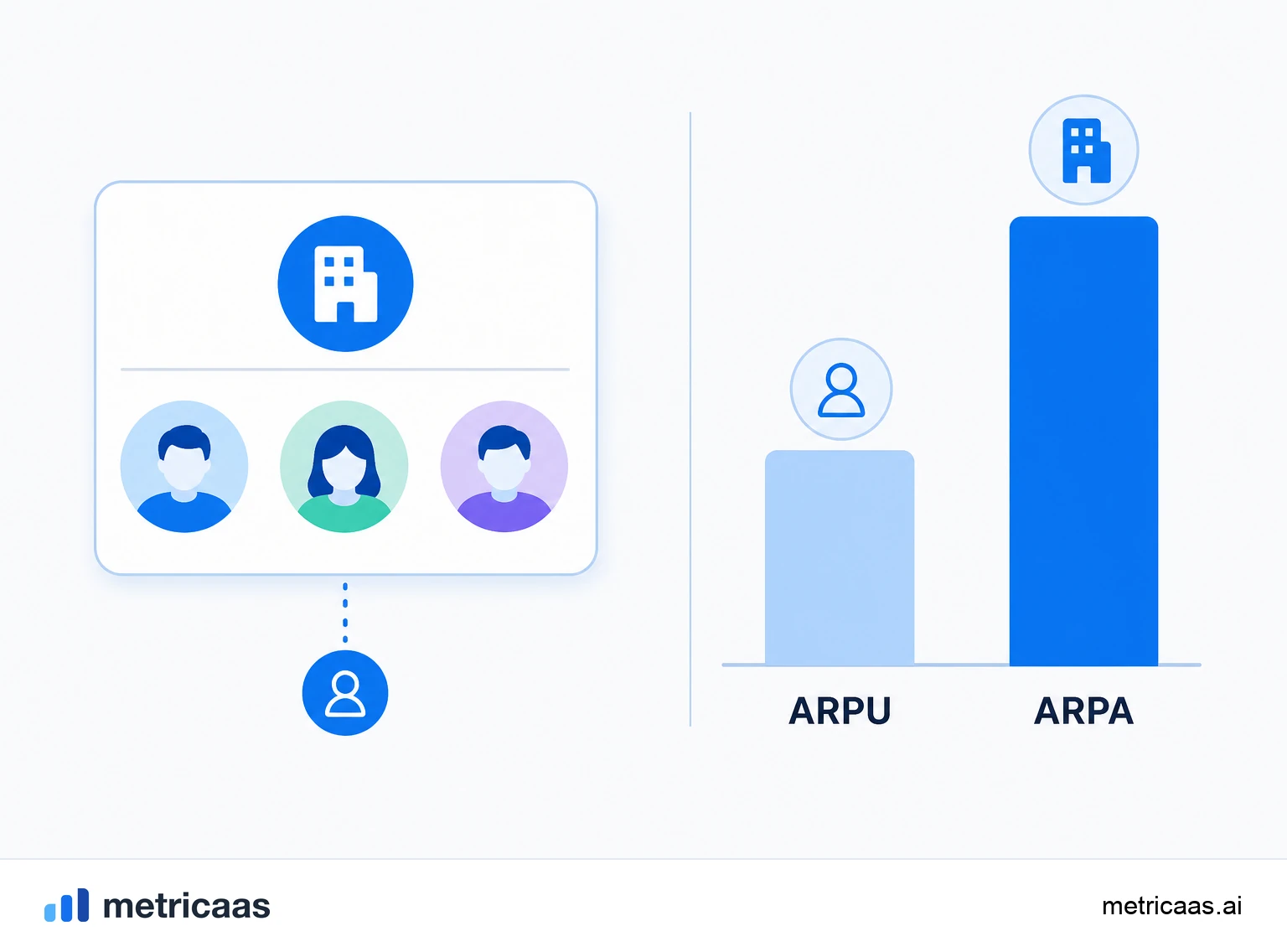
ARPU and ARPA answer the same question, how much each customer yields on average, but with different denominators. ARPU divides by the number of users; ARPA divides by the number of accounts. Because one account can hold several users, the two numbers rarely match.
The choice depends on the billing model. Products sold by seat, where each extra user generates revenue, read better through ARPU. Products sold by account or by company, with a fixed price per organization, read better through ARPA. Using the wrong metric hides what actually moves revenue.
How to increase ARPU
Increasing ARPU means making each user yield more, without relying only on bringing in new people. The classic paths are expansion: moving up a plan, activating paid features and aligning price to the value delivered.
- Upsell: move the user to a higher plan.
- Cross-sell: sell complementary modules or add-ons.
- Pricing: revisit prices and packaging based on perceived value.
A rising ARPU signals that the product is capturing more of the value it creates. But it has to be read alongside churn: raising price to the point of scaring users away can lift ARPU in the short term and erode revenue down the line.
ARPU and LTV: the link
ARPU is one of the ingredients of LTV / CLV. The more each user yields per month and the longer they stay, the more value they generate over their lifetime. That is why lifting ARPU without hurting retention is one of the most efficient growth levers.
Benchmark studies, such as those from Benchmarkit, track average revenue per customer as a core efficiency metric, and research from SaaS Capital shows that companies with strong net retention expand revenue within their existing base, lifting value per user without needing new logos.
Why ARPU guides the business
ARPU condenses the health of the revenue model into a single line. It tells you whether price is aligned to value, whether the base is made of the right users and whether the plan strategy is working. A drop in ARPU can reveal excessive discounting, a mix skewed to cheap plans or inactive users polluting the count.
Tracked over time, ARPU also guides acquisition decisions: if each user yields more, there is more margin to invest in bringing in the next ones. It is a small metric in form, but one that connects price, product and growth in a single read.
Frequently asked questions
Divide recurring revenue by the number of active users in the same period. For monthly ARPU, use the month MRR over the average active users that month.
It is the average recurring revenue each active user generates in a period. It shows how much, on average, one user is worth.
Not exactly. ARPU divides revenue by users; ARPA divides by accounts. Since one account can hold several users, the numbers differ.
ARPU is the average revenue per user in a period; LTV is the total value a user generates over their lifetime. ARPU is one of the inputs of LTV.
It can be either. Monthly ARPU is the most common, but you just need recurring revenue and users from the same window, month or year.
Related concepts

ARPA
ARPA (Average Revenue Per Account) is a SaaS recurring revenue divided by the number of active accounts. It shows how much each account generates, on average, per month or year. It is the metric that reveals the typical value of a customer and one of the main levers for growing revenue without relying only on new sales.

MRR
MRR (Monthly Recurring Revenue) is the monthly recurring revenue of a SaaS: the sum of all active subscriptions normalized to a month. It is the core metric of a subscription business because it shows, predictably, how much the company earns on a recurring basis each month, without counting one-off charges.

LTV / CLV
LTV (Lifetime Value), also called CLV or CLTV, is the total value a customer generates while they stay in your base. In a simple form, it is the recurring average revenue times margin times the customer lifetime. It is the metric that shows how much it is worth investing to win and keep each customer.