
Win rate: what the sales win rate is and how to calculate it
By Tiago Costa · Updated on July 9, 2026

Definition
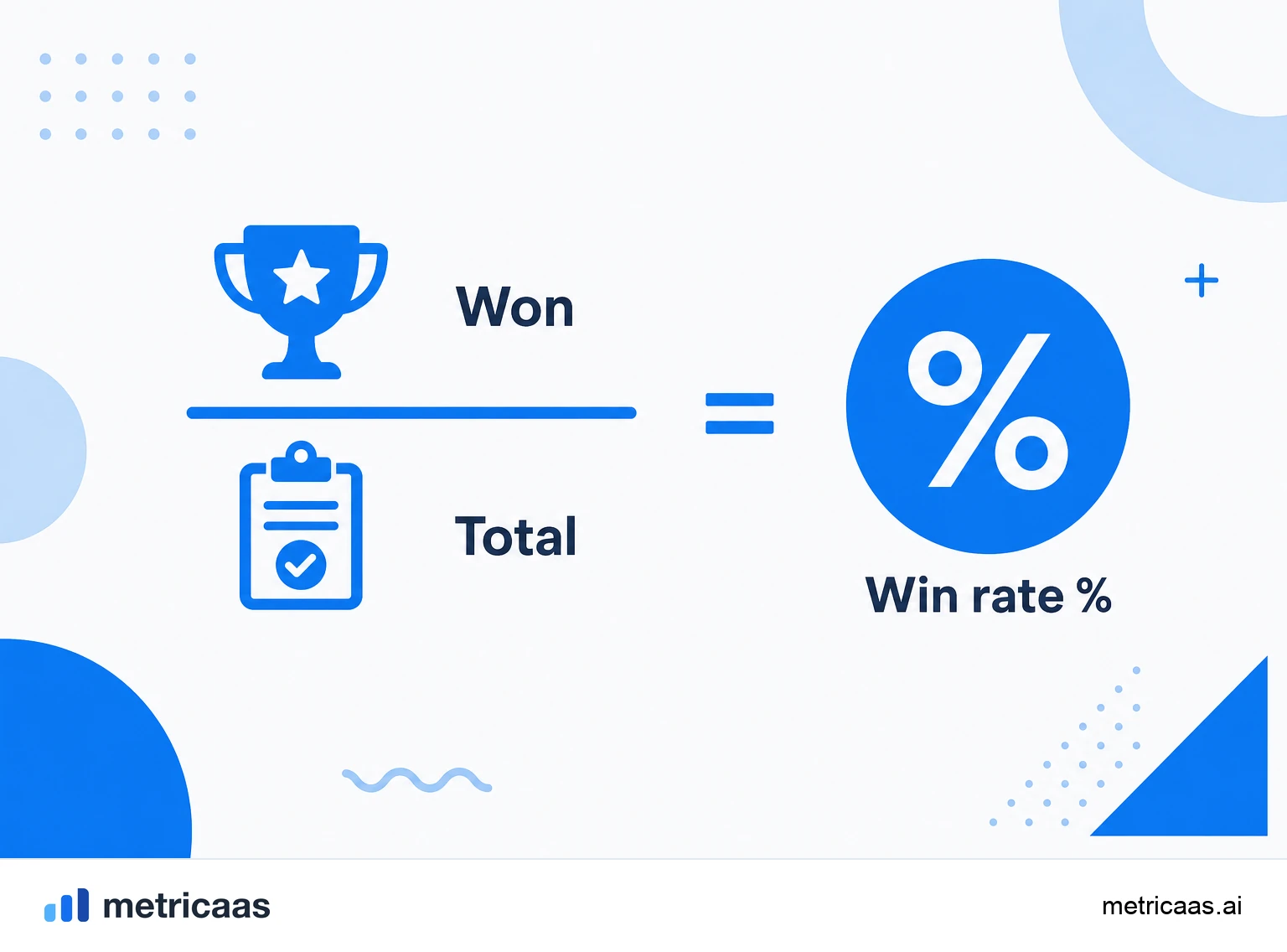
Win rate is the share of opportunities that turn into sales: deals won divided by the total deals closed in the period.
- Formula: won divided by (won plus lost).
- Measures commercial efficiency and the quality of qualification.
- Raising win rate lowers the cost of each customer won.
What win rate is
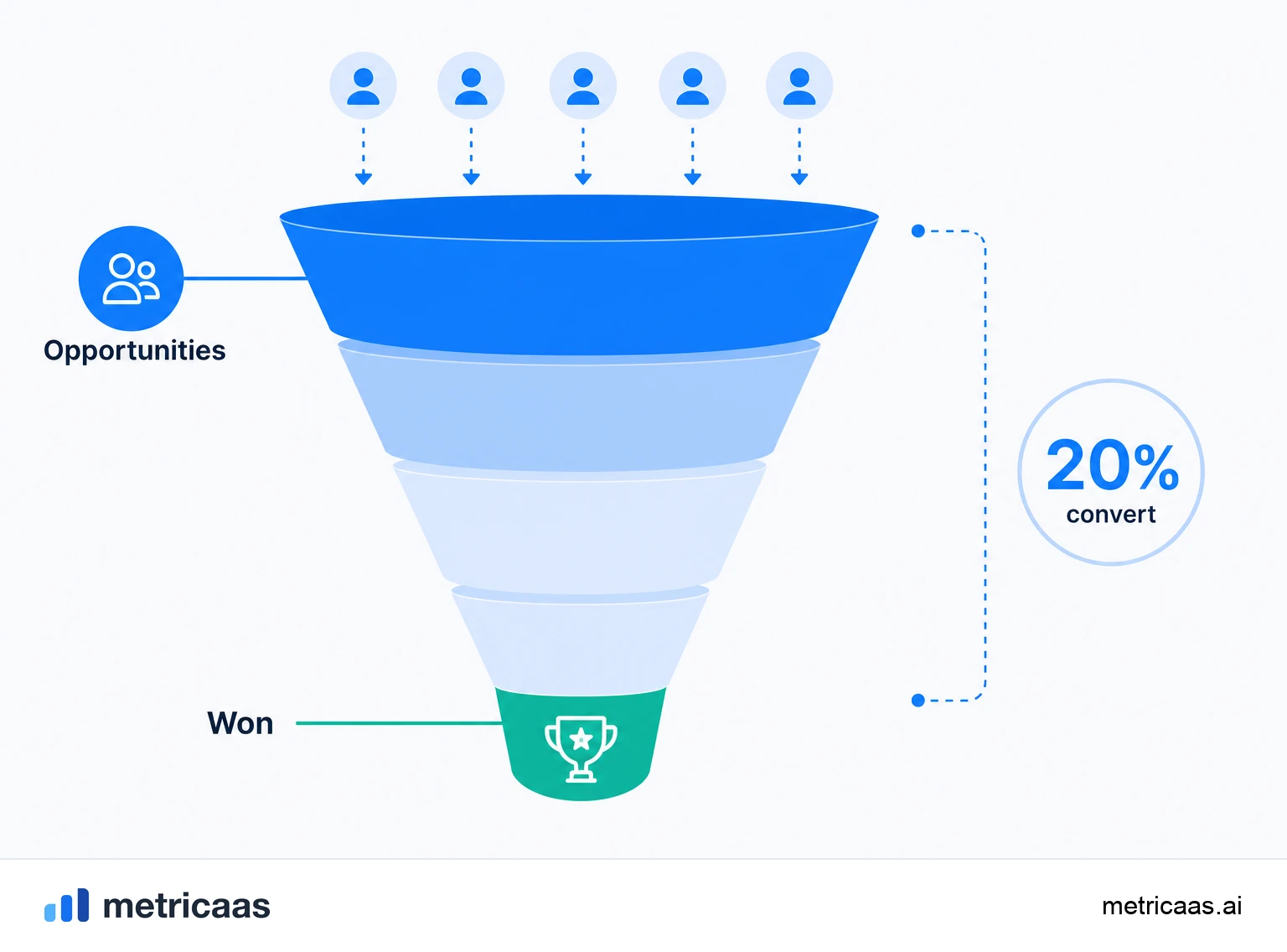
The win rate measures how many sales opportunities actually turn into contracts. Instead of looking at the volume of open deals, it looks at the outcome: of everything that was contested and reached a decision, what fraction the team managed to close. That makes it a direct read of commercial efficiency, not of effort.
A high volume of opportunities does not mean sales. A full funnel can hide a low win rate, a sign that a lot of energy is lost on deals that would never close. Reading win rate alongside the sales cycle shows not only how much the team wins, but how long it takes to win, and where deals die.
How to calculate win rate
The base formula is simple: divide deals won by the total deals closed in the period, that is, won plus lost.
- Win rate = deals won / (won + lost).
- Count only what closed in the period; still-open deals stay out of this version of the denominator.
- A stricter variation uses every opportunity created as the denominator, including those still open, and tends to give a smaller number.
Example: with 20 deals won and 30 lost in a quarter, the win rate is 20 divided by 50, or 40%. What matters is fixing one definition, the same period and the same entry stage, so the series stays comparable month to month. Swapping the denominator midway is the most common way to fool yourself.
Win rate by stage, segment and source
A single win rate hides more than it reveals. The real value shows up when you break the rate down by cut: by funnel stage, by customer segment, by lead source and by deal size band. Each cut answers a different question about where the sales process wins and where it stalls.
Win rate by source, for example, shows which channels bring demand that actually closes, not just volume. This is where lead scoring connects: if the highest-scored leads close at a much higher rate, the qualification model works; if not, it needs recalibrating. Segmenting win rate turns a vanity number into a map of decisions.
Overall win rate and late-stage win rate
There is an important difference between the overall win rate and the late-stage win rate. The overall rate starts from every qualified opportunity and measures the whole journey. The late-stage rate looks only at deals that reached the final phase, typically proposal or negotiation, and measures the team closing strength.
The two tell different stories. A low overall win rate with a high late-stage win rate suggests the problem sits at the top of the funnel: too many deals enter that should not. The opposite, a decent overall rate but weak late stage, points to trouble closing, whether on price, competition or a poorly built proposal. Separating the two readings avoids fixing the wrong part of the process.
Win rate, qualification and CAC
A low win rate paired with high volume is almost always a qualification problem, not an effort problem. When the team chases leads with no fit, it spends expensive hours on deals that do not close, and every sale won costs more. That is why win rate speaks directly to CAC: raising the win rate spreads the cost of acquisition over more closed customers.
The math is direct. If the same team and the same marketing spend convert a larger share of opportunities, the cost per customer falls without any extra budget. A higher win rate on deals with a higher average selling price improves the equation even more, because each win brings more revenue for the same commercial cost.
How to raise win rate
Raising win rate is less about closing harder and more about choosing better what to compete for. Tighter qualification at the entry, focus on the segments where the historical rate is already high, and quick disqualification of what does not fit tend to move the number more than any closing technique.
- Tighten qualification: fewer deals, better fit, higher win rate.
- Concentrate effort on the segments and sources with the highest historical rate.
- Study the losses: understand why and to whom deals are lost.
- Reduce friction at the final stage, where the deal is already mature.
Benchmarks help calibrate expectations, but with caution: annual studies such as those from Benchmarkit show that win rate varies widely by segment, deal size and sales model, so there is no single right number. What matters is the trend of your own series and what moves it.
Frequently asked questions
It is the share of opportunities that turn into closed sales: deals won divided by the total deals closed in the period, that is, won plus lost. It measures commercial efficiency.
Divide deals won by the total closed (won plus lost) in the period. With 20 won and 30 lost, the win rate is 20 divided by 50, or 40%.
It depends on segment, deal size and sales model; there is no single number. More useful than comparing to the market is tracking the trend of your own rate over time.
With high volume, it usually points to poorly qualified leads or weak fit: the team spends effort on deals that do not close. Tightening qualification usually raises the rate.
The overall rate starts from every qualified opportunity and measures the whole journey; the late-stage rate looks only at deals in the final phase and measures closing strength.
Yes. Converting a larger share of opportunities with the same team and spend lowers the cost per customer won without any extra budget.
Related concepts

Sales cycle
The sales cycle is the average time an opportunity takes from first contact to closed deal, moving through qualification, demo, proposal and negotiation. Short cycles enable a low CAC and fast cash; long cycles need a high deal size to justify the effort. Shortening the cycle improves sales efficiency and CAC payback.

Average selling price (ASP)
ASP (Average Selling Price) is the average value of the new contracts a company closes: total new-business revenue divided by the number of deals in a period. It reflects the segment the company serves (self-serve low, SMB mid, enterprise high) and determines how much CAC and how long a sales cycle the model can bear. A high ASP sustains a human sales motion; a low ASP demands self-serve.

Lead scoring
Lead scoring is the practice of assigning points to each lead based on fit (how well they match the ideal customer profile) and engagement (the actions, product usage and interactions they show). The score ranks the queue and separates hot, warm and cold leads, so sales contacts the highest-probability deals first. Done well, it improves MQL-to-SQL conversion and must be calibrated against data on who actually becomes a customer.