
ASP: what average selling price is and how it shapes your sales motion
By Tiago Costa · Updated on July 9, 2026

Definition
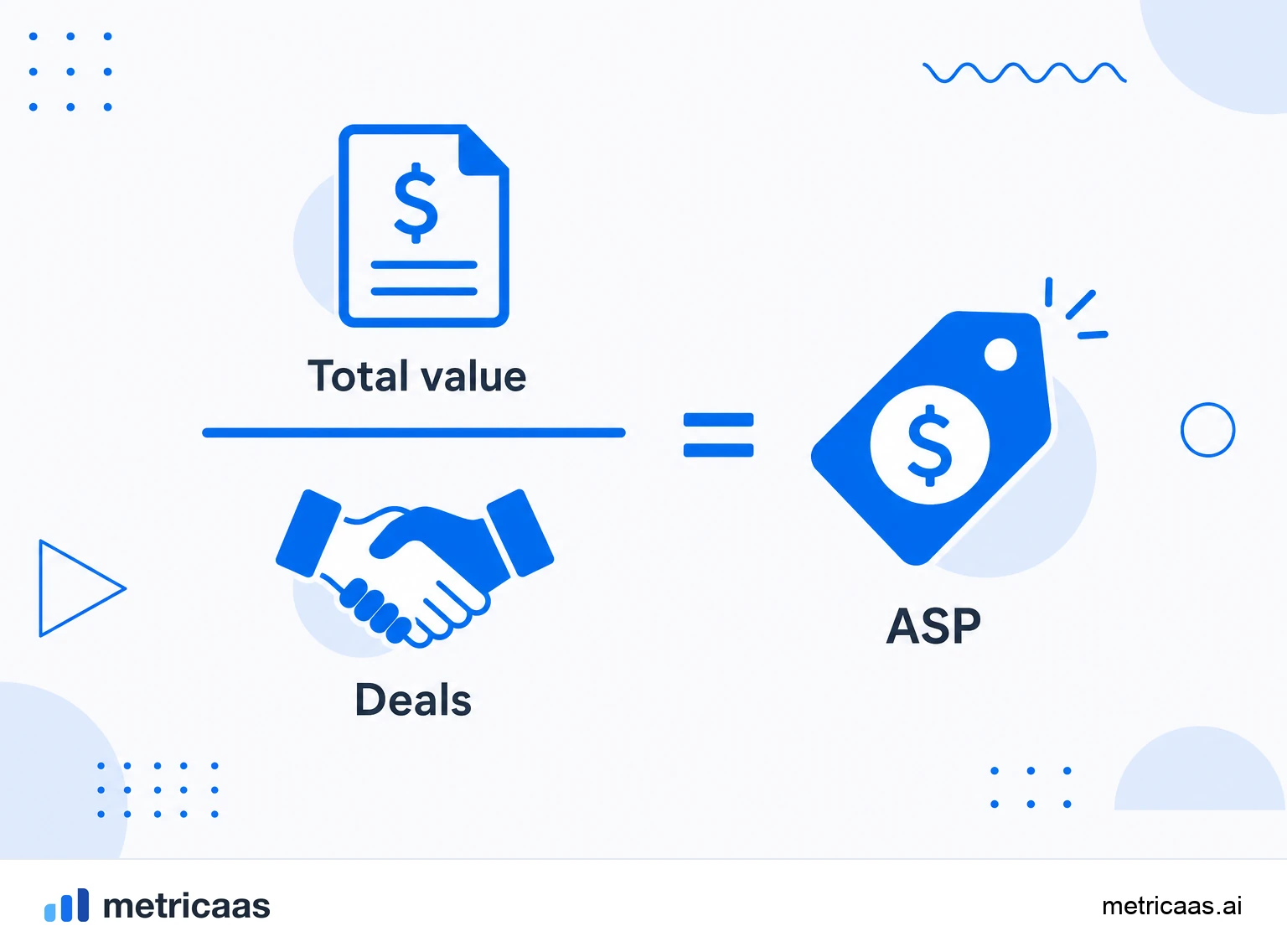
ASP (average selling price) is new-contract revenue divided by the number of closed deals.
- Measures the size of the typical deal, not the revenue of the whole base.
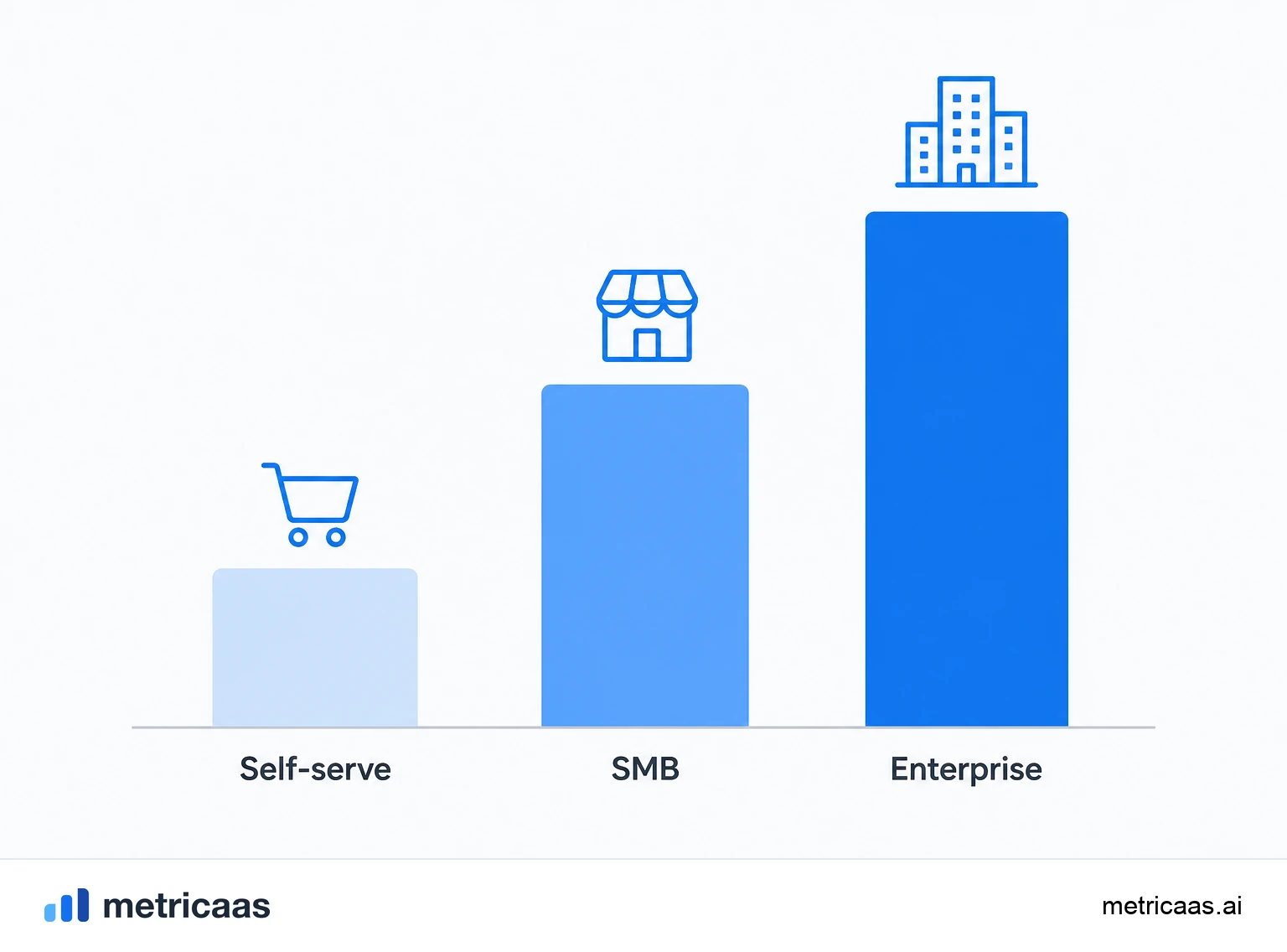
- Reflects the segment: low in self-serve, mid in SMB, high in enterprise.
- Sets how much CAC and how long a cycle the model can afford.
What ASP is
ASP (Average Selling Price) measures how much, on average, a new contract the company closes is worth. It is the value of the typical deal: sum the revenue of all new contracts in a period and divide by the number of deals. The result tells you whether you sell subscriptions of tens, of thousands, or of hundreds of thousands.
Unlike installed-base metrics, ASP looks only at what was just sold. That makes it a snapshot of your current go-to-market: the segment you serve, how well the product is packaged, and the pricing power of the sales team all show up in this one number. An ASP that rises over time usually signals a company moving up-market; one that falls can flag aggressive discounting or a drift toward smaller plans.
How to calculate ASP
The formula is straightforward: divide total new-contract revenue by the number of deals closed in the same period.
- ASP = new-contract revenue / number of deals.
- Decide the value basis: use annual contract value (ACV) to compare against the market, or the full contract value when terms vary widely.
- Watch for outliers: a single giant contract pulls the mean up and misleads. Look at the median too, to see the truly typical deal.
Example: if in a quarter you closed 40 contracts totaling $800k of annual value, the ASP is $20k. It pays to segment the calculation by plan, channel and sales team, because the self-serve ASP and the enterprise ASP rarely live in the same range, and the overall average can hide two very different businesses inside the same company.
ASP, ACV and ARPA: what changes
Three acronyms that look like the same thing but capture different moments. Confusing them leads to bad pricing and quota decisions.
- ASP: the average value of the new contracts closed. It measures how strong your sales motion is today.
- ACV (Annual Contract Value): the annualized value of a single contract. It is the unit that usually feeds the ASP calculation when terms vary.
- ARPA: the average recurring revenue per account across the whole base, new and old. It rises with expansion and falls with contraction over time.
In practice, ASP is a photo of the front door and ARPA is a photo of the whole house. A company can have a high ASP on new sales and a lower ARPA because the old base was sold cheap, or the reverse, if the base grew through upsell while new deals shrank.
How ASP shapes the sales motion
This is the most important decision ASP forces. The average contract value determines how much the company can spend to win each customer and, therefore, what kind of selling fits the model.
- Low ASP (self-serve): subscriptions of a few tens per month cannot pay for a human seller. The path is self-serve, with the product selling itself and scale marketing.
- Mid ASP (SMB): it can support an inside sales motion, with pre-sales and an account executive closing over the phone and a demo.
- High ASP (enterprise): contracts of tens or hundreds of thousands justify field sales, proofs of concept, and long cycles with several decision makers.
The classic mistake is building an expensive sales team for a low-ASP product, or trying to sell an enterprise product that needs a human touch through self-serve. Private SaaS surveys, like the company survey from KeyBanc Capital Markets, show how the go-to-market model and the typical deal size move together by segment. ASP, more than any preference, is what decides that design.
ASP, CAC and the sales cycle
ASP works as the budget that funds all acquisition. The higher the average contract value, the more CAC the company can absorb and the longer the sales cycle it can sustain without breaking unit economics.
A high-ASP product can afford months of conversations, demos and proofs of concept, and even a lower win rate, because each deal won pays for many attempts. A low-ASP product, by contrast, needs short cycles and minimal CAC: there is no margin for a seller to chase a small contract for weeks. That is why moving the ASP changes everything downstream. Going up-market raises the ASP, but it also lengthens the cycle, involves more decision makers, and demands a more expensive sales team. The practical reference from the B2B benchmarks compiled by Benchmarkit helps calibrate what is healthy for the contract value of each band.
How to raise ASP
Raising ASP means making each new deal worth more, which widens the acquisition budget and improves unit economics. There are well-known levers, almost all tied to packaging and positioning.
- Move up-market: target larger accounts that buy bigger plans and more seats.
- Package and tier: bundle features into higher tiers and use add-ons to lift the full contract value.
- Annual and multi-user contracts: close by the year and by volume, rather than monthly and single-seat.
- Price by value: charge for the outcome delivered, not for cost, shifting price upward where perceived value is highest.
The caution is not to confuse a high ASP with health: raising price without delivering more value drags down the win rate and stretches the cycle beyond what the team can bear. A healthy ASP is the one the chosen market pays without friction, not the highest one the spreadsheet allows you to type.
Frequently asked questions
ASP (average selling price) is the average value of the new contracts a company closes: new-business revenue divided by the number of deals in the period.
Divide total new-contract revenue by the number of deals closed in the same period. If 40 contracts totaled $800k, the ASP is $20k.
ASP measures only the new contracts closed; ARPA measures the average recurring revenue of the whole active base, new and old. One is the front door, the other is the entire house.
Neither is better in itself. The ASP must match the sales motion: a low ASP demands self-serve, and a high ASP sustains a human sales team and long cycles.
They are close. ASP usually refers to the value of the new contract closed, while average deal size is often used the same way, though ARPA covers the average revenue per account across the active base.
By moving up-market, packaging features into higher tiers, selling annual and multi-user contracts, and pricing by value. All without pushing price above what the chosen market pays.
Related concepts

CAC
CAC (Customer Acquisition Cost) is how much, on average, you spend to win a new customer. Add up everything invested in marketing and sales over a period and divide by the number of new customers who came in during that period. It is the metric that tells you whether your growth is economically healthy.

Sales cycle
The sales cycle is the average time an opportunity takes from first contact to closed deal, moving through qualification, demo, proposal and negotiation. Short cycles enable a low CAC and fast cash; long cycles need a high deal size to justify the effort. Shortening the cycle improves sales efficiency and CAC payback.

Win rate
Win rate is the share of opportunities that turn into closed sales: deals won divided by the total deals closed (won plus lost) in a period. It measures commercial efficiency and the quality of the pipeline and qualification. A low win rate with high volume usually points to poorly qualified leads or weak fit, and raising the rate is one of the most direct ways to lower CAC.