
Sales cycle: what it is, stages and how to shorten it
By Tiago Costa · Updated on July 9, 2026

Definition
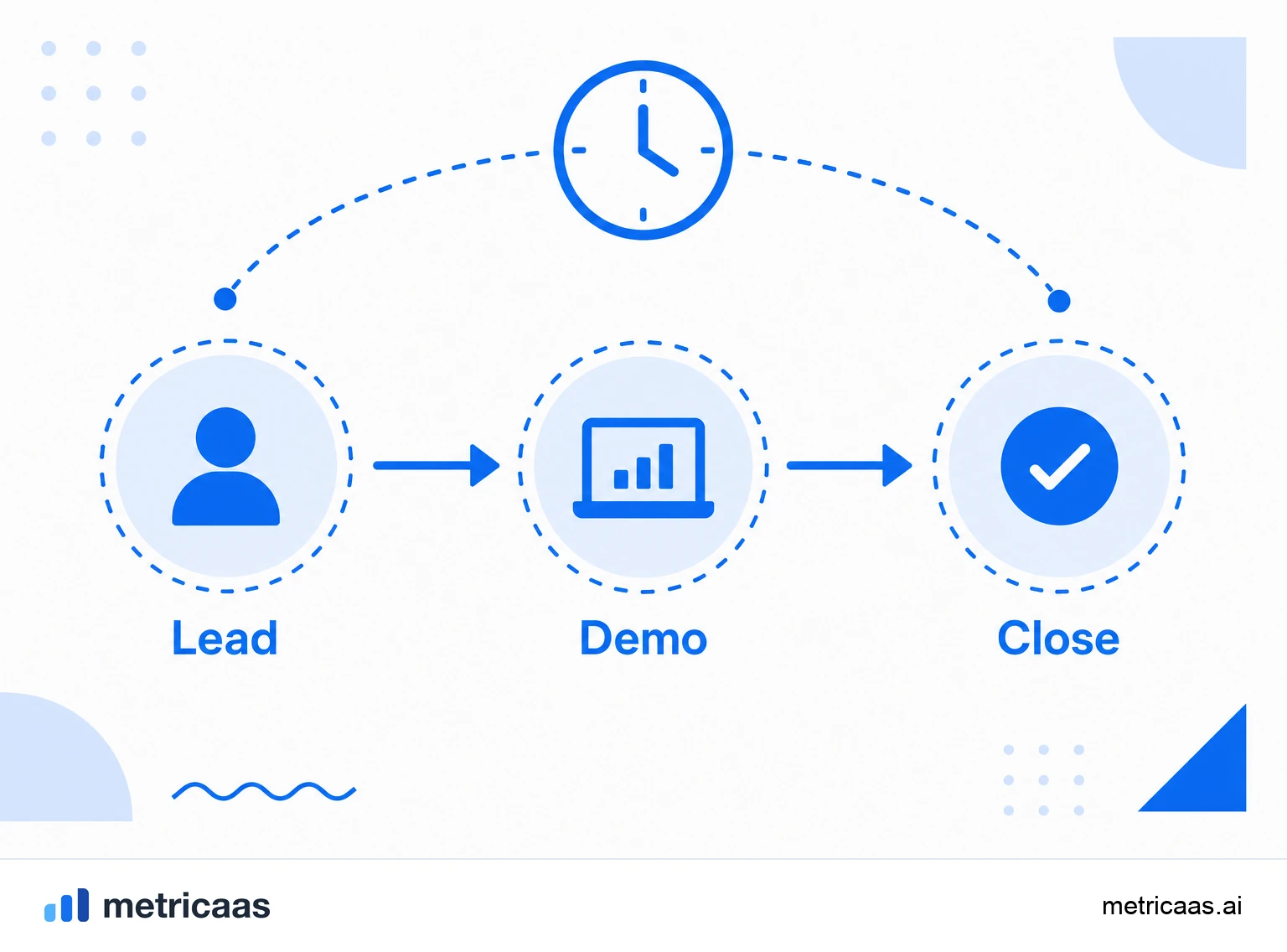
The sales cycle is the average time from first contact to closed deal, moving through qualification, demo, proposal and negotiation.
- Short cycles enable a low CAC and fast cash.
- Long cycles need a high deal size to compensate.
- Shortening the cycle improves sales efficiency.
What a sales cycle is
The sales cycle is the average time an opportunity takes from first contact to closed deal, moving through qualification, demo, proposal and negotiation. In SaaS, it describes how long the sales team needs to turn a lead into recurring revenue, which makes it one of the most revealing indicators of how a company sells.
There is no single right number in isolation: a self-serve product can close in days, while a sale to a large enterprise can take months. What matters is knowing your own cycle, measuring its length consistently and understanding what stretches or shortens it, because it connects sales effort directly to the cash that comes in.
The stages of the sales cycle
Although every company designs its own process, most B2B cycles run through similar stages, from the top down to the close:
- Prospecting and contact: identifying and reaching potential customers.
- Qualification: confirming budget, authority, need and timing, so no time is spent on those who will not buy.
- Demo: showing the product solving the prospect real problem.
- Proposal: presenting price, scope and terms.
- Negotiation and close: adjusting terms, removing objections and signing.
Each stage has its own conversion rate, and their combination defines the funnel win rate. Mapping where deals stall shows which stage stretches the cycle and where to intervene first.
How to measure sales cycle length
Cycle length is the average number of days between first contact and close, computed over the deals won in a period. The formula is straightforward:
- Average length = sum of the days of each closed deal / number of closed deals.
- Measure only over won deals, so you do not mix in opportunities that are still open.
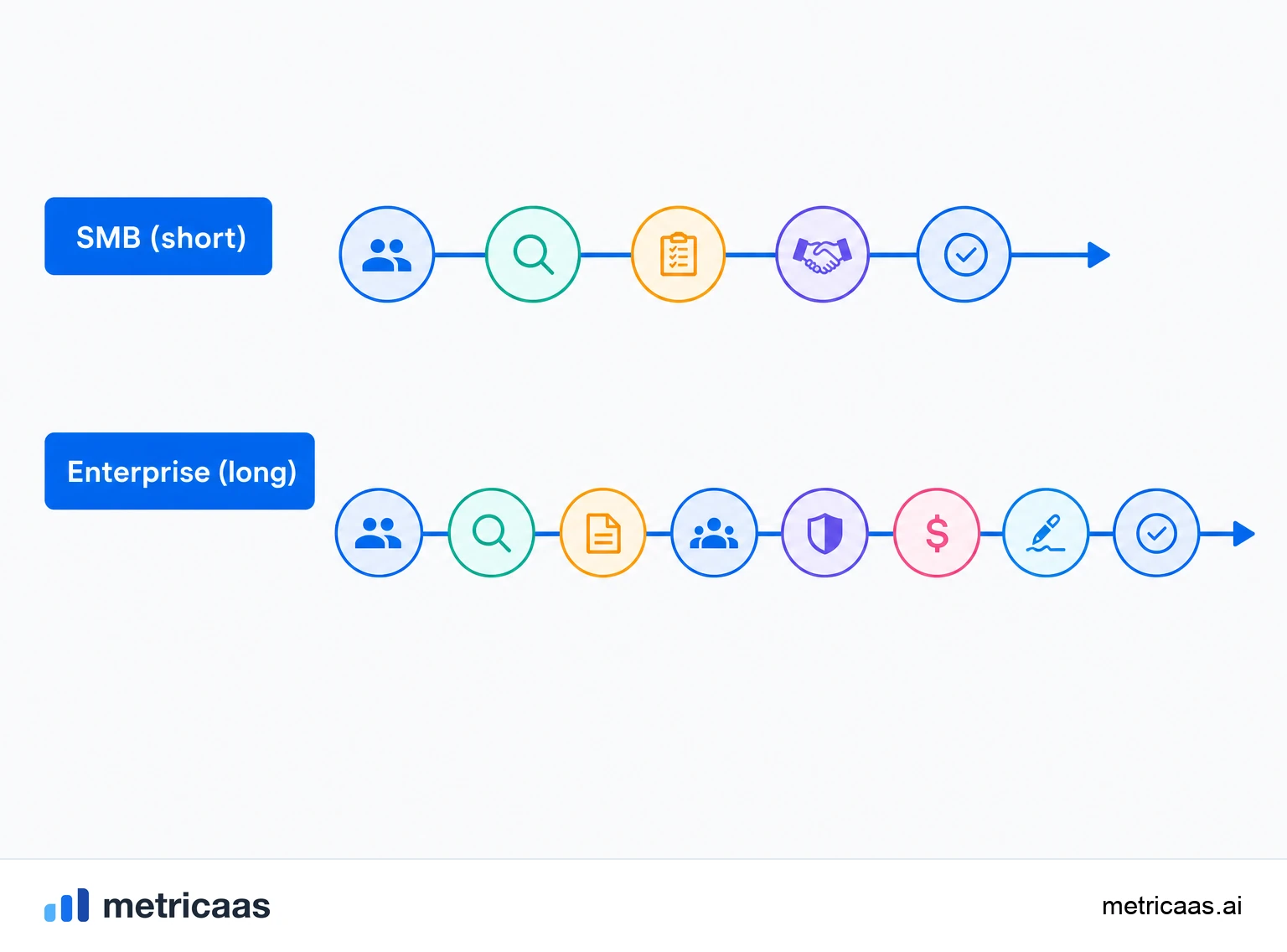
- Break it down by segment, channel and deal size, because the overall average hides huge differences between SMB and enterprise.
It also pays to track the median, which resists better than the average when a few very long deals distort it. Measuring by stage, that is, how much time each phase consumes, reveals the real bottleneck, not just the total.
Short cycle and long cycle: CAC, cash and ASP
Cycle length shapes the entire economics of the sale. Short cycles, typical of self-serve and SMB, enable a low CAC and fast cash: the customer pays early and the money invested in acquisition returns quickly. Long cycles, typical of enterprise, cost more in rep hours and pre-sales engineering, and are only justified when the average selling price is high enough to pay for that effort.
That is why cycle and deal size go together. A six-month cycle with a low ticket destroys unit economics; the same cycle with a solid annual contract can be excellent. The right question is never only whether the cycle is short, but whether its length is proportional to the value of each deal.
How to shorten the sales cycle
Shortening the cycle is one of the most efficient growth levers, because it accelerates cash without requiring more leads. Some proven tactics:
- Qualify better at the top: spending time only on prospects with fit and urgency reduces deals that drag on.
- Remove friction: focused demos, short proofs of concept and materials that answer objections before they stall the decision.
- Engage decision makers early: uncovering the buying committee early avoids surprises in the final stretch.
- Self-serve where it fits: letting part of the journey flow without a rep, in the spirit of a more product-led model.
Not every cycle should be shortened at any cost. In sales-led growth, a longer, consultative cycle can raise the deal size and retention. The goal is to remove useless delay, not to rush the buying decision.
Sales cycle and sales efficiency
The sales cycle is a multiplier of sales efficiency. The faster a rep closes, the more deals they run in a year and the sooner the CAC pays back. Shortening the cycle directly improves CAC payback, the number of months a company takes to recover the cost of winning a customer.
David Skok, in ForEntrepreneurs, detailed how the economics of a SaaS depend on this relationship between acquisition cost and speed of return. Market benchmarks, such as those compiled by Benchmarkit, confirm that cycle length varies widely with deal size, which reinforces the lesson: comparing your own cycle with companies of similar size and model is worth more than chasing a universal number.
Frequently asked questions
It is the average time an opportunity takes from first contact to closed deal, moving through qualification, demo, proposal and negotiation. It measures how long the sales team needs to turn a lead into recurring revenue.
In most B2B cycles they are prospecting and contact, qualification, demo, proposal and negotiation with close. Some companies group them into four broad phases, others into seven more detailed steps, but the logic is the same.
Sum the days between first contact and close for each won deal and divide by the number of closed deals in the period. Break it down by segment and deal size, because the overall average hides large differences.
One whose length is proportional to the value of each deal. Short cycles are great for low tickets; long cycles only pay off when the average selling price is high enough to cover the effort.
By qualifying better at the top, removing friction with focused demos and short proofs of concept, engaging decision makers early and allowing self-serve where it fits. The goal is to cut useless delay, not to rush the decision.
Not always. In consultative or high-ticket sales, a longer cycle can raise the contract value and retention. What hurts is not the length itself, but delay without proportional return.
Related concepts

Win rate
Win rate is the share of opportunities that turn into closed sales: deals won divided by the total deals closed (won plus lost) in a period. It measures commercial efficiency and the quality of the pipeline and qualification. A low win rate with high volume usually points to poorly qualified leads or weak fit, and raising the rate is one of the most direct ways to lower CAC.
Average selling price (ASP)
ASP (Average Selling Price) is the average value of the new contracts a company closes: total new-business revenue divided by the number of deals in a period. It reflects the segment the company serves (self-serve low, SMB mid, enterprise high) and determines how much CAC and how long a sales cycle the model can bear. A high ASP sustains a human sales motion; a low ASP demands self-serve.
CAC
CAC (Customer Acquisition Cost) is how much, on average, you spend to win a new customer. Add up everything invested in marketing and sales over a period and divide by the number of new customers who came in during that period. It is the metric that tells you whether your growth is economically healthy.