
Usage-based pricing: what it is and how consumption billing works
By Tiago Costa · Updated on July 9, 2026

Definition
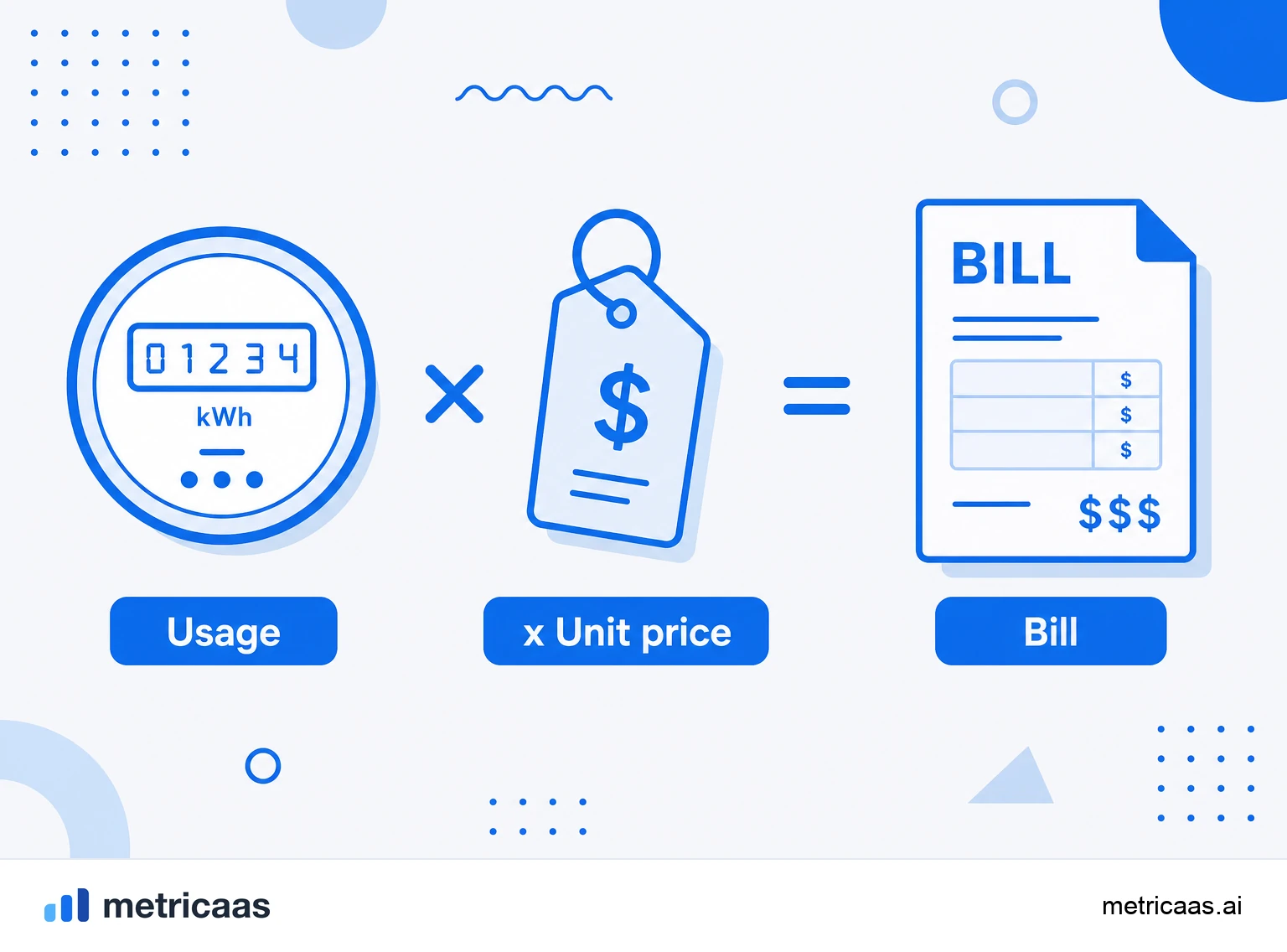
Usage-based pricing is the model where the bill grows with the customer consumption, measured by a usage metric.
- Billing follows usage: API calls, GB, events or active seats.
- Aligns cost with value and lowers the barrier to entry, but makes revenue less predictable.
- It can be pure (consumption only) or hybrid (base subscription plus overage).
What usage-based pricing is
Usage-based pricing is the model where the bill grows as the customer consumes the product. Instead of a fixed value per seat or per plan, billing follows a consumption metric: API calls, gigabytes stored, events processed, messages sent or seats that were actually active during the month.
The logic is direct: use little, pay little; use a lot, pay more. This brings price closer to the value actually delivered and lowers the barrier to entry, since the customer can start small without committing to a large contract. In return, revenue becomes less predictable, because it depends on the consumption behavior of each month.
The usage metric: why it is the heart of the model
In usage-based pricing, everything revolves around the chosen usage metric, also called the value metric. It is the unit the company measures and charges for, and it needs to grow together with the benefit the customer perceives.
- API calls or requests: common in infrastructure and developer tools.
- Data volume: gigabytes stored, processed or transferred.
- Events or transactions: messages, emails, payments or records processed.
- Active seats: users who actually used the product in the period, not just those registered.
The wrong metric misaligns price and value. If the unit charged does not reflect the customer gain, they feel they are paying for something they do not use, and the bill loses the logic that makes the model attractive.
Pure or hybrid: the two formats
Usage-based pricing comes in two formats. In the pure model, there is no fixed monthly fee: the customer pays strictly for what they consume, and a bill can go to zero in a month with no usage. It is the most aligned to value, but the most unpredictable for the business.
In the hybrid model, there is a base subscription that guarantees a revenue floor and an included consumption bundle, and usage above that limit becomes overage charged separately. That overage works much like an add-on: an additional charge added to the plan when the customer exceeds the allowance. The hybrid combines the predictability of the subscription with the natural growth of consumption, which is why it is the most adopted format.
Benefits and risks of usage-based pricing
The greatest appeal of usage-based pricing is the alignment between cost and value. The customer enters with low commitment, tests the product paying little, and scales spend as they reap results. This reduces the friction of the initial sale and tends to accelerate adoption.
- Benefits: low barrier to entry, price perceived as fair, and expansion that follows customer success.
- Risks: less predictable revenue, bills that vary and may surprise the customer, and harder cash planning.
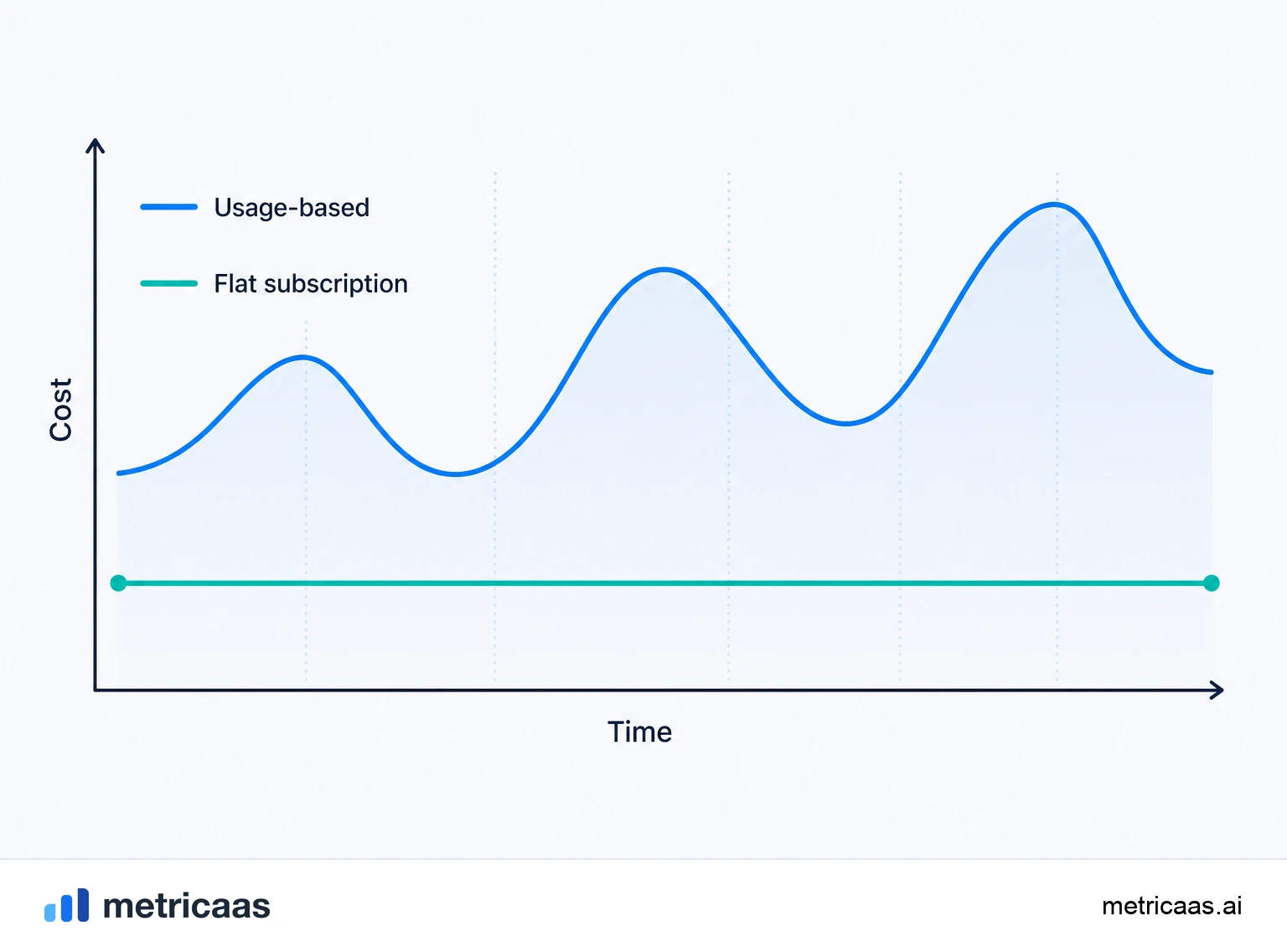
The lost predictability is the price to pay. While a fixed subscription delivers a stable number every month, usage-based pricing swings with consumption, which requires tracking usage trends closely to forecast revenue with confidence.
Impact on MRR and NRR
Under usage-based pricing, MRR stops being a fixed contracted value and becomes a reading of recurring consumption. Many companies normalize recent usage to estimate an equivalent MRR, but it naturally varies more than in a traditional subscription plan.
The upside shows up in revenue retention. When the customer grows and consumes more, the bill rises on its own, with no contract to renegotiate. This organic expansion tends to lift NRR, which is why the private SaaS survey by KeyBanc Capital Markets shows net revenue retention above 100% among the healthiest companies. OpenView, which popularized tracking the adoption of this model, points to usage-based pricing as one of the main drivers of net expansion in SaaS.
How to pick the right usage metric
Choosing the billing unit is the most important decision in the model. The ideal metric grows with the value delivered, is easy for the customer to understand and forecast, and is cheap to measure precisely. Billing for something the customer does not control or grasp creates friction and invoice disputes.
- It follows value: the more the customer gains, the more they consume.
- It is predictable: the customer can estimate the bill before receiving it.
- It is simple to measure and audit, with no ambiguity about what was charged.
Many businesses combine usage-based pricing with elements of value-based pricing to anchor price perception, and the cloud consumption that underpins this model keeps growing: Gartner forecasts that worldwide public cloud end-user spending will reach $723 billion in 2025.
Frequently asked questions
It is the model where the bill grows with the customer consumption, measured by a usage metric such as API calls, gigabytes or events. Use little, pay little; use a lot, pay more.
In the pure model, the customer pays only for what they consume, with no subscription. In the hybrid model, there is a base subscription with included consumption, and usage above that is charged as overage.
Yes. Because the bill varies with consumption month to month, revenue swings more than with a fixed subscription. The hybrid model reduces that risk by guaranteeing a floor with the base subscription.
A good metric grows with the value the customer perceives, is easy for them to forecast, and is simple to measure precisely. Billing for something the customer does not control creates friction.
It usually does. When the customer grows and consumes more, the bill rises on its own, with no renegotiation, generating organic expansion that lifts net revenue retention.
No. It works best when there is a consumption metric that follows the value delivered. Products with fixed value per user may do better with a subscription or a hybrid model.
Related concepts

Value-based pricing
Value-based pricing sets the price from the value perceived and delivered to the customer, not from production cost nor only from what competitors charge. It anchors price to each segment willingness to pay, which tends to capture more revenue. It depends on understanding value per persona and choosing a good value metric.

Expansion
Expansion (expansion revenue or expansion MRR) is the additional recurring revenue that comes from customers you already have, without relying on new sales. It comes from upsell (higher plan), cross-sell (more products), add-ons and usage growth. It is the force that pushes net revenue retention above 100% and makes the base grow on its own.

MRR
MRR (Monthly Recurring Revenue) is the monthly recurring revenue of a SaaS: the sum of all active subscriptions normalized to a month. It is the core metric of a subscription business because it shows, predictably, how much the company earns on a recurring basis each month, without counting one-off charges.