
Unit economics: what it is and how to know if each customer pays off
By Tiago Costa · Updated on July 9, 2026

Definition
Unit economics is the economics of one customer of a SaaS: how much margin they generate over the relationship versus what it cost to acquire and serve them.
What unit economics is
Unit economics looks at the business through the lens of a single unit. In SaaS, that unit is almost always a customer or an account. The question is direct: over the whole relationship, does that unit generate more value than it cost to acquire and serve?
If the answer is yes with room to spare, the business can grow while paying its own way, because each new customer adds margin. If it is no, the opposite happens: every sale deepens the loss, and scaling only speeds up the cash burn. That is why unit economics is the math that separates healthy growth from growth that survives only as long as there is investor money to burn.
LTV vs CAC: the central ratio
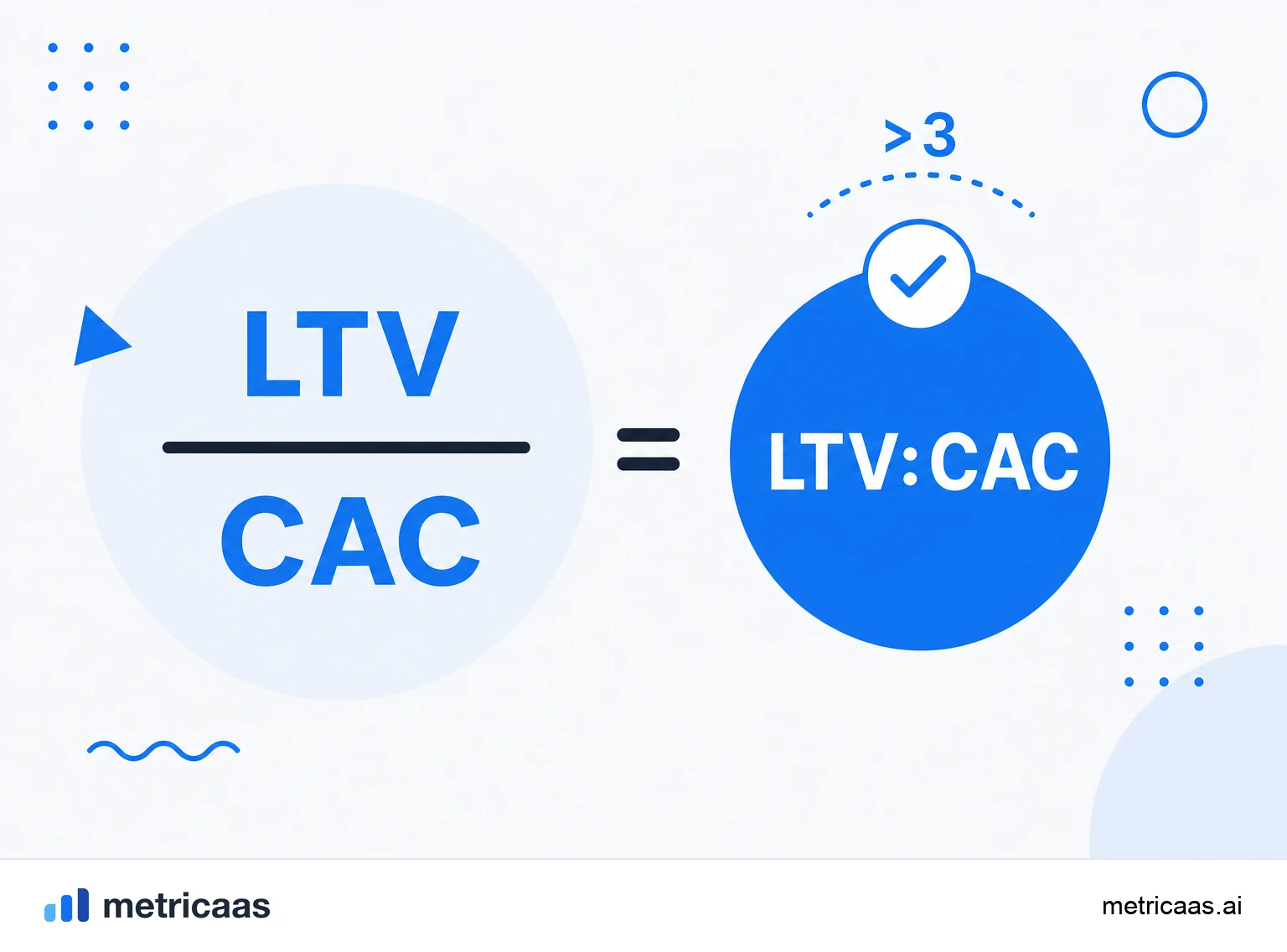
The heart of unit economics is the pair formed by LTV, the value a customer generates over the relationship, and CAC, the cost to acquire that customer. The ratio between them, LTV:CAC, sums up in one number whether acquisition is worth it.
- Below 1: you lose money on every customer. Growing makes it worse.
- Around 3: the classic benchmark of a healthy business, recovering the cost with room for profit and reinvestment.
- Well above 5: it can signal that you are underinvesting in growth and leaving market on the table.
The 3 to 1 rule was popularized by David Skok, who describes it as the balance point between profitability and growth speed, per ForEntrepreneurs. It is not a law of physics, it is a heuristic: it tells you whether the acquisition engine is calibrated.
CAC payback: how long to recover
The LTV:CAC ratio does not capture time, and time is cash. A customer can have an excellent LTV:CAC and still take too long to return what they cost. That is why unit economics needs CAC payback, which measures how many months the margin from a customer takes to repay the acquisition cost.
The practical benchmark is recovering CAC in under 12 months, with a 12 to 18 month band still tolerable for more complex sales. Market benchmarks such as Benchmarkit compile these numbers by segment and show medians that in recent years tend to stretch beyond a year, which helps calibrate expectations rather than chase an unrealistic ideal, per the Benchmarkit report. A long payback drains cash even when the ratio looks great, because the company funds acquisition today and only reaps the return much later.
Gross margin ties it together
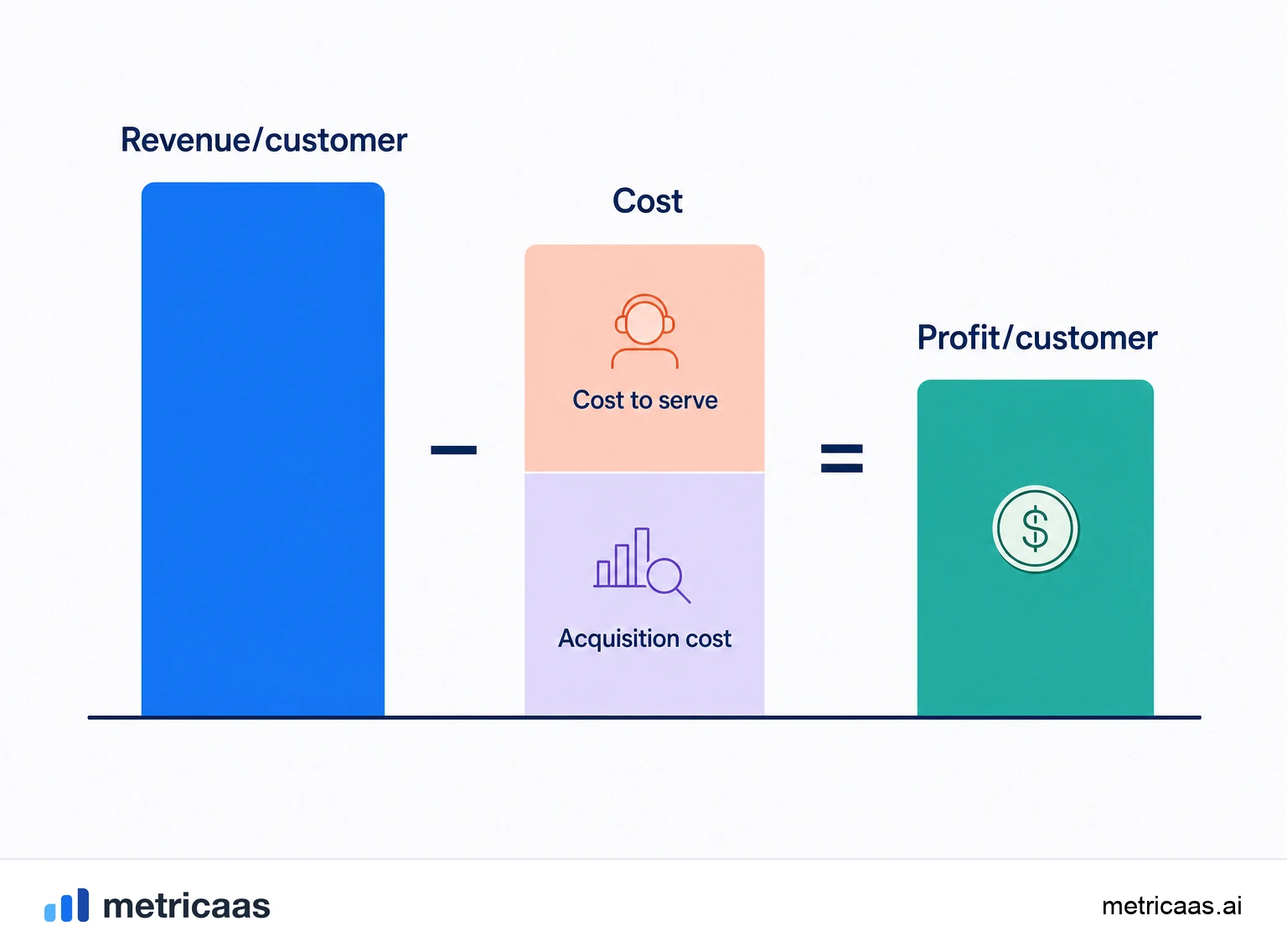
The most common mistake in unit economics is building LTV on revenue instead of margin. What actually remains to repay CAC and turn into profit is revenue after subtracting the cost to serve the customer, that is, gross margin. It is what turns billings into real economics.
The effect is large. A dollar of revenue at 80% margin returns CAC far faster than a dollar at 40%, even at the same list price. That is why two SaaS with the same MRR and the same CAC can have opposite unit economics: the one with high gross margin scales comfortably, while the one with thin margin needs far more volume to reach the same result. Gross margin is the multiplier that connects revenue to the health of each customer.
How to calculate it, with an example
It helps to run the math with round numbers. Suppose a customer paying $200 per month, with 80% gross margin and 2% monthly churn, which gives an average lifetime of 50 months (1 divided by 0.02).
- LTV = $200 x 0.80 x 50 = $8,000 of margin over the relationship.
- CAC = $2,000 to acquire that customer.
- LTV:CAC = 8,000 divided by 2,000 = 4 to 1, above the rule of 3.
- CAC payback = 2,000 divided by (200 x 0.80) = 12.5 months.
This customer has healthy unit economics: they recover the cost in just over a year and generate four times what they cost. Rerun the math with margin at 40% and the payback doubles, showing in practice how margin drives the result.
Why healthy unit economics is the base to scale
When each customer pays for themselves with margin and within a reasonable window, spending on acquisition stops being a leak and becomes an investment: every dollar put into marketing and sales comes back multiplied. This is the mechanism that lets a company grow without depending on endless funding rounds, because the product itself finances part of the expansion.
It is also why investors examine unit economics before backing growth. Trajectory frameworks such as T2D3, sometimes called the 3-3-2-2-2 rule, describe an aggressive growth pace, but they are only sustainable on a foundation of solid LTV:CAC and short payback. Without that, accelerating just brings the cash shortfall forward. Healthy unit economics does not guarantee success, but it is the precondition for scaling to build value instead of destroying it.
Frequently asked questions
It is the economics of a single customer or account: how much margin they generate over the relationship versus what it cost to acquire and serve them. It boils down to the LTV:CAC ratio and CAC payback.
The classic benchmark is 3 to 1: the customer generates at least three times what they cost. Below 1 you lose money on every sale; well above 5 can mean you are underinvesting in growth.
A customer at $200 per month, 80% margin and a 50-month lifetime yields an LTV of $8,000. With CAC of $2,000, the ratio is 4 to 1 and payback is 12.5 months. Healthy unit economics.
It is another name for T2D3: triple revenue for two years, then double for three years. It is a growth-pace framework, not unit economics, but it only holds up on solid LTV:CAC and short payback.
It is the proof that the model pays for itself per customer before scaling. Investors use unit economics to separate growth that builds value from growth that only burns cash.
Because LTV should be calculated on margin, not revenue. High margin returns CAC faster and lets you scale comfortably; thin margin demands far more volume for the same result.
Related concepts

LTV / CLV
LTV (Lifetime Value), also called CLV or CLTV, is the total value a customer generates while they stay in your base. In a simple form, it is the recurring average revenue times margin times the customer lifetime. It is the metric that shows how much it is worth investing to win and keep each customer.

CAC
CAC (Customer Acquisition Cost) is how much, on average, you spend to win a new customer. Add up everything invested in marketing and sales over a period and divide by the number of new customers who came in during that period. It is the metric that tells you whether your growth is economically healthy.

Gross margin
Gross margin is the share of revenue left after the direct cost of delivering the service: (revenue minus COGS) divided by revenue, as a percentage. Pure SaaS usually runs between 70% and 85% or more, and that headroom is what sustains the model, feeds LTV and funds reinvestment in growth.