
Rule of 40: what the SaaS rule of 40 is and how to calculate it
By Tiago Costa · Updated on July 9, 2026

Definition
The Rule of 40 says that the revenue growth rate of a SaaS plus its profit margin should add up to 40% or more.
- Balances growth and profitability in a single number.
- Above 40 signals a healthy business; below it, a warning.
- The margin is usually free cash flow or EBITDA.
What the Rule of 40 is
The Rule of 40 is a rule of thumb that gauges the health of a SaaS by adding two numbers: the revenue growth rate and the profit margin. If the sum is 40% or higher, the company is considered healthy; if it is lower, it is a warning sign.
The idea behind it is simple: growth and profit tend to pull in opposite directions, and looking at only one of them misleads. A company can grow fast while burning cash, or be very profitable without growing. The Rule of 40 forces you to read them together, showing whether growth is being bought at a healthy cost. The concept was popularized by investor Brad Feld in 2015 and adopted by firms like Bessemer Venture Partners as a shortcut for sizing up software businesses.
How to calculate the Rule of 40
The math is a straight sum:
- Rule of 40 = revenue growth rate (%) + profit margin (%).
- The growth rate is usually the year-over-year change in revenue, often measured on ARR.
- The profit margin is usually the free cash flow (FCF) or EBITDA margin, not net accounting profit.
Example: a SaaS growing 30% a year with a 15% FCF margin adds up to 45, above the line. Another growing 50% but burning cash at a -20% margin adds up to 30, below 40. Both grow, but only the first passes the test.
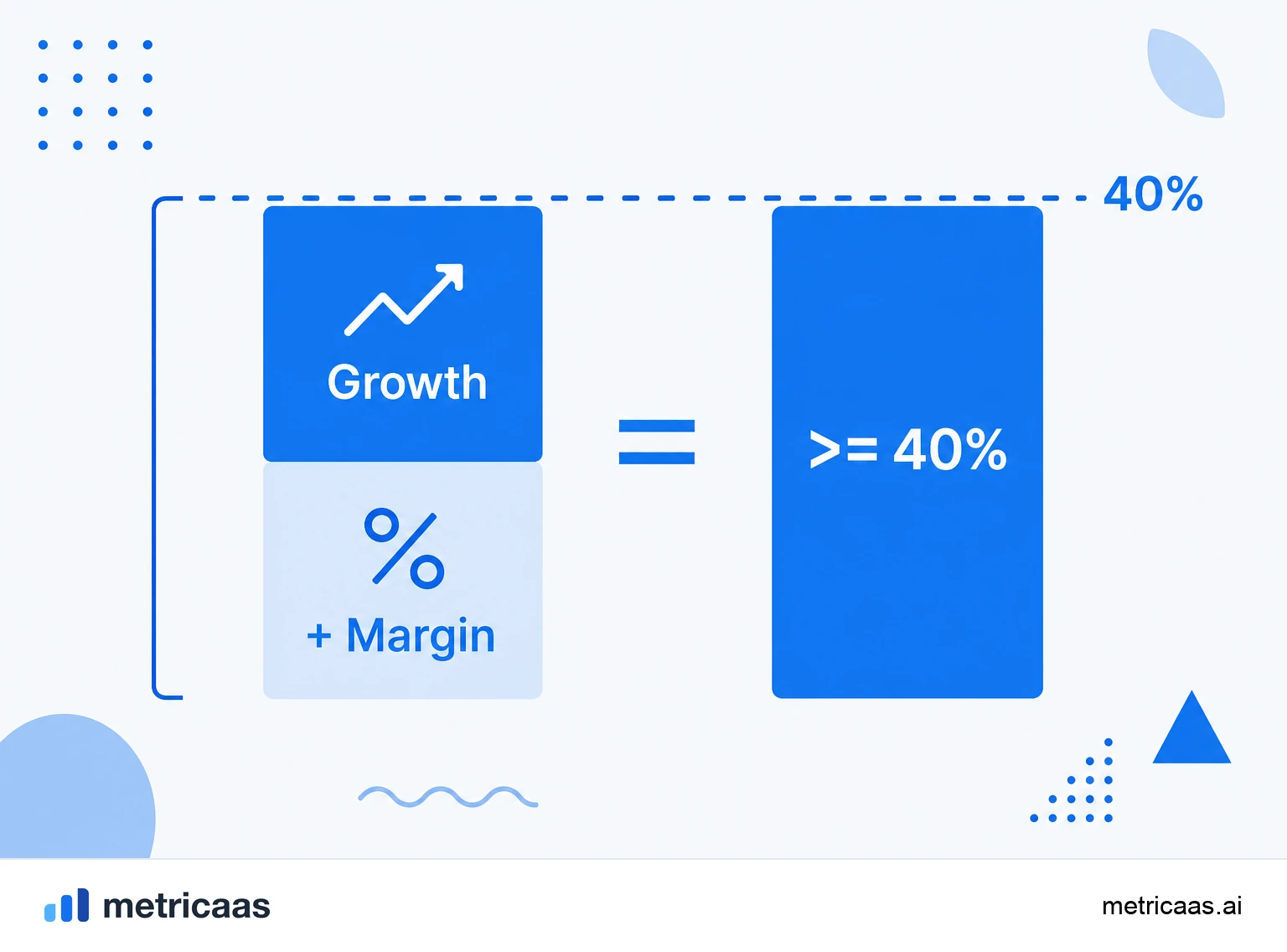
Growth and profit: the two sides of the equation
The power of the rule is that it treats growth and profitability as weights on the same scale. Young companies tend to lean toward growth, accepting low or negative margins to win market share. Mature companies lean toward profit, with more modest growth. The Rule of 40 accepts both strategies, as long as the sum lands at 40.
That does not mean any combination is equal. Growing 40% at a zero margin is very different from growing 10% at a 30% margin, even if both add to 40 or 50. Fast growth is only sustainable if the cost of acquiring customers makes sense: if CAC spikes, the margin collapses and the growth stops paying off. The rule is a starting point, not the final answer.
Which profit margin to use
There is no single definition of margin, and that is the biggest source of confusion. The three most common are:
- Free cash flow (FCF) margin: the favorite of investors, because it shows the cash that is actually left over.
- EBITDA margin: useful for comparing operations before interest, taxes and depreciation.
- Operating margin: closer to accounting, but sensitive to non-cash items.
The choice changes the result, so what matters is being consistent and making clear which margin is in the math. The private SaaS survey by KeyBanc Capital Markets tracks growth and FCF margin side by side, exactly the two ingredients of the rule, and has become one of the benchmark references of the sector.
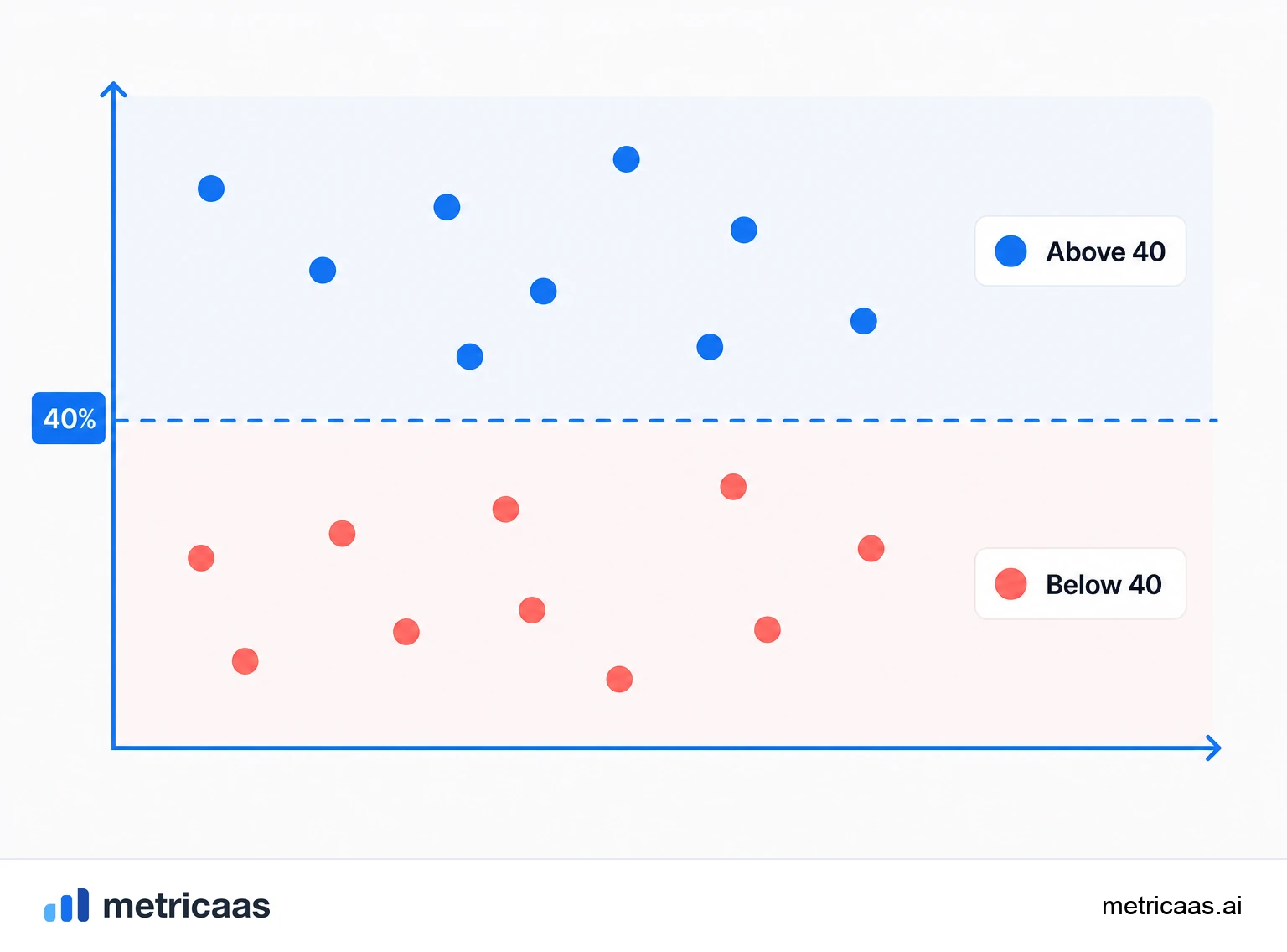
Is the Rule of 40 still relevant?
The rule was born in a moment of abundant money, when growth at any cost was rewarded. With higher interest rates and a focus on efficiency, many asked whether it still makes sense. The short answer: yes, and perhaps more than before.
What changed is the relative weight of the two sides. When capital was cheap, growth carried the sum; today, profitability weighs more heavily on the minds of investors. A total of 40 is still a good yardstick, but more people now look at the quality of that sum, not just the total. Public companies that combine solid growth with strong margins, clearing 40 with room to spare, remain the most highly valued.
Limits and traps of the Rule of 40
The Rule of 40 is a shortcut, and like any shortcut it has limits. It does not replace a unit-economics analysis, says nothing about retention and can be distorted by accounting choices. A few cautions:
- It works best at scale. A very small SaaS grows 200% easily and passes the test without that proving anything solid.
- Swapping the margin used (FCF, EBITDA, operating) changes the result and lets you dress up the number.
- It ignores the durability of growth. Growth sustained by retention is worth more than a one-off spike, and research from SaaS Capital shows that net retention is what makes growth durable.
Used with these cautions, the rule is an excellent thermometer. Used alone, it misleads. Best to read it alongside retention, acquisition efficiency and margin metrics, never in place of them.
Frequently asked questions
It is a rule that adds the revenue growth rate of a SaaS to its profit margin; the result should be 40% or higher. Above 40 signals a healthy business, below it a warning.
By adding the revenue growth rate to the profit margin. A SaaS growing 30% with a 15% FCF margin adds up to 45, above the 40 line.
Usually the free cash flow (FCF) or EBITDA margin. What matters is picking one and staying consistent, because each margin changes the result.
Yes. With a stronger focus on efficiency, the profitability side weighs more, but a sum of 40 is still a useful benchmark for balancing growth and profit.
It is a different benchmark, about growth pace: revenue triples for two years in a row and then doubles for three. It measures growth speed, while the Rule of 40 balances growth and profit.
It was born in SaaS and fits best there, thanks to recurring, predictable revenue. The logic of balancing growth and margin can inspire other businesses, but the benchmark levels change.
Related concepts

ARR
ARR (Annual Recurring Revenue) is the annual recurring revenue of a SaaS: MRR multiplied by 12. It represents how much the company earns on a recurring basis over a year, counting only active subscriptions, with no one-off charges. It is the metric of choice for companies selling annual contracts and the standard language of investors.

CAC
CAC (Customer Acquisition Cost) is how much, on average, you spend to win a new customer. Add up everything invested in marketing and sales over a period and divide by the number of new customers who came in during that period. It is the metric that tells you whether your growth is economically healthy.

MRR
MRR (Monthly Recurring Revenue) is the monthly recurring revenue of a SaaS: the sum of all active subscriptions normalized to a month. It is the core metric of a subscription business because it shows, predictably, how much the company earns on a recurring basis each month, without counting one-off charges.