
ROAS: what return on ad spend is and how to calculate it
By Tiago Costa · Updated on July 9, 2026

Definition
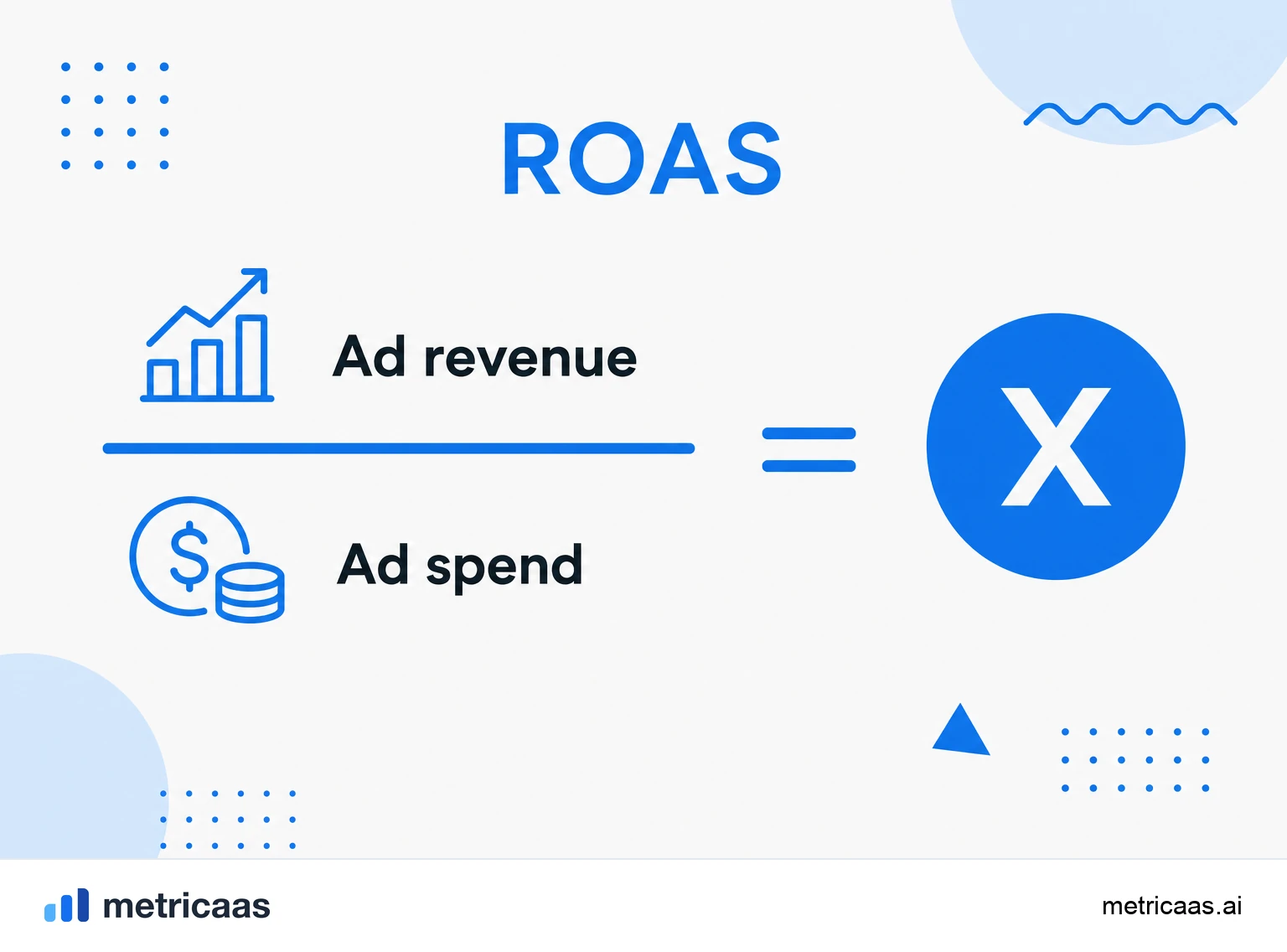
ROAS (Return on Ad Spend) is the return on ads: the revenue a campaign generates divided by the amount spent on it.
- A ROAS of 4 means $4 of revenue per $1 of ad.
- It measures revenue, not profit, and ignores margin.
- It is the inverse logic of CAC: it looks at the media, not the total cost.
What ROAS is
ROAS (Return on Ad Spend) measures how much revenue each dollar spent on paid media brought back. It is a simple ratio: the revenue attributed to a campaign divided by the amount invested in it. A ROAS of 4 means each $1 of ad generated $4 of revenue.
It usually shows up as a number (4), a multiple (4x) or a percentage (400%), and all three say the same thing. It is the metric of choice for people running campaigns day to day because it answers the question a media manager asks most: does this ad pay for itself? But revenue is not profit, and in a SaaS the honest answer takes more care than the number suggests.
How to calculate ROAS
The formula is direct: take the revenue a campaign generated and divide it by the cost of that same campaign.
- ROAS = campaign revenue / ad spend.
- Revenue: only what came from that campaign or channel, in the same period and the same attribution window.
- Spend: the media cost paid to the platform, without agency fees or salaries, which belong in the total cost of acquisition.
Example: a campaign cost $10k and brought in $40k in sales. ROAS is 4, or 400%. The sensitive point is the revenue: do you count the first charge, the whole contract or the customer lifetime value? In SaaS, that choice changes the number completely, and it is where the biggest ROAS trap lives.
ROAS, ROI and CAC: what changes
All three measure acquisition efficiency, but they are not interchangeable, and mixing them up leads to wrong calls.
- ROAS: revenue over media spend. It looks only at the ad and ignores costs and margin.
- ROI: profit over investment. It subtracts costs and shows the real return, not gross revenue.
- CAC: the total cost to win a customer, summing media, sales salaries and tools.
In practice, ROAS is the most optimistic of the three because it sees revenue, not profit: a campaign can have a high ROAS and a negative return if the margin is low. That is why ROAS is usually just the first filter, while CAC asks what it actually cost to win each customer once everything is added up. One helps you react fast; the other tells you whether the growth engine closes the books.
Why gross ROAS overstates returns in SaaS
In a subscription business, a customer revenue does not arrive all at once: it drips in month after month. That breaks gross ROAS in two opposite ways. If you measure ROAS on the first charge alone, it looks tiny, because it ignores almost all the recurring revenue still to come. If you count projected lifetime value as if it were revenue already realized, it looks huge, but that is money that may never land if the customer cancels first.
The way out is to be explicit about which revenue enters the calculation and to read ROAS alongside LTV / CLV, the value a customer generates over the whole relationship. A first-charge ROAS is fine for quick findings; to decide real budget, what matters is how long the media takes to pay for itself with the recurring revenue it brings. Rebuilding attributed revenue from real subscriptions, rather than from an optimistic projection, is what stops ROAS from lying.
Break-even ROAS: margin decides
Not every ROAS above 1 turns a profit. The break-even point depends on your margin, and break-even ROAS is the inverse of gross margin: 1 divided by the margin.
- 50% margin: break-even at ROAS 2 (you need $2 of revenue per $1 of ad just to break even).
- 80% margin, typical of SaaS: break-even at ROAS 1.25.
- The higher the margin, the lower the ROAS that already turns a profit.
This is why the yardstick for a "good ROAS" varies so much across sectors. A thin-margin retailer may need a ROAS of 4 or 5 to breathe, while a high-margin SaaS already profits at a much lower ROAS. Setting a ROAS target without starting from your margin is shooting in the dark.
How to compare channels with ROAS
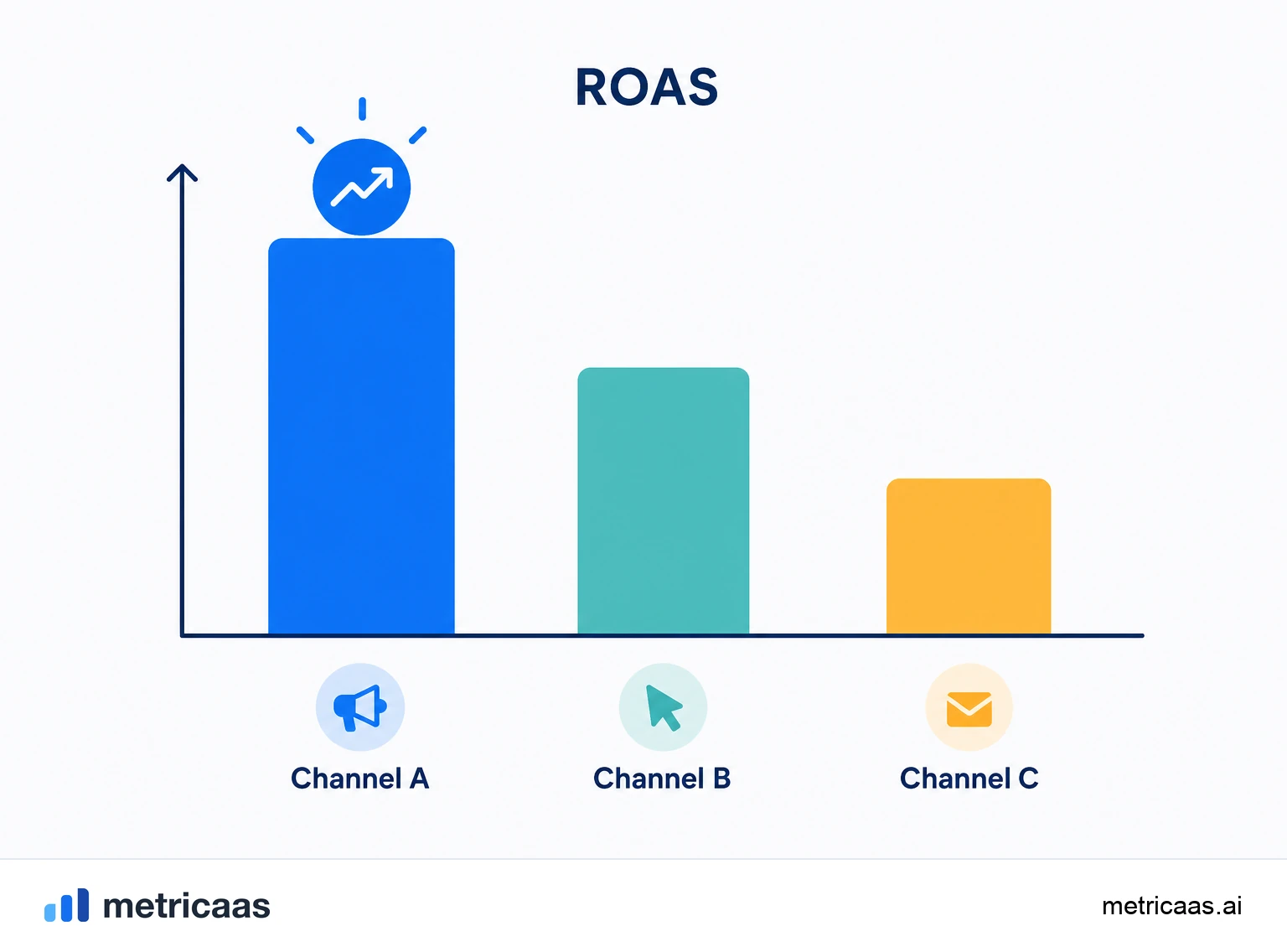
ROAS shines when comparing channels and campaigns, as long as the base is the same. To compare fairly, use the same revenue definition, the same attribution window and the same treatment of refunds across every channel. Mixing a channel measured by first charge with one measured by projected lifetime value produces a meaningless ranking.
- Compare each channel ROAS against its own break-even, not against a single absolute number.
- Watch the volume too: a channel with a sky-high ROAS and little scale can be worth less than one with a middling ROAS and heavy volume.
- Move up the funnel: Cost per lead (CPL) helps explain why a channel ROAS dropped before the sale even happened.
Public benchmarks help calibrate expectations, but every model has its own physics of margin and sales cycle. The annual SaaS benchmarks from Benchmarkit reinforce that acquisition efficiency is one of the biggest separators between median companies and top performers. The best comparison, in the end, is your own ROAS tracked over time.
Frequently asked questions
There is no magic number: it depends on your margin. A good ROAS sits above your break-even, which is 1 divided by gross margin. At 80% margin the break-even is 1.25; at 50% it is 2. High-margin SaaS profits at a lower ROAS than retail.
ROAS means Return on Ad Spend, the return on money invested in ads. It is the revenue a campaign generates divided by the amount spent on it.
Divide the revenue attributed to the campaign by the ad spend. If the campaign cost $10k and generated $40k, ROAS is 4, or 400%.
ROAS looks at revenue over media spend; ROI looks at profit over total investment. A campaign can have a high ROAS and a negative ROI if the margin is low.
It depends on your margin. Break-even ROAS is 1 divided by gross margin, so at 80% margin (common in SaaS) break-even is 1.25 and a 2.5 ROAS is comfortably profitable; at 40% margin, break-even is 2.5 and you would only break even.
Usually, but not in isolation. A very high ROAS with little volume can earn less than a middling ROAS at scale, and gross ROAS overstates returns in SaaS, where revenue arrives over months.
Related concepts

CAC
CAC (Customer Acquisition Cost) is how much, on average, you spend to win a new customer. Add up everything invested in marketing and sales over a period and divide by the number of new customers who came in during that period. It is the metric that tells you whether your growth is economically healthy.

LTV / CLV
LTV (Lifetime Value), also called CLV or CLTV, is the total value a customer generates while they stay in your base. In a simple form, it is the recurring average revenue times margin times the customer lifetime. It is the metric that shows how much it is worth investing to win and keep each customer.

Cost per lead (CPL)
Cost per lead (CPL) is the marketing spend of a period divided by the number of leads generated in that period. It measures how much it costs, on average, to attract an interested contact, and it sits before CAC in the acquisition funnel. It is mainly used to compare channels, as long as you also look at the quality and conversion of the leads, not just the price.