
Cost per lead (CPL): what it is, how to calculate it and how to use it
By Tiago Costa · Updated on July 9, 2026

Definition
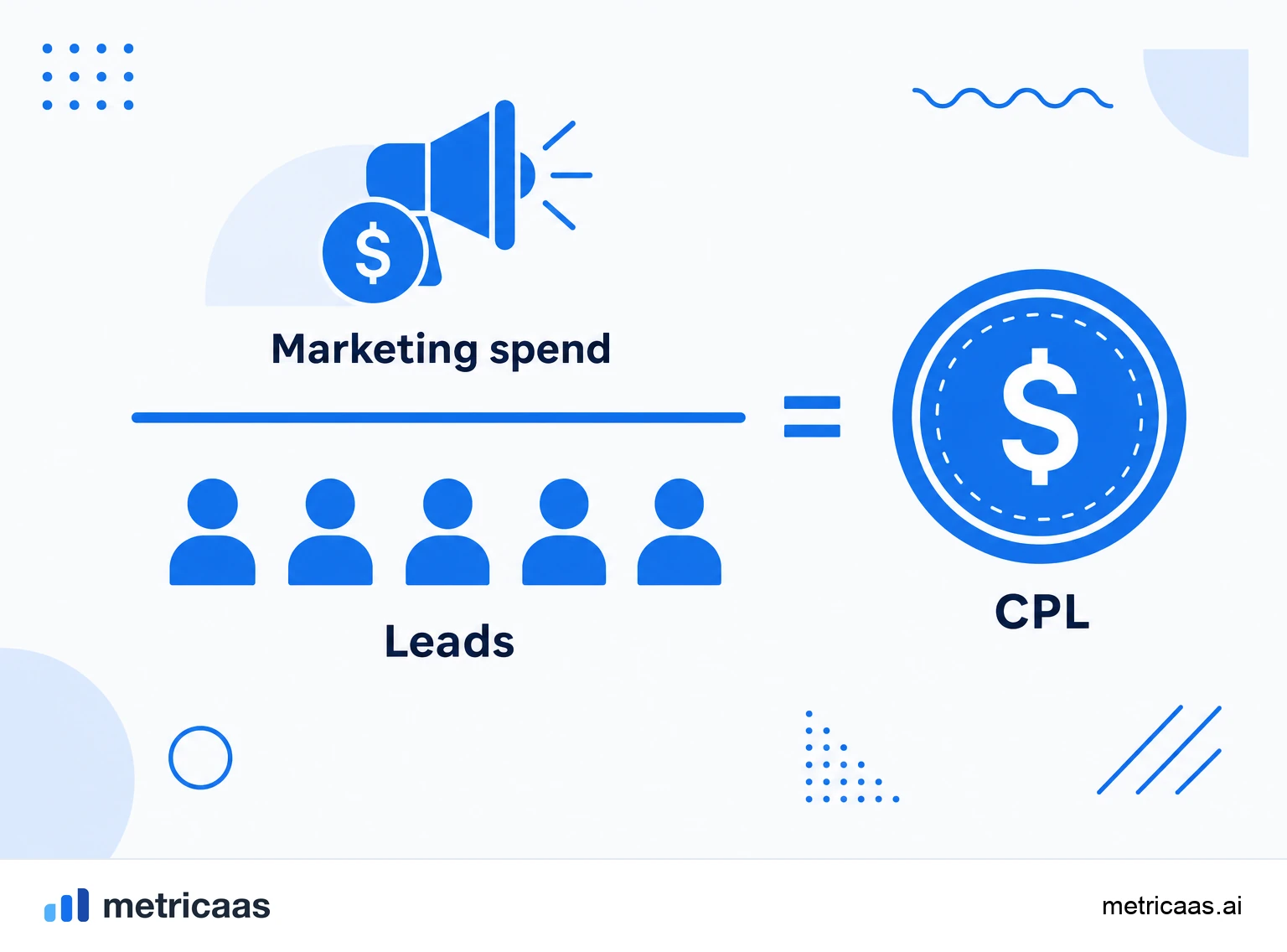
Cost per lead (CPL) is marketing spend divided by the number of leads generated in the period.
- Formula: marketing spend divided by leads generated.
- It sits before CAC in the acquisition funnel.
- Useful for comparing channels, but a low CPL does not help if the lead never converts.
What cost per lead (CPL) is
Cost per lead (CPL) measures how much it costs, on average, to generate a lead from marketing spend. A lead is a contact who showed interest: left an email, downloaded a resource, requested a demo or filled in a form. CPL divides everything spent to attract those contacts by the number of contacts obtained.
It is a top-of-funnel metric. The lead is not yet an opportunity or a customer, just someone who raised a hand. So CPL answers a specific and limited question: how much each raised hand costs. It does not tell you whether that contact will close, and that is exactly where many people go wrong.
How to calculate CPL
The formula is direct: divide the marketing spend of the period by the number of leads generated in the same period.
- CPL = marketing spend / leads generated.
- Example: a $10,000 campaign that brought in 200 leads has a CPL of $50.
- Define the numerator well: paid media only, or also tools, agency and team hours? The more complete the spend, the more honest the number.
The denominator also needs a rule. If you count every form visit as a lead, CPL plummets, but it becomes an illusion. Standardize what a valid lead is (real data, within the target audience) and always use the same yardstick, or comparisons across months and channels lose their meaning.
CPL and lead quality: MQL vs. raw lead
A low CPL is worthless if the leads do not move forward. You can buy very cheap contacts that never respond, and a $5 CPL with zero conversion is worse than an $80 CPL that closes deals. That is why it pays to separate the cost per raw lead from the cost per qualified lead.
- Raw lead: any contact who came in. Cheap to generate, but of unknown quality.
- Qualified lead: a contact who passed a filter and fits the buyer profile, which usually becomes an MQL / SQL.
Calculating the cost per MQL, rather than per raw lead, brings CPL closer to commercial reality. A channel with a high raw-lead CPL may have the lowest cost per qualified lead, because almost everyone who comes in through it has the right profile.
From CPL to CAC: the acquisition funnel
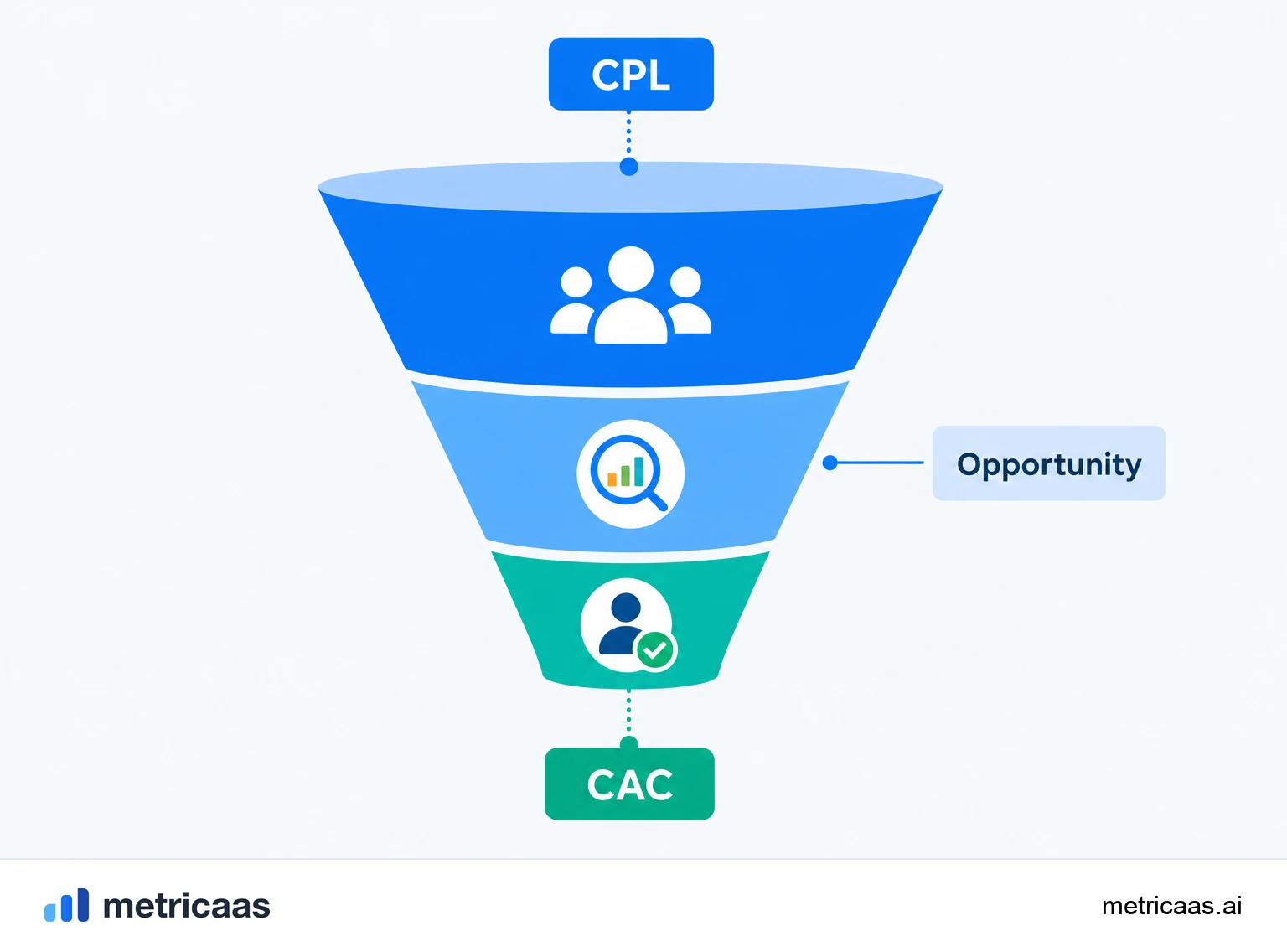
CPL lives at the start of a chain. The typical path is lead, opportunity and customer, and each step has a conversion rate that shrinks the number of contacts left. CAC closes that chain: it takes all the acquisition spend and divides it by the customers actually won.
In practice, CPL propagates down the funnel. If every 100 leads become 20 opportunities and 4 customers, the cost per customer carries the cost of all the leads that did not close. Roughly, CAC tends toward CPL divided by the lead-to-customer conversion rate, plus sales costs. Improving CPL helps, but improving conversion between stages usually moves CAC more than making the lead cheaper.
Per-channel CPL vs. blended CPL
There is blended CPL, which lumps all spend and all leads into a single number, and per-channel CPL, which isolates each source: paid search, social, referral, events, organic content. Blended is good for a general read, but it hides brutal differences between sources.
- A cheap, high-volume channel can mask an expensive, poor one inside blended CPL.
- Per-channel CPL shows where to scale and where to cut.
- Compare channels not only by cost, but by return: ROAS shows how much each dollar of media gives back in revenue.
The smart decision crosses both: channels with similar CPL can have very different conversion and deal sizes, so the cheapest at the top is not always the most profitable at the end.
Benchmarks: why they vary so much
There is no universal CPL. It shifts with the channel, the industry, the maturity of the brand and, above all, the deal size. An enterprise lead, with high-ticket contracts, can cost hundreds or thousands and still be profitable; a self-serve, low-ticket product needs cheap leads to make the math work.
So comparing your CPL against a generic average misleads more than it helps. Acquisition benchmarks, such as those published by Benchmarkit, show that go-to-market efficiency and the cost of winning customers vary widely by segment and by average contract value. CPL only makes sense when anchored to your own deal size, your conversion and what a customer is worth over time.
Frequently asked questions
It is how much it costs, on average, to generate a lead from marketing. It divides the marketing spend of a period by the number of leads generated in that period.
CPL = marketing spend / leads generated. Example: a $10,000 campaign that brought in 200 leads gives a CPL of $50.
There is no single figure. CPL varies widely by channel, industry and deal size: enterprise leads cost more and still pay off, while low-ticket products need cheap leads.
CPL measures the cost of generating a lead, at the top of the funnel. CAC measures the cost of winning a customer, at the end of the funnel, and carries the cost of every lead that did not close.
It depends on the rule. Cost per raw lead counts every contact; cost per qualified lead (MQL) counts only those who fit the buyer profile and better reflects commercial value.
CPL stands for cost per lead. It is an acquisition-efficiency metric used to compare channels and campaigns.
Related concepts

CAC
CAC (Customer Acquisition Cost) is how much, on average, you spend to win a new customer. Add up everything invested in marketing and sales over a period and divide by the number of new customers who came in during that period. It is the metric that tells you whether your growth is economically healthy.

ROAS
ROAS (Return on Ad Spend) is the return on money invested in ads: the revenue a campaign generates divided by the amount spent on it. A ROAS of 4 means $4 of revenue for every $1 of ad. Unlike CAC, which sums the full cost of acquisition, and ROI, which looks at profit rather than revenue, ROAS measures only the efficiency of paid media.
MQL / SQL
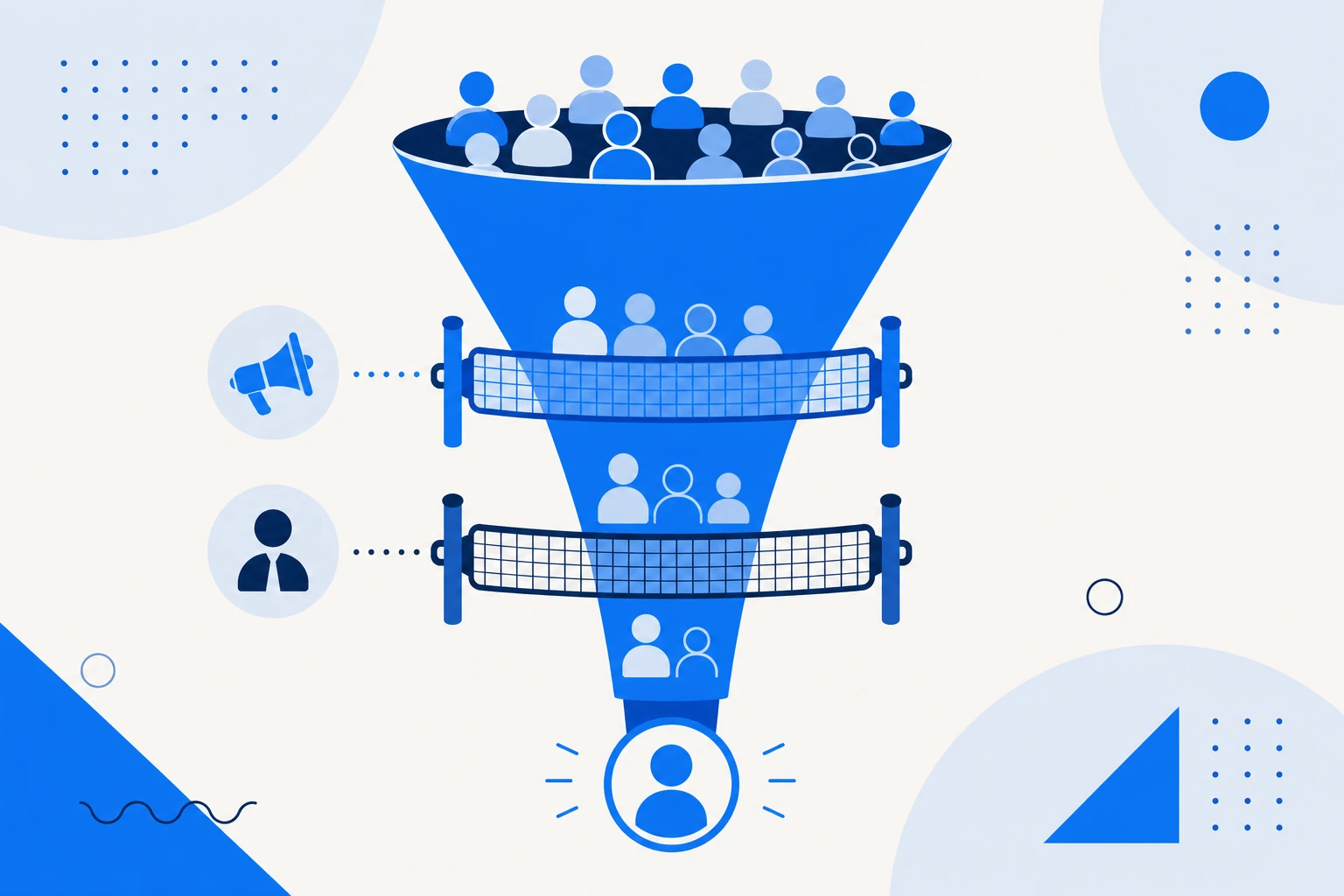
MQL (Marketing Qualified Lead) is the lead that marketing has qualified as interested enough to pass to sales; SQL (Sales Qualified Lead) is the lead that sales has validated as a real opportunity. They are successive stages of qualification in the funnel (Lead, MQL, SQL, Opportunity), and the MQL to SQL conversion rate measures alignment between the two teams.