
Network effects: what they are, the types, and why they build a moat
By Tiago Costa · Updated on July 9, 2026
Definition
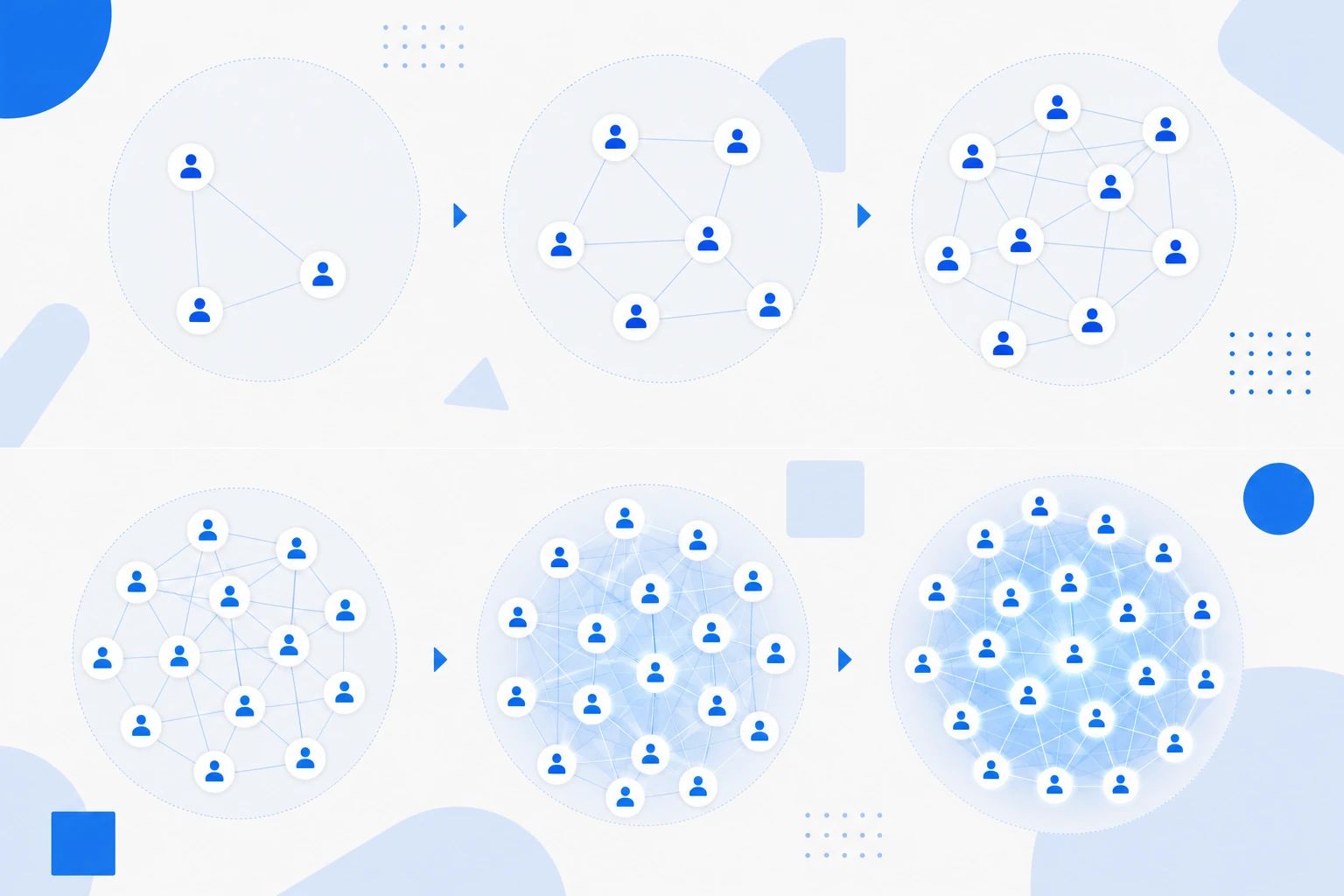
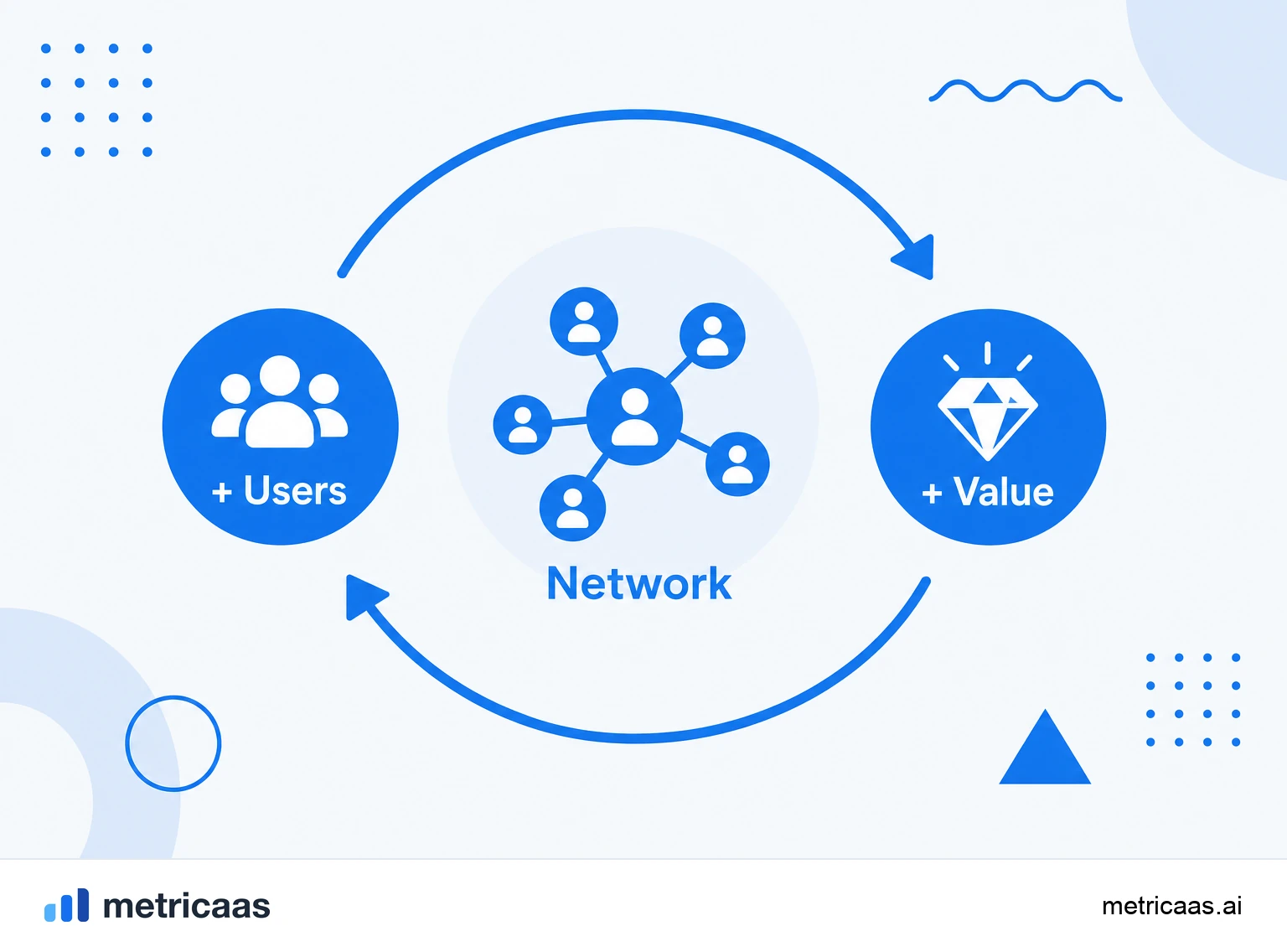
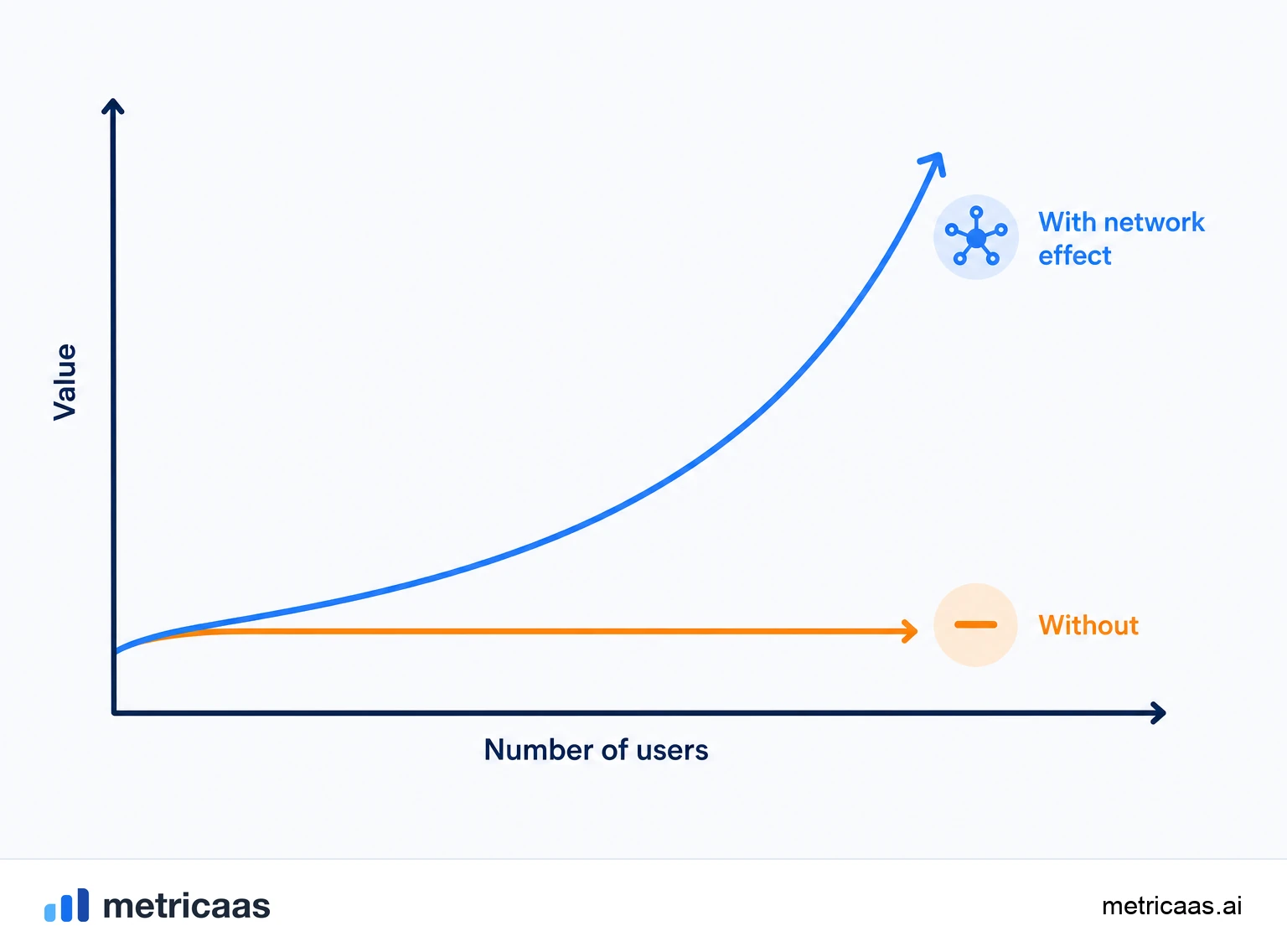
Network effects happen when each new user makes the product more valuable for everyone else, fueling a self-reinforcing loop of growth.
- They can be direct (same network) or indirect (two sides of the market).
- They are one of the hardest moats to copy.
- They make acquisition cheaper as the network grows.
What network effects are
Network effects describe a simple, powerful dynamic: the more people use a product, the more valuable it becomes for each user. A single phone is useless; the second phone creates a connection, and every new device multiplies the possible connections. In SaaS, this shows up in collaboration platforms, marketplaces and communication networks, where the value lies not only in the software but in who is already on the other side.
This dynamic creates a self-reinforcing loop: more users generate more value, which attracts even more users. It is not a niche detail. Platforms built on network effects dominate much of the world software, and the market is huge: according to Gartner, worldwide spending on SaaS applications is set to approach $300 billion in 2025.
Direct and indirect network effects
Not every network effect works the same way. In direct effects, value grows within the same network: each new user of a messaging app or a collaboration tool increases the value for existing users, because there are more people to interact with.
In indirect effects, or two-sided effects, one group attracts a different one. In a marketplace, more buyers attract more sellers, which in turn attract more buyers. The venture firm a16z, which popularized a detailed manual on the types of network effect, shows there are dozens of variations. The main ones are worth telling apart:
- Direct: same side, same network (communication, collaboration).
- Indirect: two sides that attract each other (marketplaces, platforms).
- Data: every use improves the product for everyone (recommendations, models).
How network effects fuel the flywheel
Network effects are the classic fuel of a flywheel: each turn generates energy for the next. New users add value, value increases retention and word of mouth, word of mouth brings new users, and the wheel spins with less effort every cycle.
The most valuable practical effect is on acquisition. As the network grows, part of the growth starts coming from users inviting others, which reduces dependence on paid media and drives the cost of acquisition down over time. That is why businesses with strong network effects tend to get more efficient as they scale, rather than more expensive.
Network effects as a moat
A moat is the structural advantage that protects a company from competition, and network effects are among the most durable. The reason is direct: a competitor can copy your features, but not your network of users. The bigger the network, the harder it is to leave, because the user would lose access to everyone else.
This moat shows up in retention numbers. Strong networks make leaving costly, which sustains revenue over time, so much so that the private SaaS survey by KeyBanc Capital Markets shows net revenue retention above 100% among the healthiest companies. A network that retains is a network that defends itself.
How to measure and accelerate network effects
Network effects are not magic: they can be measured and accelerated. The most direct metric is the viral coefficient (K-factor), which estimates how many new users each current user brings. When that number passes 1, the network grows on its own; below it, invitations help but do not sustain growth by themselves.
To accelerate, the most common path is product-led growth (PLG), where the product itself becomes the engine of acquisition. A few practical points:
- Reduce the friction to invite and bring new people into the network.
- Deliver value even with few users, so the network does not die at the start.
- Measure network density, not just total users: dense local networks are worth more than a broad, scattered base.
Negative network effects and the limits of the model
Not all network growth is good. There are negative network effects, where more users make the experience worse: congestion, spam, noise, falling quality. A social network flooded with low-quality content or a marketplace crowded with irrelevant sellers loses value even as it gains users.
There is also the cold-start problem, the well-known chicken-and-egg dilemma: early on, the empty network offers little value, and it is hard to attract the first users precisely because there is no network yet. Getting past this initial phase, often by focusing on a dense niche before expanding, is the biggest challenge for any product that depends on network effects.
Frequently asked questions
It is when each new user increases the product value for everyone else, creating a loop where more value attracts more users. It is common in marketplaces, communication networks and collaboration platforms.
The main ones are direct, when value grows within the same network, and indirect or two-sided, when one group attracts another, like buyers and sellers in a marketplace.
A collaboration tool: the more colleagues use it, the more useful it becomes for each person. A marketplace too: more sellers attract more buyers, who attract more sellers.
Yes, and one of the strongest. A competitor can copy the features but not the network of users, and leaving a large network is costly, which protects revenue over time.
They are situations where more users make the experience worse, through congestion, spam or falling quality. In those cases, growing in users can reduce the value of the network.
Related concepts

Moat
A moat (competitive moat) is the structural advantage that protects a company from being copied and sustains its margins over time. In SaaS, the most common types are network effects, switching costs, brand, scale and proprietary data. A wide moat shows up in the metrics as high retention and strong NRR.

Flywheel
The flywheel, or growth flywheel, is a model in which each gain feeds the next and builds momentum that eventually spins almost on its own: happy customers drive referrals, which lower the cost of acquisition and free up revenue to reinvest in the product, which creates more happy customers. Unlike the funnel, which ends at the sale, the flywheel puts retention and referral at the center of growth.

Product-led growth (PLG)
Product-led growth (PLG) is the growth strategy in which the product itself drives acquisition, activation, conversion and expansion, with little or no sales touch. The user enters through a free trial or a freemium plan, feels the value on their own and becomes a paying customer. The buying signal is no longer a filled-in form but usage: the PQL, the lead qualified by the product.