
Moat: what a competitive moat is and how it protects a SaaS
By Tiago Costa · Updated on July 9, 2026

Definition
A moat (competitive moat) is the structural advantage that protects a company from being copied and sustains margins over time.
- Common types in SaaS: network effects, switching costs, brand, scale and data.
- A wide moat shows up as high retention and strong NRR.
- The wider the moat, the harder and costlier it is to copy the business.
What a moat is
A moat, or competitive moat, is the structural advantage that protects a company from being copied and lets it sustain healthy margins year after year. The term comes from the idea of an economic moat, popularized by investor Warren Buffett to describe what keeps competitors at bay even when a market turns attractive.
In a SaaS, a moat is not a single feature that any rival can clone in a few weeks, but an advantage that compounds over time and gets harder to replicate as the company grows. When it truly exists, it shows up quietly in the numbers: customers who stay, revenue that repeats and an acquisition cost that pays back with room to spare.
The types of moat
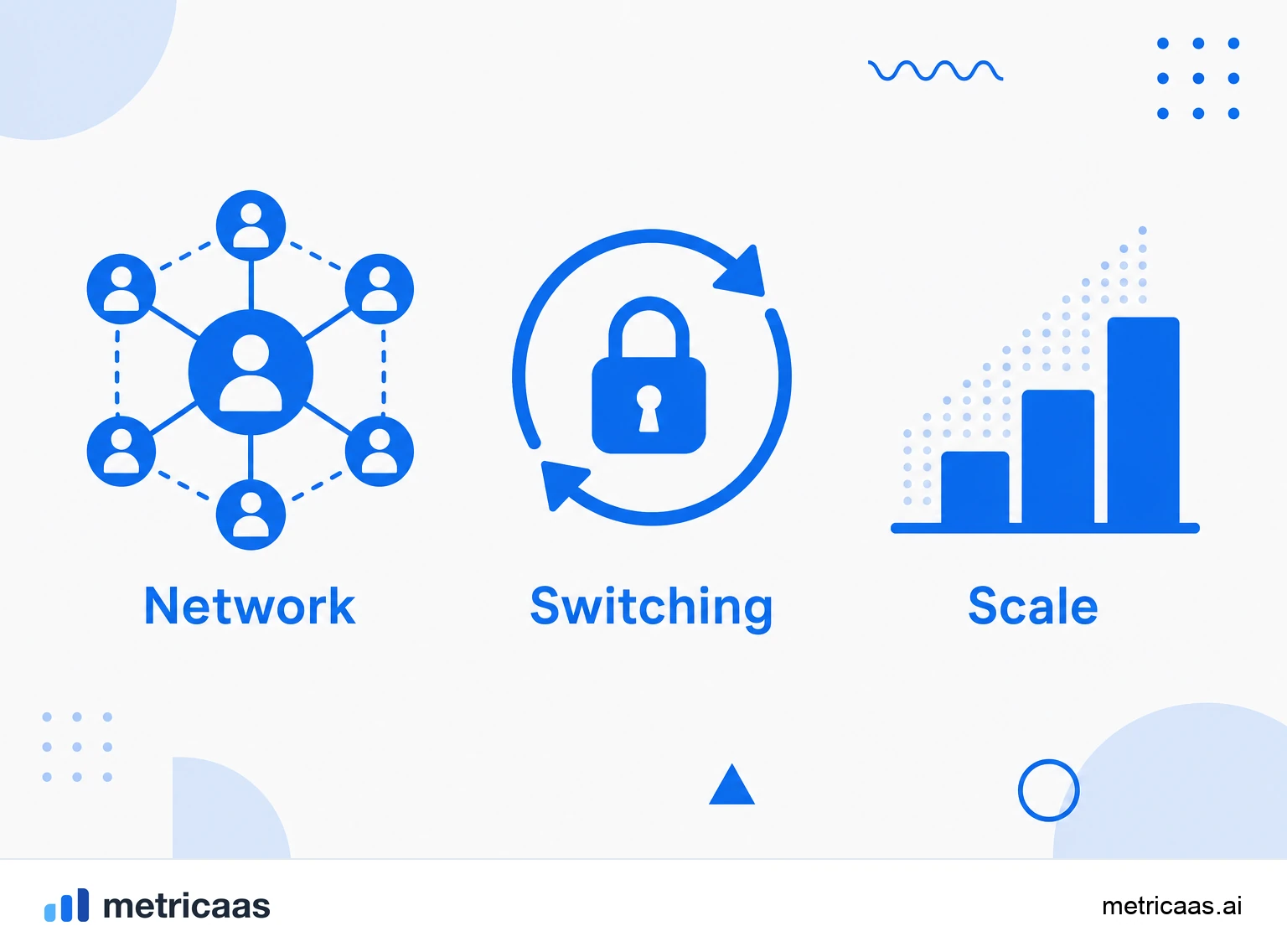
There is no generic moat. In practice, almost every competitive moat in a SaaS falls into five sources that tend to reinforce one another.
- Network effects: the product gets more valuable with each new user, a pattern firms like a16z have studied for years. See network effects.
- Switching costs: leaving the product takes work, costs money or disrupts operations.
- Brand: trust and recognition make customers choose you without shopping on price.
- Scale: higher volume drives down unit cost and frees up investment a small rival cannot match.
- Proprietary data: the more the product is used, the more data it accumulates, and the better its recommendations and models become.
The hardest moats to attack combine more than one of these sources. Bessemer, an investment firm well known for its SaaS work, often notes that isolated advantages erode, while advantages that stack create real distance.
Switching costs: the most common SaaS moat
Of all the sources, switching cost is the most attainable moat for most SaaS companies. It is born when the product weaves itself into the customer daily routine: historical data stored inside it, integrations with other tools, workflows designed around the software and teams already trained on it. Leaving stops being a price decision and becomes a migration project, with its own risk and cost.
This kind of moat deepens with use. The more a customer configures, imports and integrates, the more expensive it becomes to leave, and the less price-sensitive they get. That is why much of the product strategy in a mature SaaS is, at heart, a switching-cost strategy: making the product the center of gravity of the customer operation.
How a moat shows up in the metrics
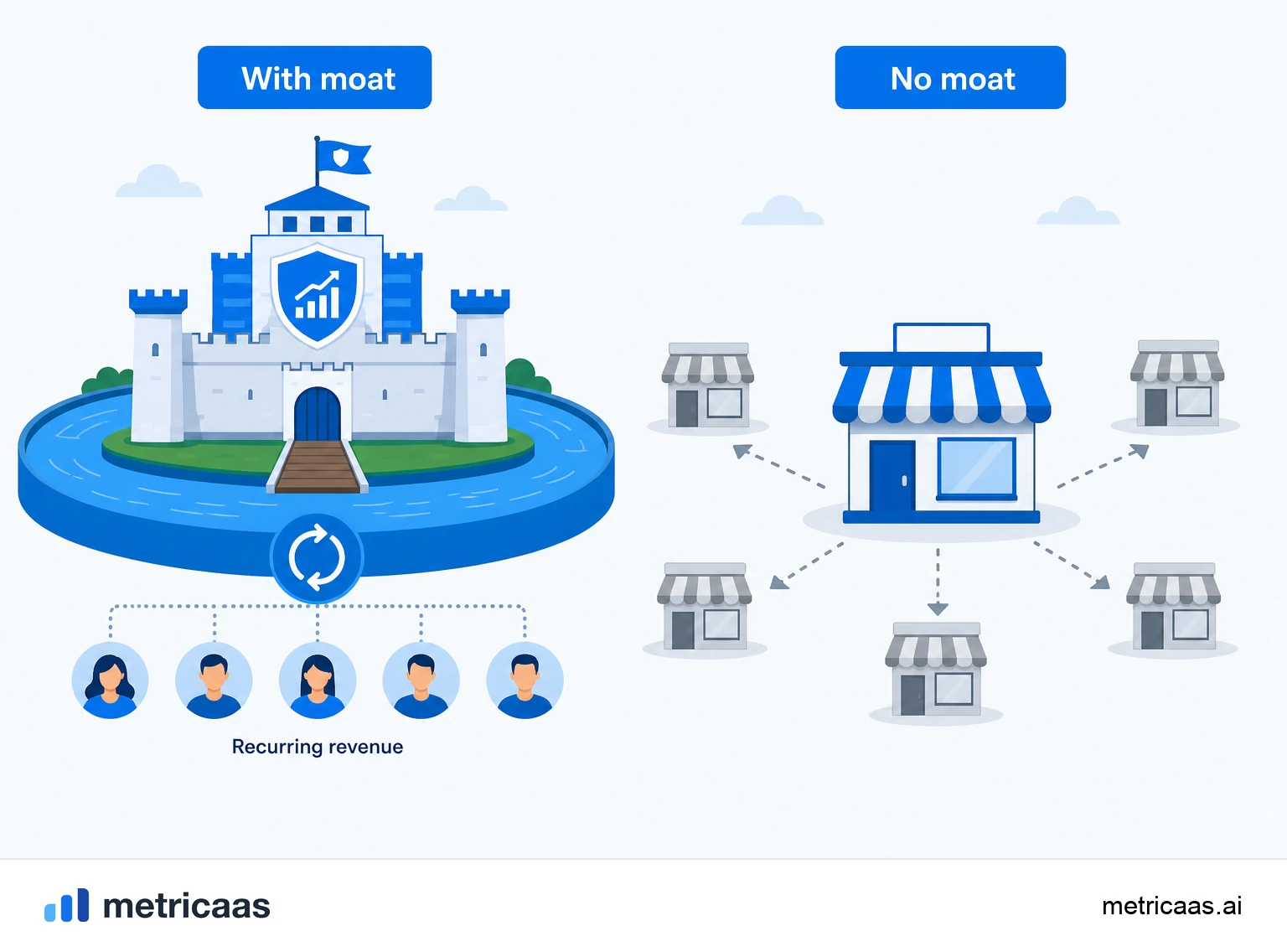
A moat is a strategic concept, but it does not stay in theory: it leaves clear marks on the metrics. The most direct signal is retention. Companies with a wide moat lose fewer customers and expand the accounts they already have, which translates into a high Net Revenue Retention (NRR). The private SaaS survey by KeyBanc Capital Markets shows net revenue retention at the best companies above 100%, a sign of a moat working in favor of revenue.
The second signal is unit economics. When customers stay longer, LTV / CLV rises and the acquisition-investment math closes with more room. Research by SaaS Capital on retention rates makes the same point: companies that hold on to their base pull ahead in value over time. If retention is weak, there is probably no moat, no matter how impressive the feature list.
How to build and widen a moat
A moat is not bought, it is built over time, and almost always by accumulation. The logic is that of a flywheel: every happy customer brings data, referrals and usage that make the product better, which attracts more customers, who reinforce the advantage again. With each turn, the moat gets a little wider.
- Invest where the advantage compounds: integrations, data and community, not just standalone features.
- Lower the friction of getting in and raise the value of staying, so switching cost grows naturally.
- Measure retention by cohort: a moat that works makes older cohorts hold better than newer ones.
The classic mistake is confusing novelty with a moat. A brand-new feature gives an edge for a few months, until the market copies it. Structural advantage is what remains once the novelty wears off.
Wide moat and narrow moat
Not every moat has the same depth. A wide moat protects a company for many years and is expensive to cross; a narrow moat offers some protection, but a determined competitor can overcome it. The difference matters because it is what ultimately sustains the price the company can charge and the value investors assign to the business.
That distinction weighs even more in a market that keeps growing. According to Gartner, worldwide public cloud spending is set to reach into the hundreds of billions of dollars in 2025, which draws more and more competitors into any promising category. When money and attention arrive, only businesses with a wide moat keep their margins and growth; the rest become commodities and compete on price.
Frequently asked questions
It is the structural competitive advantage that protects a company from being copied and sustains its margins over time. In SaaS, it shows up as high retention and revenue that repeats.
The five most common in SaaS are network effects, switching costs, brand, scale and proprietary data. The strongest moats combine more than one of these sources.
It is the advantage that arises when product usage accumulates proprietary data that improves recommendations and models, getting harder to copy the more the product is used.
Mainly in retention: a wide moat translates into high NRR, low churn and a rising LTV. Weak retention is usually a sign that there is no moat.
By accumulation, at the pace of a flywheel: integrations, data and community that stack over time and make the product ever harder to replace.
A wide moat protects a company for many years and is expensive to cross; a narrow moat offers limited protection that a determined competitor can overcome.
Related concepts

Network effects
Network effects happen when each new user increases the value of the product for everyone else, creating a loop where more value attracts more users who generate even more value. They can be direct, when users interact on the same network, or indirect, when one side of the market attracts the other. They are one of the strongest moats a SaaS can have, because they get harder to copy as the network grows.

Net Revenue Retention (NRR)
Net Revenue Retention (NRR) measures how much of the recurring revenue from your current base you keep over time, already accounting for upgrades and expansion, minus downgrades and cancellations. Above 100% it means the base grows on its own, even without new customers.
LTV / CLV
LTV (Lifetime Value), also called CLV or CLTV, is the total value a customer generates while they stay in your base. In a simple form, it is the recurring average revenue times margin times the customer lifetime. It is the metric that shows how much it is worth investing to win and keep each customer.