
MQL and SQL: what they are and how they work in lead qualification
By Tiago Costa · Updated on July 9, 2026
Definition
MQL (Marketing Qualified Lead) is the lead qualified by marketing; SQL (Sales Qualified Lead) is the lead validated by sales as an opportunity.
- MQL: enough interest for marketing to pass it to sales.
- SQL: a lead that sales accepted as a real opportunity.
- The MQL to SQL rate measures alignment between the teams.
What MQL and SQL are
An MQL (Marketing Qualified Lead) is the contact who has shown enough interest, by downloading a resource, filling out a form or requesting a demo, for marketing to decide it is worth passing to sales. An SQL (Sales Qualified Lead) is the lead the sales team has reviewed and validated as a real opportunity, with a fit, a clear need and a buying moment.
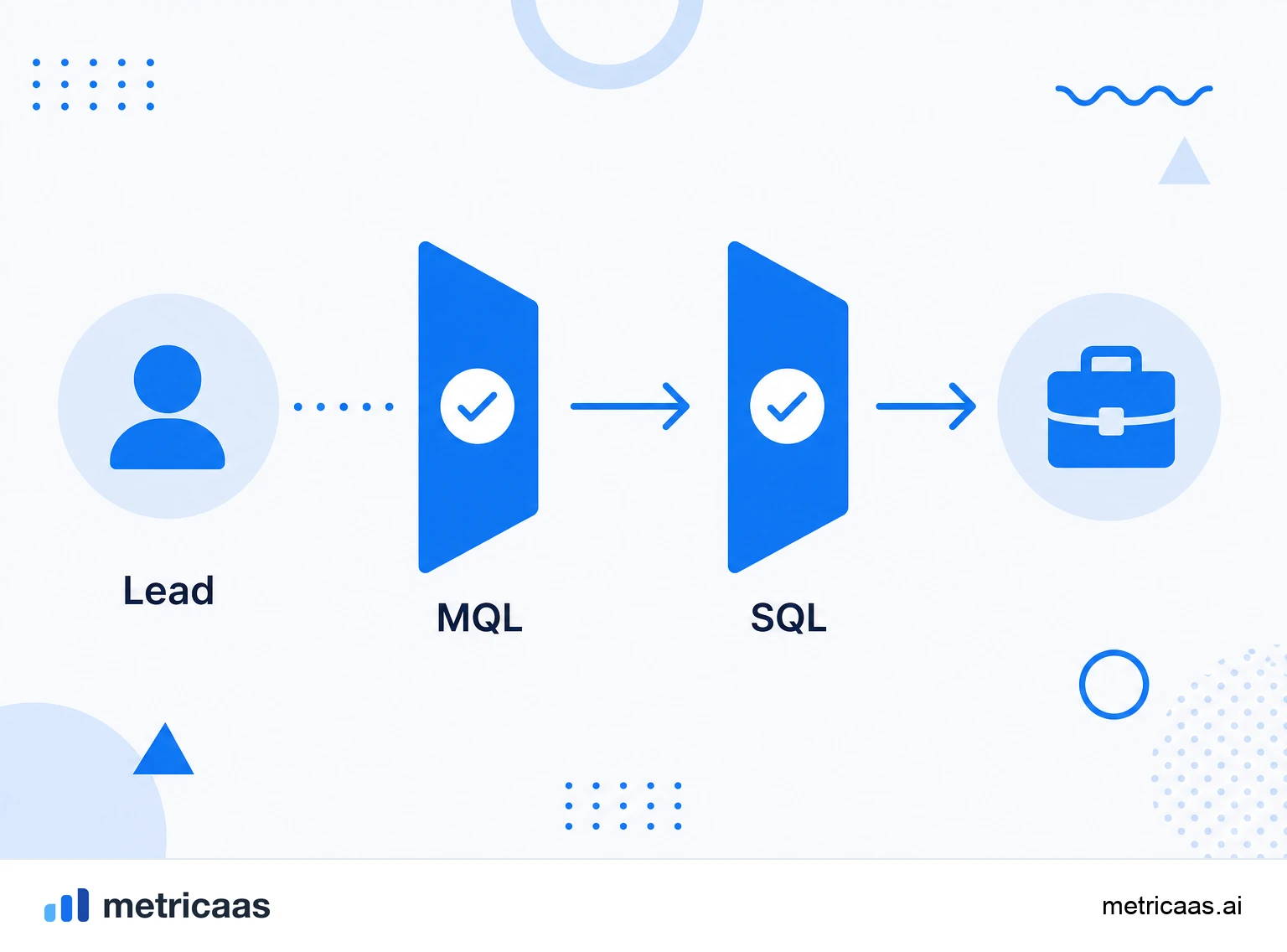
The two are stages of qualifying the same lead along the funnel, not opposite categories. The MQL signals interest; the SQL confirms intent. The core difference is who makes the call: marketing qualifies the MQL, sales qualifies the SQL. Understanding that boundary keeps lukewarm leads from clogging the reps calendars and keeps good opportunities from getting lost in the handoff.
The qualification funnel: from lead to opportunity
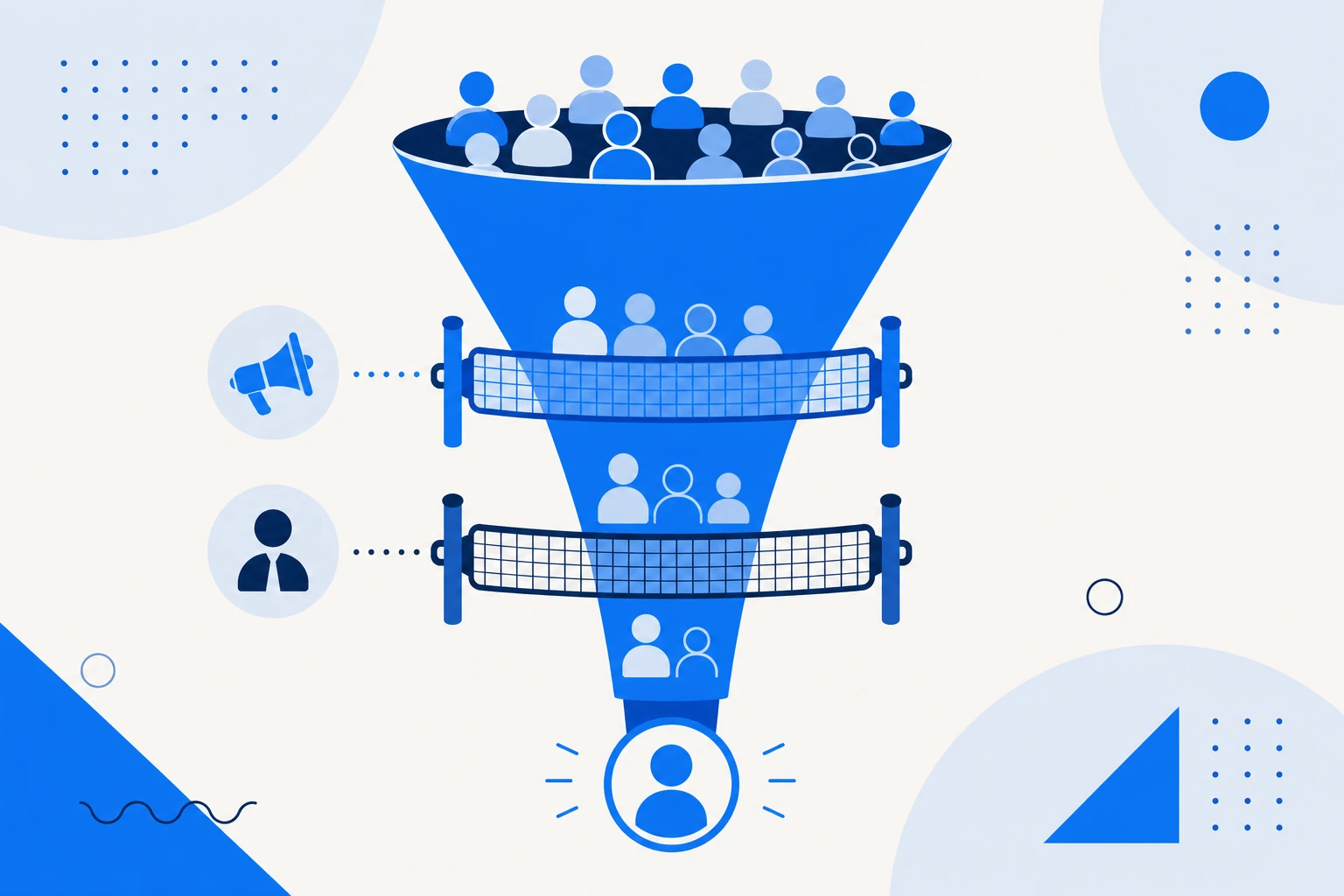
The classic path of a contact is Lead, MQL, SQL, Opportunity. It all starts with a lead, someone who entered your database. When that lead reaches a level of engagement that signals commercial interest, marketing promotes it to MQL. Sales then evaluates it; if accepted, it becomes an SQL and, next, an opportunity in the pipeline.
Between MQL and SQL many teams insert the SAL (Sales Accepted Lead), the lead sales has agreed to review but has not yet fully qualified. Each stage filters volume and raises quality, and each one has a cost: generating leads consumes budget, which is why the Cost per lead (CPL) helps measure top-of-funnel efficiency before you even talk about conversion.
Who owns each stage: marketing and sales
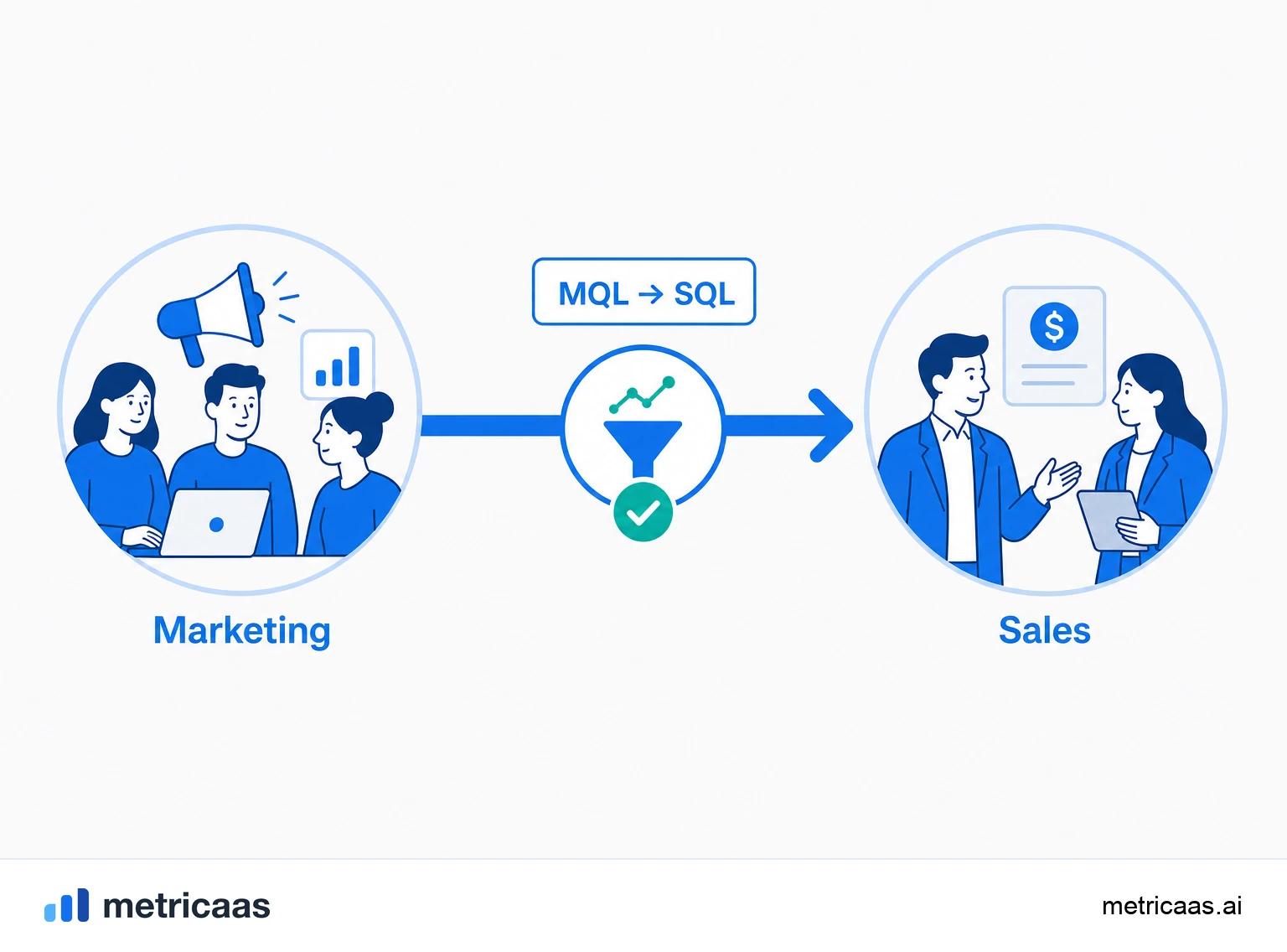
The practical rule is simple: marketing owns the lead and the MQL; sales owns the SQL, the opportunity and the close. Marketing attracts, nurtures and qualifies up to the point where the interest justifies a rep attention. From acceptance onward, responsibility shifts to the commercial side.
- Marketing: demand generation, nurturing, scoring and defining what counts as an MQL.
- Sales: accepting or rejecting the MQL, qualifying it into an SQL, and running the opportunity.
This boundary contract matters because, without it, each team uses its own ruler. Marketing thinks it delivered volume; sales complains about quality. A joint, written definition of MQL and SQL is what makes the two speak the same language.
Lead scoring: how a lead becomes an MQL
Lead scoring is the most common method for deciding when a lead becomes an MQL. It assigns points to profile attributes (job title, company size, industry) and to behaviors (opening emails, visiting the pricing page, requesting a demo). By crossing the two dimensions, the team separates those who fit from those who are merely curious.
When the score passes a threshold agreed with sales, the lead is promoted to MQL. In self-serve products a powerful variation appears: the Product Qualified Lead (PQL), which qualifies through real product usage, for example by hitting an activation milestone in the trial, rather than only through marketing engagement. PQLs tend to convert better because intent has already been demonstrated inside the product.
The MQL to SQL conversion rate
The MQL to SQL rate, that is, how many MQLs sales accepts as SQLs, is one of the best thermometers of alignment between marketing and sales. A very low rate suggests marketing is sending off-profile leads or that sales is being too strict. A rate that rises over time signals that the two teams have converged on what a good lead is.
There is no universal magic number: the benchmark varies by industry, deal size and sales model. It is worth tracking the trend of your own rate and comparing it against market patterns, like those Benchmarkit publishes in its B2B go-to-market studies. More important than the absolute value is the cost behind it: leads that never convert inflate the CAC without generating revenue.
The handoff and the most common mistakes
The handoff, the passing of the MQL from marketing to sales, is where alignment is proven in practice. A good handoff has a service-level agreement (SLA): sales commits to responding to each MQL within a deadline, and marketing commits to a volume and a minimum quality. Without it, leads go cold in the queue and the conversion rate collapses.
- Define MQL and SQL in writing, with objective criteria, and review them together periodically.
- Close the loop: sales tells marketing why it rejected each MQL, to calibrate the scoring.
- Measure the handoff, not just volume, by tracking the MQL to SQL rate and response time.
The most common mistakes are treating the MQL as marketing final goal (volume without quality), giving no feedback on rejected leads, and changing the definitions without telling the other team. Fixing those three points usually improves conversion without spending a cent more on generation.
Frequently asked questions
MQL (Marketing Qualified Lead) is the lead that marketing has qualified as interested enough to pass to sales. SQL (Sales Qualified Lead) is the lead that sales has validated as a real opportunity.
The MQL comes first. The lead is qualified by marketing as an MQL and, if sales accepts and validates it, it moves on to SQL. The funnel order is Lead, MQL, SQL, Opportunity.
There is no universal number: it varies by industry, deal size and sales model. More than the absolute value, what matters is the trend of your own rate and growing alignment between marketing and sales.
The common stages are lead, MQL, SQL and opportunity. Many teams insert the SAL (Sales Accepted Lead) between MQL and SQL, and there is also the PQL, qualified by product usage.
Someone who downloaded a resource, signed up for a webinar, requested a demo or visited the pricing page several times. These are signs of interest that justify passing the lead to sales.
SAL (Sales Accepted Lead) is the lead sales agreed to review after receiving it from marketing, but has not yet qualified as an SQL. It is an intermediate step between MQL and SQL.
Related concepts

CAC
CAC (Customer Acquisition Cost) is how much, on average, you spend to win a new customer. Add up everything invested in marketing and sales over a period and divide by the number of new customers who came in during that period. It is the metric that tells you whether your growth is economically healthy.

Cost per lead (CPL)
Cost per lead (CPL) is the marketing spend of a period divided by the number of leads generated in that period. It measures how much it costs, on average, to attract an interested contact, and it sits before CAC in the acquisition funnel. It is mainly used to compare channels, as long as you also look at the quality and conversion of the leads, not just the price.

Product Qualified Lead (PQL)
A Product Qualified Lead (PQL) is a lead qualified by product usage itself, not by marketing or sales. It is someone who reached a value milestone inside the tool, such as activating a core feature or hitting a usage limit, signaling real buying intent. It is the native lead of product-led growth and tends to convert far more than a lead qualified by profile alone.