
Grandfathering: keeping old customers on the old price
By Tiago Costa · Updated on July 9, 2026

Definition
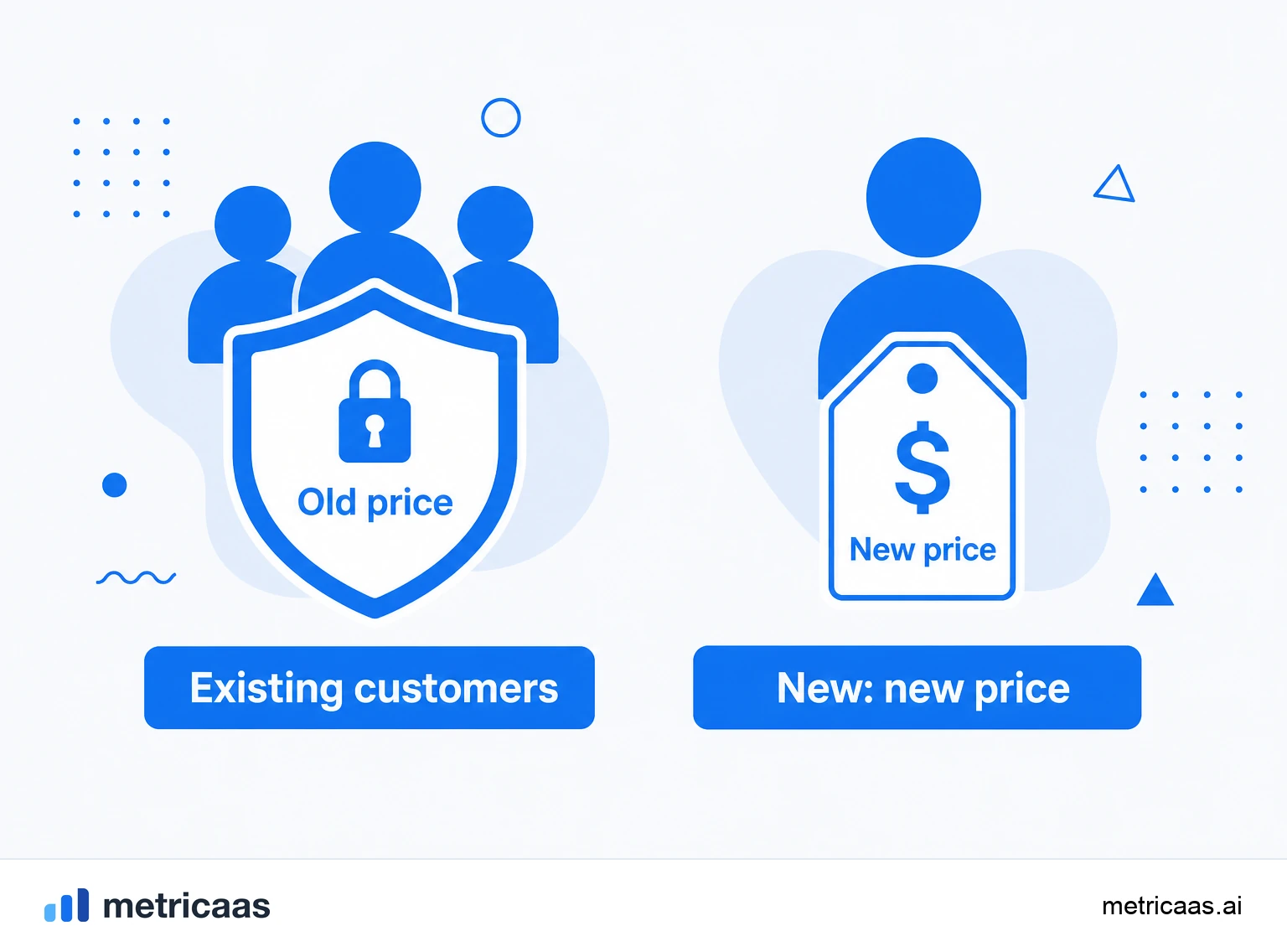
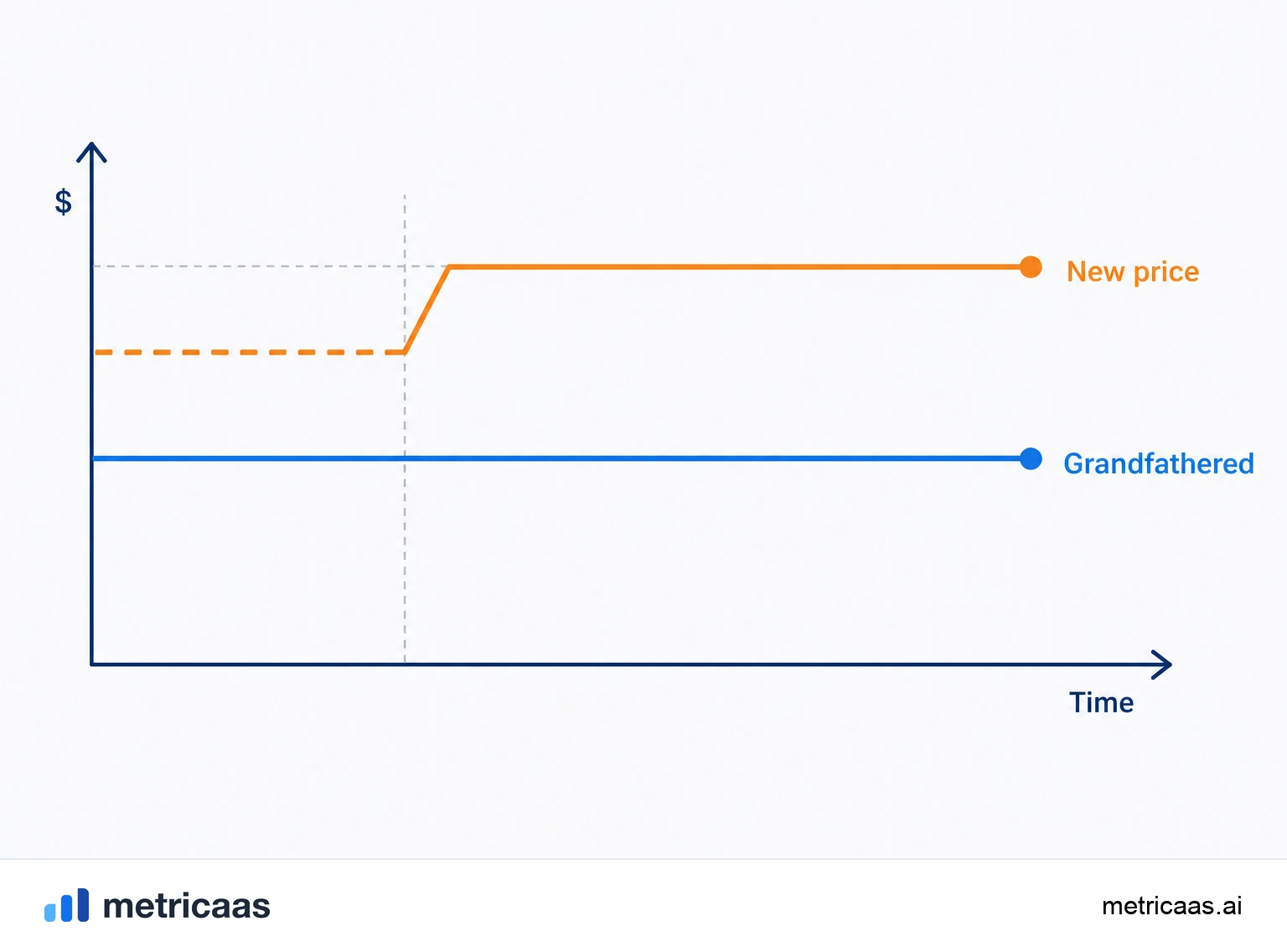
Grandfathering keeps current customers on the old price or plan after an increase, while new customers get the new terms.
- Reduces friction and churn right after the increase.
- In exchange, it caps revenue and complicates the base over time.
- The alternative is migrating everyone with notice and incentives.
What grandfathering is
Grandfathering, sometimes framed as a legacy or acquired-rights clause, means keeping current customers on the old price or plan after a price increase or a change in packaging. New customers sign up under the new terms, and the old ones stay exactly where they were, as if the increase had never happened for them.
The term describes a transition choice, not a metric. The company deliberately leaves part of the base frozen on a legacy price. That creates two worlds living side by side for a while: the current list price, which carries future revenue, and the old contracts, which preserve the relationship with early customers.
Why companies grandfather customers
The logic is protecting the relationship with people who already trusted the product. A price increase communicated carelessly can trigger cancellations, and grandfathering acts as a shock absorber: old customers do not feel the increase, the sales team avoids hard conversations, and churn does not spike in the month after the change.
There is also a fairness component. Customers who joined early, often when the product was more immature and riskier, feel they deserve the price they committed to. Keeping that price signals loyalty, reduces public complaints, and avoids a wave of refund requests right after the announcement.
The hidden cost: capped revenue and a fragmented base
The short-term relief comes with a trade-off. Every customer kept on the old price is revenue that does not track the value the product now delivers, which works as a silent ceiling on expansion. The gap between the old and the new price becomes an opportunity cost that grows with every renewal.
There is an operational cost too. A base with several legacy prices and packages is harder to support, to reprice, and to migrate later: code, billing, and support carry exceptions for years. Because retention is one of the factors that weigh most on the value of a SaaS, according to research from SaaS Capital, it makes sense to protect the customer, but not to the point of permanently freezing the ability to grow revenue inside the base.
Grandfathering or migrating everyone: the alternative
The alternative to grandfathering is migrating the whole base to the new price, with advance notice and a designed transition. Instead of freezing terms, the company gives time (say, sixty or ninety days of notice), explains why the price is changing, and offers incentives to soften the move: a guaranteed window at the old price, a loyalty discount for a few months, or an upsell that delivers more value for the new price.
Migrating everyone preserves a simple base and full revenue potential, at the cost of a more delicate conversation. Grandfathering does the opposite: it avoids the conversation now and pushes the complexity forward. Many teams combine both, keeping old customers for a defined period and migrating them in stages, rather than picking one extreme.
How to decide when to use grandfathering
The decision depends on how far the old price sits from current value and how price-sensitive the base is. If the product has evolved a lot and adopted value-based pricing, keeping old contracts indefinitely can get expensive. If the increase is small and the base is large and sensitive, temporary grandfathering protects the relationship without giving up much revenue.
A practical rule is to treat grandfathering as a transition, not a permanent state. Define how long old customers stay protected, which plans will be discontinued, and what the migration path looks like. OpenView, a well-known pricing research firm, often notes that price is the most under-invested lever in SaaS: reviewing prices regularly and planning the transition avoids piling up a base that is impossible to reprice.
How to communicate a price increase with grandfathering
Communication decides the outcome. The announcement has to be clear about what changes, for whom, when, and why, and it has to arrive before any new charge. State explicitly who is protected by the old price and for how long, so the old customer feels recognized and the new one understands the rules.
Tie the increase to value delivered, not to internal costs. List what the product has gained since the last price, offer a clear path for anyone who wants to change plans, and keep a channel open for questions. Done this way, grandfathering becomes part of a story of growth and trust, rather than a patch to postpone a hard decision.
Frequently asked questions
It is keeping current customers on the old price or plan after a price increase or repackaging, while new customers pay the new terms.
It is the old price a customer keeps paying after a general increase. It stays protected from the new list price, at least for a period the company defines.
Yes, over the medium term. Every customer on the old price is revenue that does not track delivered value, which acts as a ceiling on expansion and on growth inside the base.
With grandfathering, old customers stay on the old price; in a migration the whole base moves to the new price, with notice and incentives. One avoids friction now, the other preserves revenue and simplicity.
Treat it as a transition with a defined window (for example, six or twelve months) rather than a permanent state, to avoid ending up with a base that is impossible to reprice.
It reduces churn in the short term, because old customers do not feel the increase. The cost shows up later, as capped revenue and a base that is harder to manage.
Related concepts

Value-based pricing
Value-based pricing sets the price from the value perceived and delivered to the customer, not from production cost nor only from what competitors charge. It anchors price to each segment willingness to pay, which tends to capture more revenue. It depends on understanding value per persona and choosing a good value metric.
Churn
Churn is the loss of customers or revenue in a period. In a SaaS, it measures how many customers cancel (customer churn) or how much recurring revenue disappears (revenue churn). It is the metric that reveals whether growth is sustainable: the higher the churn, the more new sales you need just to avoid shrinking.
Expansion
Expansion (expansion revenue or expansion MRR) is the additional recurring revenue that comes from customers you already have, without relying on new sales. It comes from upsell (higher plan), cross-sell (more products), add-ons and usage growth. It is the force that pushes net revenue retention above 100% and makes the base grow on its own.