
Committed MRR (CMRR): what it is and how to calculate committed MRR
By Tiago Costa · Updated on July 9, 2026

Definition
Committed MRR (CMRR) is the committed MRR of a SaaS: it starts from current MRR, adds contracted additions and subtracts losses that are already certain.
- Factors in signed contracts still due to activate.
- Subtracts cancellations already announced.
- Shows the future recurring revenue already committed.
What Committed MRR (CMRR) is
Committed MRR (CMRR), or committed monthly recurring revenue, is the recurring revenue a company can already treat as certain for the near future. It starts from current MRR, adds contracts that have been signed but are still due to activate, and subtracts the losses that are already confirmed, such as cancellations a customer has already announced.
The acronym stands for Committed Monthly Recurring Revenue. The core idea is simple: instead of looking only at what is active today, CMRR factors in what is already locked into a contract, even if it has not shown up in billing yet. It is a more honest read of where recurring revenue is heading.
How to calculate CMRR
The calculation starts from current MRR and adjusts for the certainties you already know:
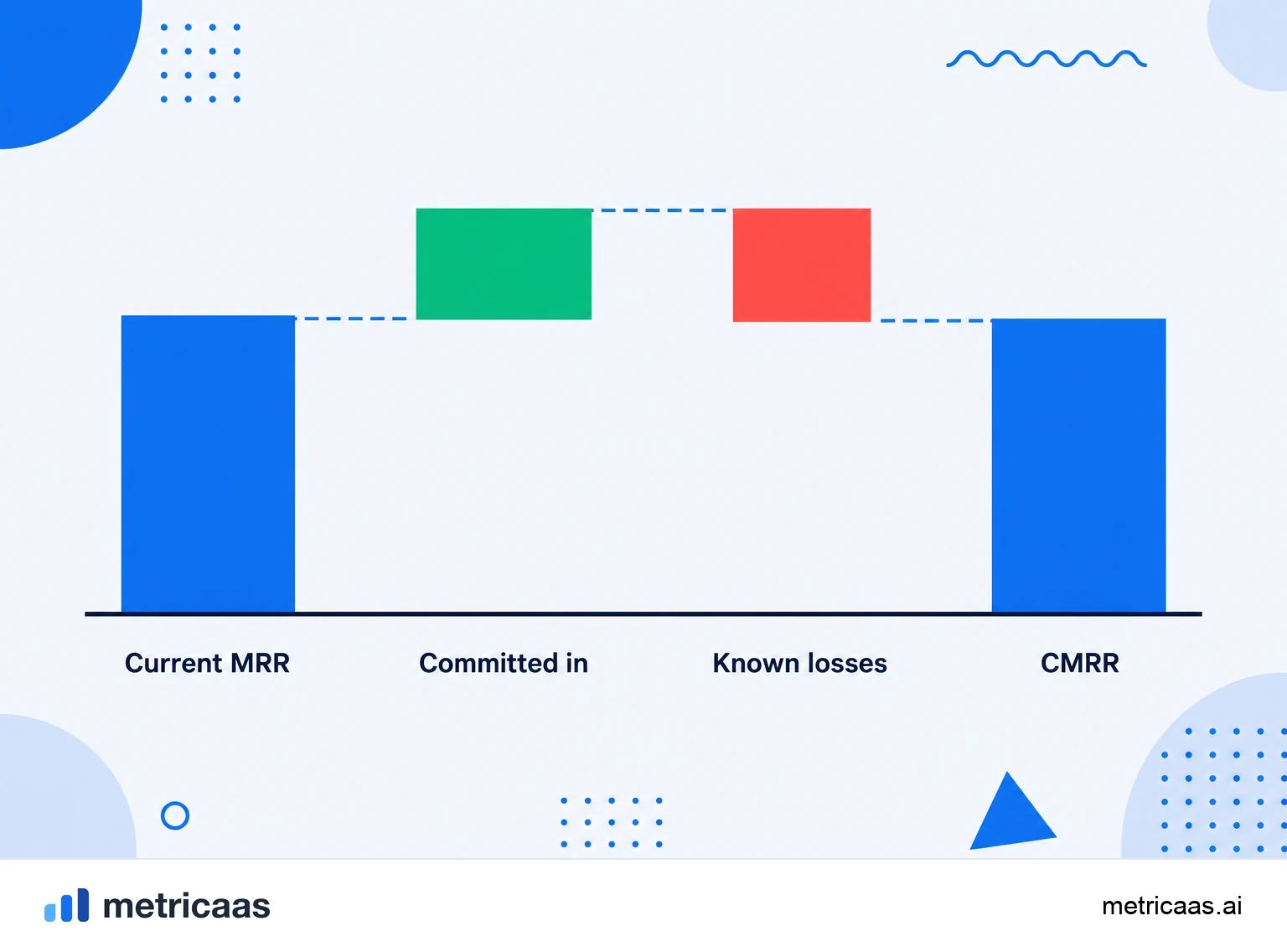
- CMRR = current MRR + contracted additions - confirmed losses.
- Additions: signed contracts not yet activated, and expansions already agreed with a start date.
- Losses: cancellations and downgrades a customer has already announced that will lower revenue.
Example: if MRR today is $100k, there is $15k in signed contracts activating next month and $5k in announced cancellations, CMRR is $110k. Only what is certain and dated counts; a deal still in negotiation, without a signature, does not. These are the same swings that show up in MRR movements, only viewed forward here.
CMRR and MRR: the difference
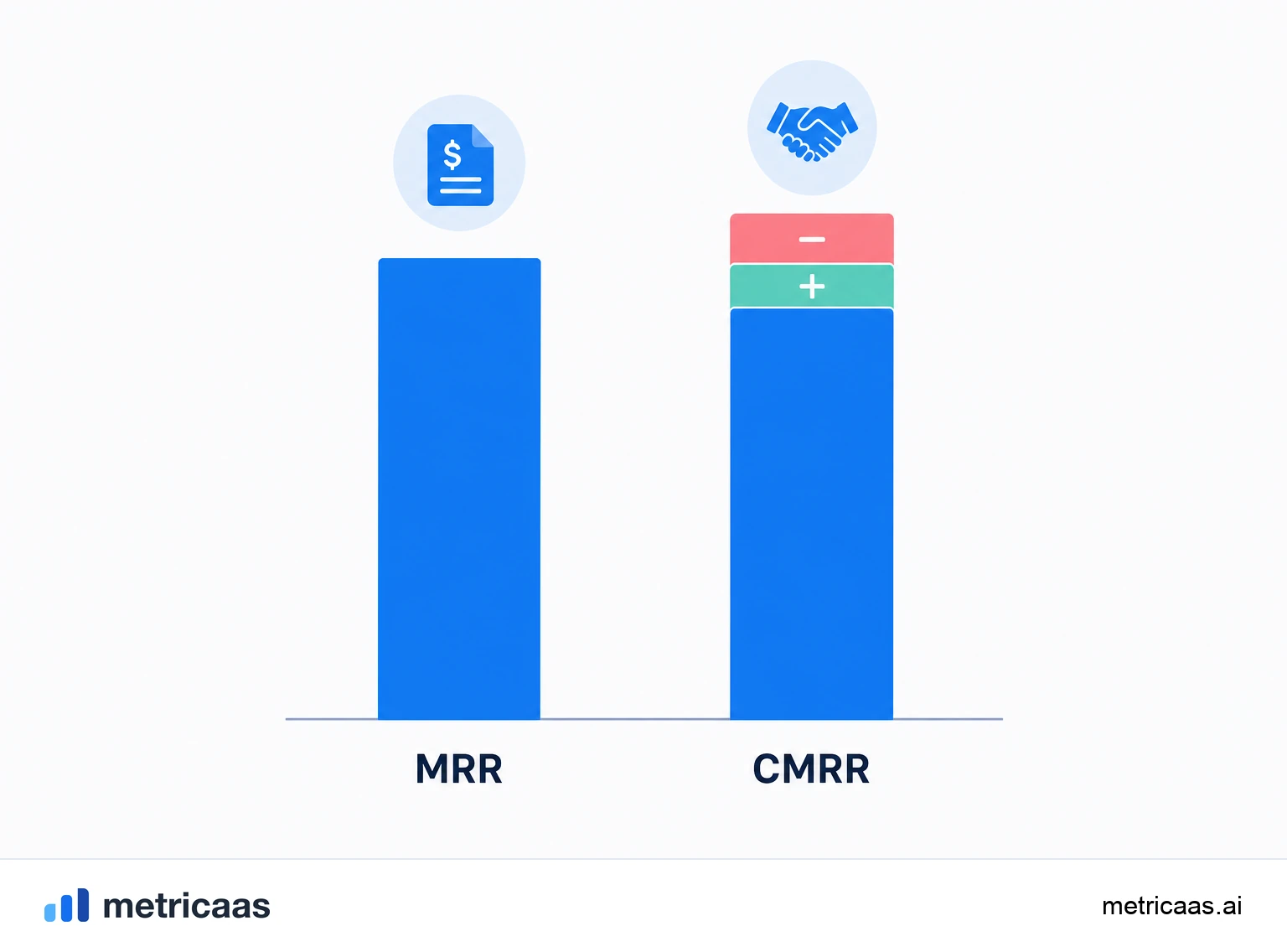
MRR is a snapshot of the present: it shows the recurring revenue of subscriptions active today. CMRR is a snapshot of the contracted future: it shows where that revenue will be once everything already closed takes effect.
- MRR: what is active and being billed right now.
- CMRR: MRR adjusted for additions and losses that are already certain but not yet reflected.
That is why CMRR tends to anticipate moves that MRR only records weeks later. When a company closes a large annual contract that activates next quarter, CMRR rises immediately, while MRR only reacts once billing starts.
What counts in and out of CMRR
The discipline of CMRR lies in being conservative about what counts as certain. On the additions side, signed contracts with an activation date and already agreed expansions qualify. On the losses side come cancellations and reductions already communicated, the announced churn that has not lowered revenue yet.
What does NOT count is as important as what does:
- Open proposals and opportunities, which may still fall through.
- Renewals that are merely likely, without confirmation.
- One-off charges and one-time fees, which are not recurring.
Keeping this discipline is what separates a reliable CMRR from an overly optimistic number. If forecast slips in where commitment should be, CMRR becomes a guess and loses its usefulness.
Committed ARR: annualized CMRR
Just as MRR becomes ARR when multiplied by 12, CMRR becomes Committed ARR. It is the same logic of already contracted revenue, only on the annual ruler that investors and boards prefer.
Committed ARR is useful for planning and fundraising conversations, because it shows the contracted floor of recurring revenue for the next twelve months. Companies with many annual contracts tend to lean on this view, since much of the revenue for next year is already signed before the year even begins.
Why CMRR guides planning
The value of CMRR is in reducing surprises. Because it already factors in what is closed, it gives a firmer base to forecast cash, size sales targets and plan hiring, without waiting for revenue to show up in billing before reacting.
It also makes the weight of retention clear: every certain loss that enters the calculation is revenue leaving the future. Fittingly, the private SaaS survey by KeyBanc Capital Markets shows net revenue retention above 100%, and SaaS Capital reinforces that retention is the main driver of predictable growth. A rising CMRR is, at heart, a sign that contracted additions comfortably outweigh the losses already certain.
Frequently asked questions
It is committed monthly recurring revenue: current MRR plus contracted additions and minus confirmed losses, such as announced cancellations. It shows the future recurring revenue that is already certain.
CMRR = current MRR + contracted additions - confirmed losses. Only what is certain and dated counts; deals still in negotiation do not.
MRR shows the recurring revenue active today; CMRR adjusts that number for additions and losses that are already certain but not yet reflected in billing.
It is revenue already secured by contract, even if it has not been billed yet. In SaaS, CMRR is the monthly, recurring version of that idea.
It is annualized CMRR, CMRR multiplied by 12. It shows the contracted floor of recurring revenue for the next twelve months.
Related concepts

MRR
MRR (Monthly Recurring Revenue) is the monthly recurring revenue of a SaaS: the sum of all active subscriptions normalized to a month. It is the core metric of a subscription business because it shows, predictably, how much the company earns on a recurring basis each month, without counting one-off charges.

ARR
ARR (Annual Recurring Revenue) is the annual recurring revenue of a SaaS: MRR multiplied by 12. It represents how much the company earns on a recurring basis over a year, counting only active subscriptions, with no one-off charges. It is the metric of choice for companies selling annual contracts and the standard language of investors.

MRR Movements
MRR movements are the breakdown of the monthly change in MRR into its causes: new, expansion, contraction, churn and reactivation MRR. Instead of watching only the final number, you separate every dollar that came in and every dollar that left, and see why recurring revenue grew, stalled or fell. The sum of all movements is the net new MRR for the period.