
Account-based marketing (ABM): what it is and how it works
By Tiago Costa · Updated on July 9, 2026

Definition
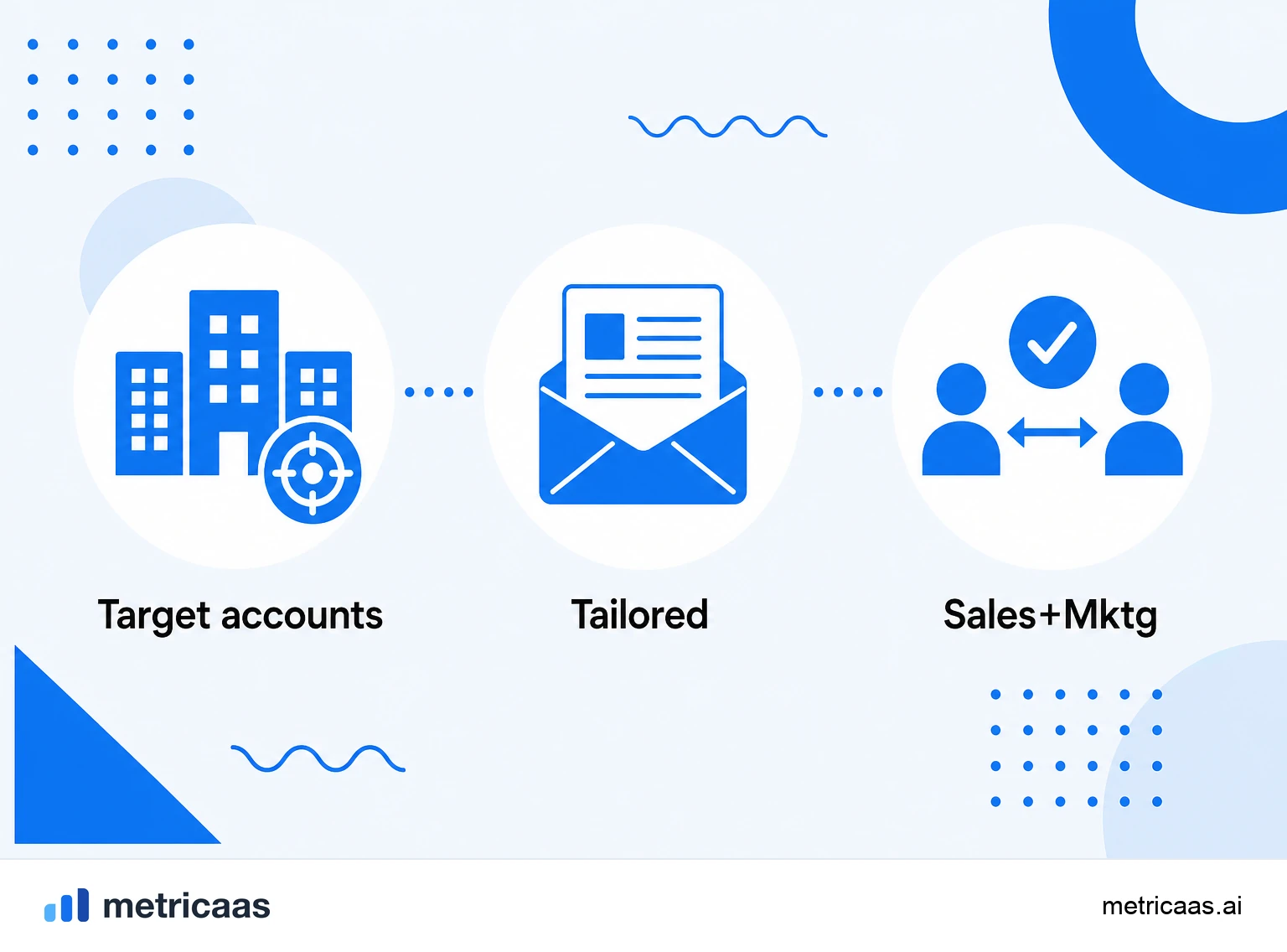
Account-based marketing (ABM) treats high-value target accounts as "markets of one", with a narrow ICP and sales and marketing aligned.
- It inverts the funnel: it starts from the right accounts, not from lead volume.
- It uses messaging personalized per account and often per person.
- It is measured by account engagement and revenue, not by lead volume.
What account-based marketing (ABM) is
Account-based marketing, or ABM, is a B2B strategy that treats a small set of high-value target accounts as "markets of one": instead of firing campaigns at as many leads as possible, the company picks the accounts that matter most and tailors marketing and sales to each one. The goal shifts from volume to precision.
In practice, ABM means marketing and sales working as one team around the same accounts, with messaging personalized per account and often per person inside it. It is the opposite of generating leads in bulk and hoping some convert: here the list of the right accounts comes first, and every effort concentrates on them.
How ABM inverts the funnel
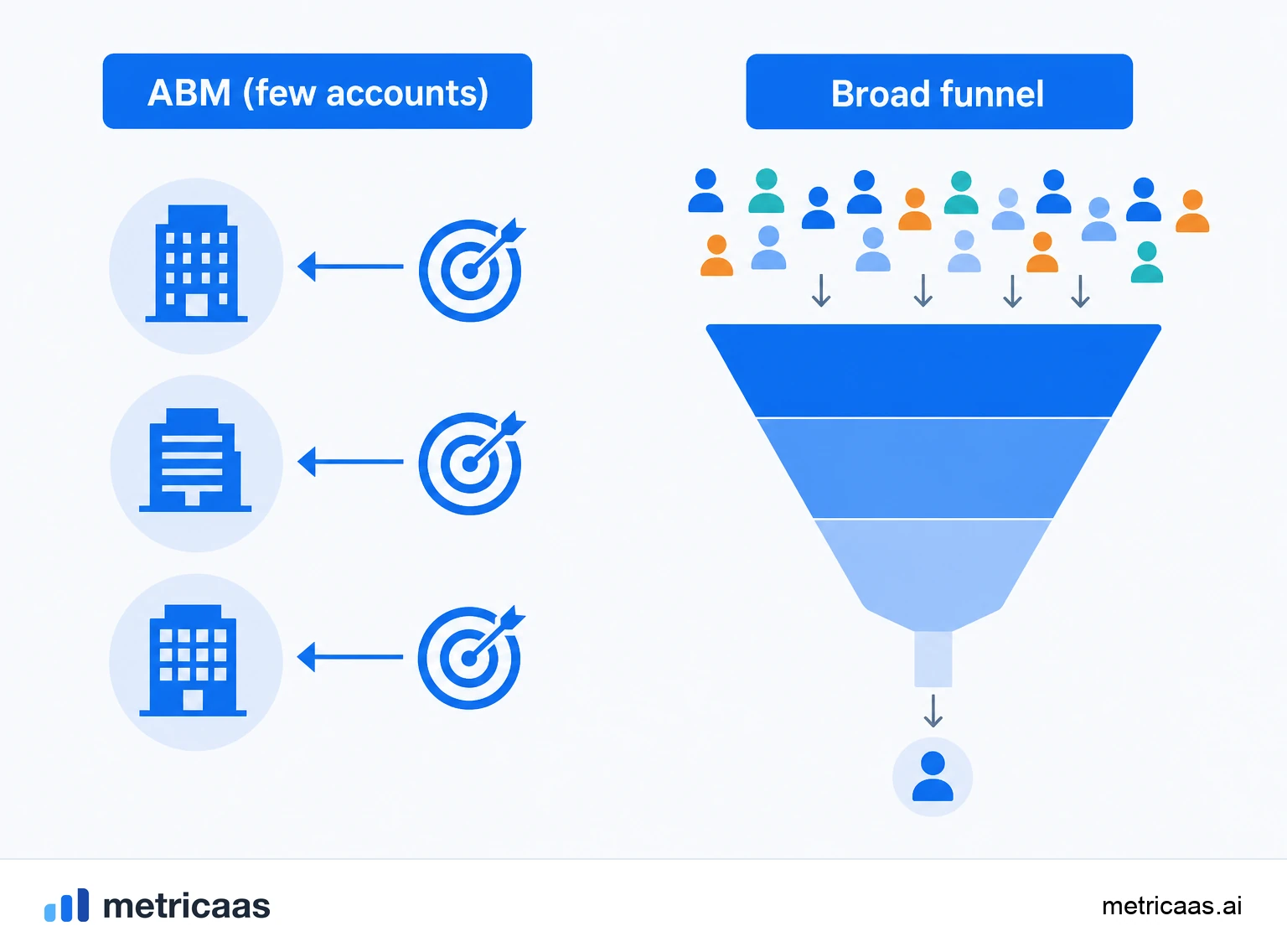
The traditional funnel is wide at the top: it attracts many visitors, filters leads, qualifies some and closes few. ABM flips that order. It starts by defining the accounts worth pursuing, the ICP applied to concrete company names, and only then invests in attracting and engaging each one. The question changes from "how do I get more leads?" to "how do I get into this specific account?".
Inverting the funnel has a practical consequence: alignment between marketing and sales stops being nice to have and becomes mandatory. Because the account list is the same for both teams, they have to agree on which accounts to pursue, who does what in each one, and when an account is ready for a sales approach.
The three types of ABM
ABM is usually split into three formats, by scale and degree of personalization:
- One-to-one (strategic ABM): a handful of accounts, each treated as a unique project, with content and offers built to measure.
- One-to-few (ABM lite): small clusters of accounts with similar traits, served by semi-personalized campaigns.
- One-to-many (programmatic ABM): dozens or hundreds of accounts, with personalization powered by technology and data.
The choice depends on the value of each account and the resources at hand. The higher the deal size and the more strategic the account, the more one-to-one makes sense; the larger the list, the more the process leans on automation to keep some personalization at scale.
ABM and demand generation: the difference
Demand generation (demand gen) works the market broadly: it creates interest, captures many leads and nurtures them until they are ready to buy. ABM does the reverse: it starts from a closed list of accounts and concentrates resources on them. One measures success by lead volume; the other, by depth of engagement in specific accounts.
The two are not mutually exclusive. Many companies run demand generation to feed the top and ABM for their highest-value accounts, and they pair ABM with a sales-led growth (SLG) engine, where the sales team drives complex, high-ticket deals. The core difference is focus: demand generation seeks the widest efficient reach; ABM seeks the right accounts, with whatever effort it takes within reason.
When ABM makes sense
ABM shines when the ICP is narrow and the deal size is high. If only a few accounts in the world can buy your product and each contract is worth a lot, it pays to invest heavily in each one. If instead your market is huge and the ticket is small, the cost of personalizing account by account rarely pays off.
It is worth watching CAC closely: ABM tends to carry a higher cost per account, so it needs large contracts and strong retention to pay back. Firms like Bessemer have long argued that in enterprise B2B software, concentrating effort on the right accounts returns more than spreading budget thin. In a SaaS applications market heading toward hundreds of billions of dollars a year, according to Gartner, the fight for the highest-value accounts is intense, and ABM is how you concentrate budget where the revenue is.
How to measure ABM
Measuring ABM by lead volume is a classic mistake: the strategy exists to generate a few right accounts, not many contacts. The useful metrics treat the account as the unit: coverage of the target list, engagement per account, pipeline progression and, in the end, revenue generated in the chosen accounts.
Rather than scoring isolated contacts, ABM applies lead scoring at the account level, adding up the signals from everyone involved to gauge how engaged that account is. The final scoreboard is simple: how many of the target accounts became customers, how much revenue they brought and at what cost.
Frequently asked questions
It is a B2B strategy that treats specific high-value target accounts as markets of one, with sales and marketing aligned and messaging personalized per account, instead of generating leads in bulk.
Demand generation captures many leads across the broad market and measures volume; ABM starts from a closed list of accounts and measures engagement and revenue per account. Many companies use both together.
One-to-one (strategic, a few highly personalized accounts), one-to-few (ABM lite, similar clusters with semi-personalized campaigns) and one-to-many (programmatic, dozens or hundreds of accounts supported by technology).
A team picks 50 target companies, builds a personalized page and content for each and the rep reaches specific contacts inside them, all coordinated between marketing and sales.
When the ICP is narrow and the deal size is high, with a few accounts worth a lot. If the market is huge and the ticket is small, personalizing account by account rarely pays off.
By coverage of the target list, by engagement and pipeline progression per account and by revenue generated in the chosen accounts, not by lead volume.
Related concepts

ICP
The ICP (Ideal Customer Profile) describes the type of company that gets the most value from your product and gives the most back in retention, expansion and referrals. It combines firmographics (industry, size, geography), the real need the product solves and fit criteria. Focusing on the ICP lowers CAC and improves retention; targeting outside it inflates cost and churn.

Sales-led growth (SLG)
Sales-led growth (SLG) is the growth model in which a sales team drives customer acquisition and expansion, using demos, proposals and negotiation to guide the buyer to the contract. It is the default for high-ticket, complex sales where the product alone does not close the deal. It contrasts with product-led growth, and many companies combine both models.
CAC
CAC (Customer Acquisition Cost) is how much, on average, you spend to win a new customer. Add up everything invested in marketing and sales over a period and divide by the number of new customers who came in during that period. It is the metric that tells you whether your growth is economically healthy.