
ICP: what the ideal customer profile is and how to define it
By Tiago Costa · Updated on July 9, 2026

Definition
The ICP (Ideal Customer Profile) is the profile of the company that benefits most from your product and gives the most back in retention, expansion and referrals.
- Combines firmographics, need and fit criteria.
- Focusing on the ICP lowers CAC and improves retention.
- It is not the persona (the person) nor the buyer (who signs off on the purchase).
What ICP is
The ICP (Ideal Customer Profile) is the description of the company that gets the most out of your product and, in return, gives the most back to the business: it stays longer, spends more over time and refers other similar companies. It is not a wish list nor the biggest possible contract, but the kind of account where your product delivers the promised outcome with the least friction.
In SaaS, the ICP usually emerges once a company reaches product-market fit (PMF) and notices that a specific subset of customers behaves better than the average. Instead of selling to everyone, the ICP turns that pattern into a criterion: it says who to sell to and, just as important, who not to sell to.
Firmographics, need and fit: the ICP criteria
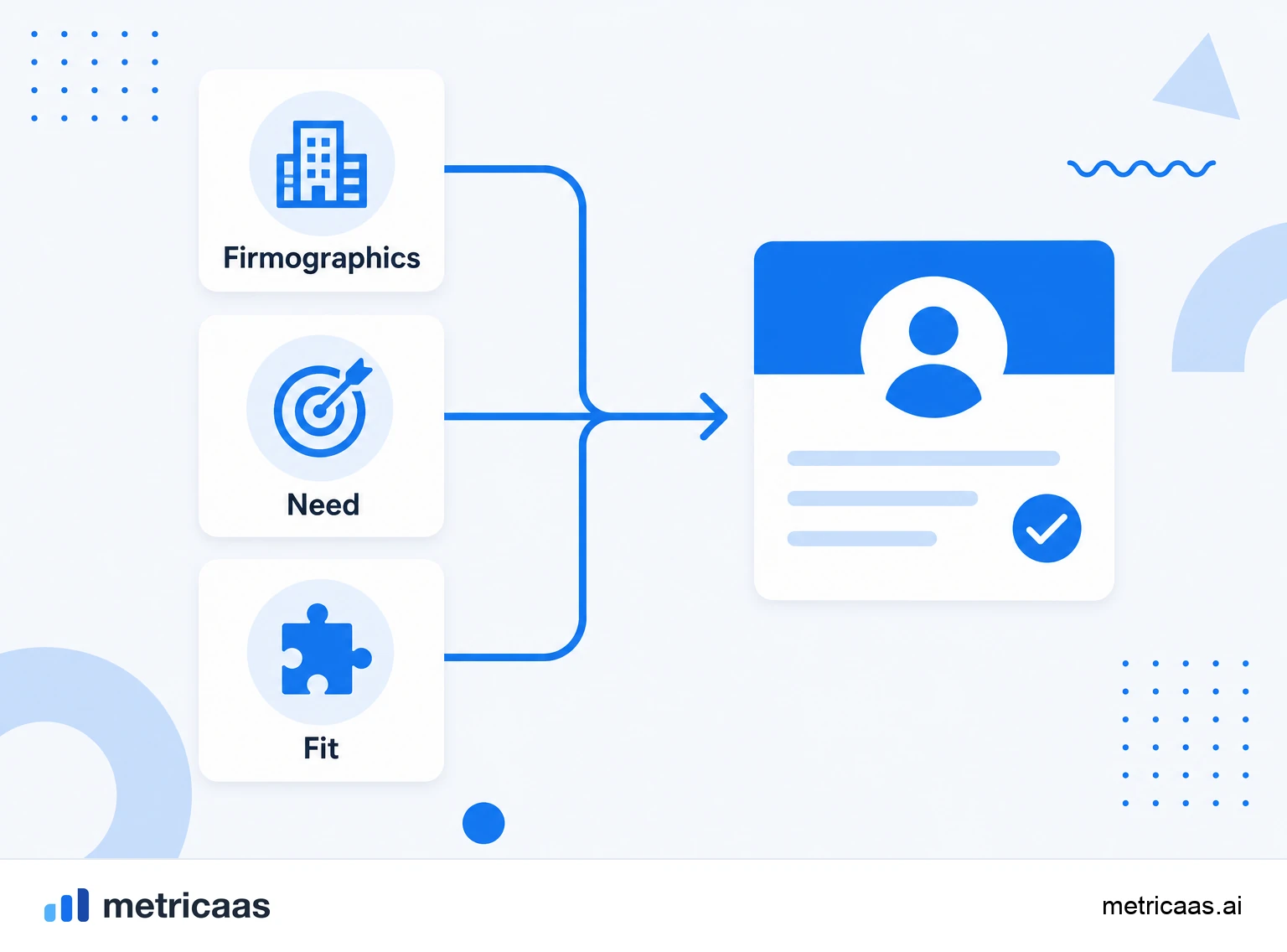
A useful ICP rests on three layers. Firmographics describe the observable attributes of the company: industry, size (headcount or revenue), geography, business model and technical maturity. Need describes the concrete pain your product solves and why it is urgent enough to become a budget priority. Fit joins the two and adds compatibility signals such as budget, existing stack and the ability to implement.
- Firmographics: industry, size, geography, revenue model.
- Need: the pain the product solves and how urgent it is.
- Fit: budget, stack, processes and maturity to succeed.
The sharper these layers, the easier it is to design campaigns, sales scripts and qualification criteria around a real target. That sharpness is what connects the ICP to account-based marketing (ABM), where the target account list comes straight from the ideal customer definition.
ICP, persona and buyer: what each one is
Three terms often get confused, but they describe different things. The ICP is the ideal company, the account. The persona is the person inside that company: the role, goals, pains and daily routine of whoever will use or approve the product. The buyer is the buying role, whoever holds the budget and signs the contract, who is not always the person using the tool day to day.
In practice, you define the ICP first (which companies to pursue) and, within it, map personas and buyers (who to talk to and how to convince them). Reversing the order, starting from the persona without bounding the company, produces polished messaging that attracts the wrong accounts. The ICP is the filter; the persona and the buyer are the script for the conversation once the account has passed that filter.
How ICP lowers CAC and improves retention
Focusing on the ICP has a direct effect on SaaS economics. Accounts within the profile close faster, with shorter sales cycles and less discounting, which drives down CAC. After the sale, they activate better, ask for less out-of-scope support and renew more often, which sustains retention and opens room for expansion. It is the same customer paying back the acquisition cost sooner and generating more revenue over time.
Firms like Bessemer have argued for years that efficient growth comes from concentrating go-to-market on the best-fit accounts, not from spreading effort across the whole market. Retention is the scoreboard of that discipline: analyses such as the one from SaaS Capital show that companies with a well-chosen base retain revenue at consistently higher rates. A good ICP shows up, in the end, as low churn and revenue that expands on its own.
How to define your ICP
The most reliable way to define the ICP is not to guess, but to look at your best current customers. List the accounts that retain, expand and refer the most, and look for what they have in common in firmographics, need and fit. That pattern, written as objective criteria, is the draft of your ICP.
- Start from the customers that retain and expand best, not the biggest logos.
- Describe firmographics, need and fit as criteria a salesperson can actually apply.
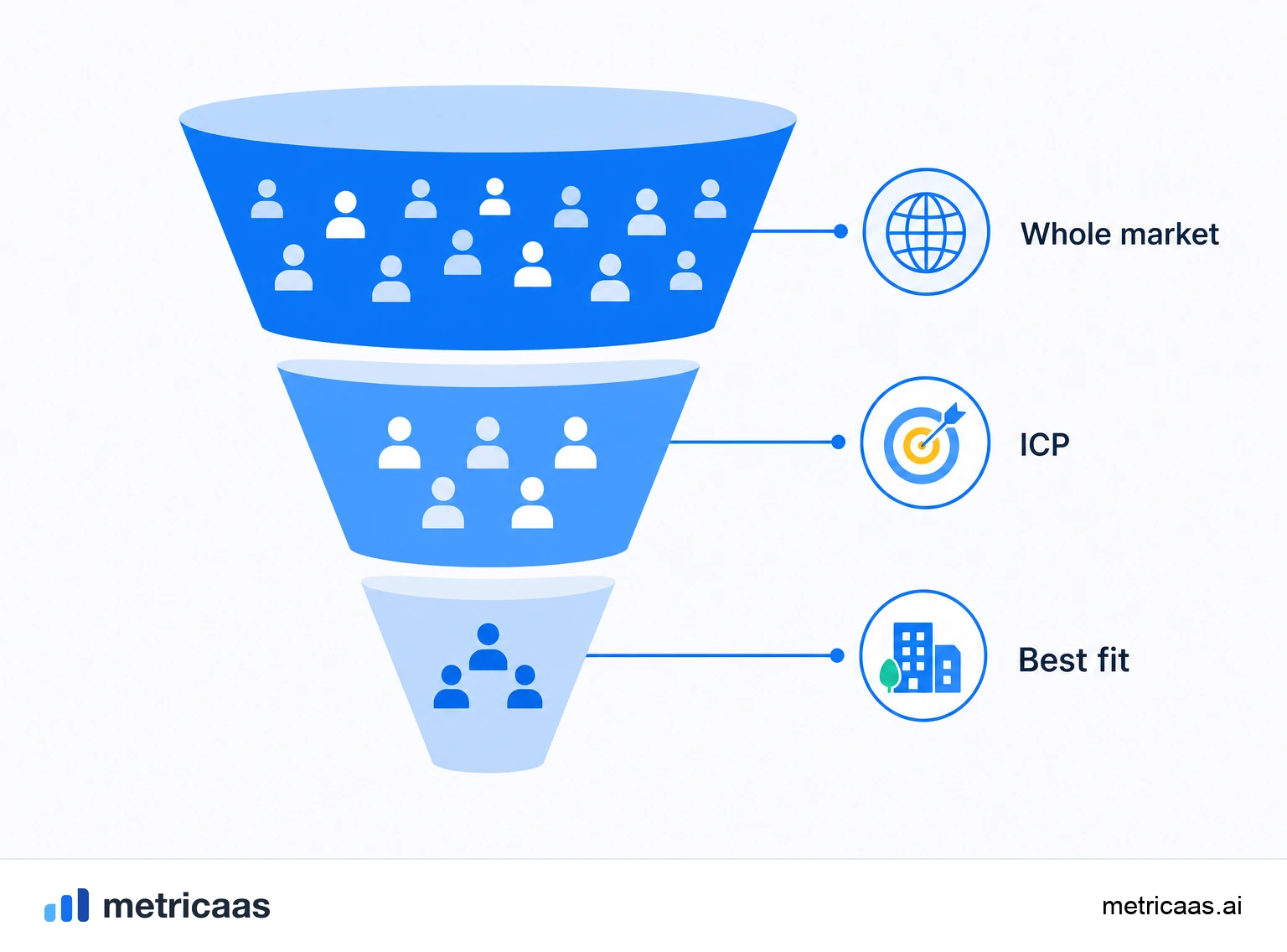
- Estimate how many accounts fit that profile; this is where the ICP connects to TAM / SAM / SOM.
- Revisit it every few quarters as the product and the market change.
The ICP is not set in stone: it narrows or shifts as you learn. What matters is that it is specific enough to guide decisions and be abandoned when the data shows another profile winning.
Common mistakes when targeting outside the ICP
The most expensive mistake is treating the ICP as slide decoration and selling to anyone who raises a hand. Accounts outside the profile look like revenue in the short term but charge a high price later: long sales cycles, aggressive discounting, painful implementation, above-average support and, almost always, churn. They inflate CAC and contaminate the metrics, hiding the real performance of the right accounts.
Other common slips are defining the ICP too broadly (so as not to say no to anyone), confusing the ICP with the persona, and never revisiting the profile. The best test is simple: if your ICP does not exclude a meaningful part of the market, it is not ready yet. Saying no to the wrong accounts is what makes the ICP worth having.
Frequently asked questions
An ICP (Ideal Customer Profile) is the profile of the company that gets the most value from your product and gives the most back in retention, expansion and referrals. It combines firmographics, need and fit criteria.
The ICP describes the ideal company (the account); the persona describes the person inside it (role, pains, goals). You define the ICP first, then the personas and buyer within it.
By looking at the current customers that retain, expand and refer the most, and turning what they have in common (firmographics, need, fit) into objective criteria. Revisit it every few quarters.
The ICP concept is typical of B2B, where the customer is a company with clear firmographics. In B2C the focus tends to sit on the persona and consumer segments, though the logic of fit and retention is similar.
Because accounts within the profile close faster, with less discounting, and retain better. The acquisition cost is paid back sooner and the same account generates more revenue over time.
No. A target audience is broad and demographic; the ICP is a specific slice of the customer that works best, defined by firmographics, need and fit, and built to guide sales and marketing.
Related concepts

Product-market fit (PMF)
Product-market fit (PMF) is the fit between the product and a strong, real market demand, the point where the product starts to pull on its own. The signals are retention that flattens, organic growth and word of mouth, and a large share of users who would be very disappointed without the product. Without PMF, scaling acquisition only accelerates churn.

TAM / SAM / SOM
TAM, SAM and SOM are three nested market sizes. TAM (Total Addressable Market) is the total demand if you served everyone; SAM (Serviceable Available Market) is the slice your product and model actually serve; SOM (Serviceable Obtainable Market) is what you can realistically capture in the near to medium term. Together they frame ambition, focus and the valuation narrative.

Account-based marketing (ABM)
Account-based marketing (ABM) is a B2B strategy that treats specific high-value target accounts as "markets of one", with marketing and sales aligned and messaging personalized per account, instead of generating leads in bulk. It inverts the funnel: it starts from the right accounts, defined by the ICP, and concentrates every effort on them. It fits a narrow ICP and high deal sizes, and is measured by account engagement and revenue, not by lead volume.