
SLA: what a service level agreement is and how it works
By Tiago Costa · Updated on July 9, 2026
Definition
An SLA (Service Level Agreement) is the contractual commitment to a SaaS service quality, with targets such as guaranteed uptime and support response time.
- Sets objective targets for availability and support.
- Defines credits or penalties when the targets are missed.
- Gives the customer predictability and becomes a selling point in enterprise.
What an SLA is
An SLA (Service Level Agreement) is the part of the contract that defines, in numbers, the service quality a SaaS vendor promises to deliver. Instead of a vague promise that the product will work, the SLA sets objective targets, such as monthly availability and the time to respond to a ticket, and spells out what happens if they are not met.
It exists because the customer is outsourcing something critical to their own business. By signing an SLA, the vendor turns trust into a measurable obligation, and the customer gains predictability over a service they do not control. That is why the SLA is central to enterprise sales, where legal and procurement read every clause before closing.
What goes into an SLA
A well-written SLA is specific and measurable. It avoids adjectives and swaps "reliable service" for numbers you can audit every month.
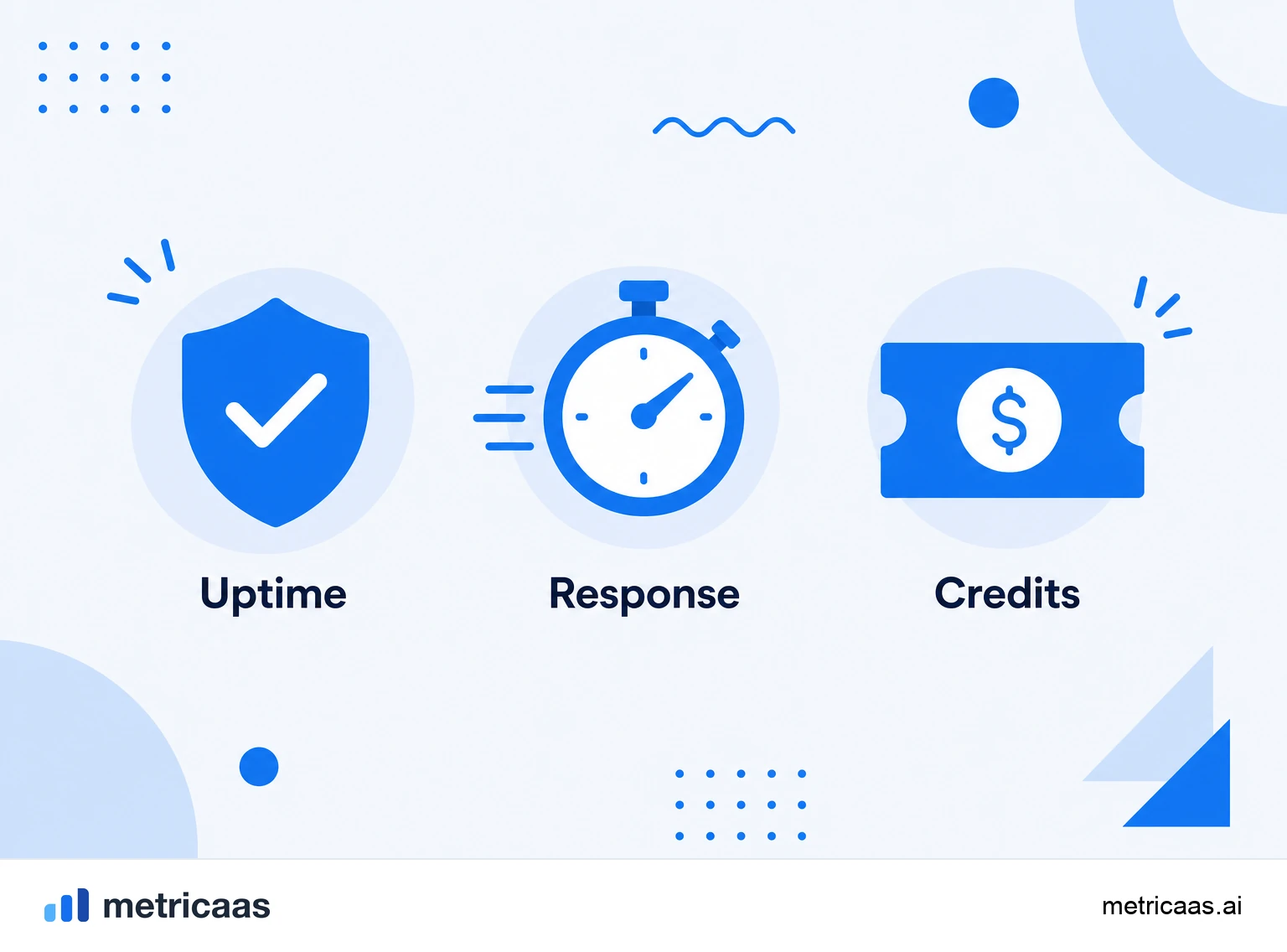
- Guaranteed uptime: the minimum availability, almost always expressed as a monthly percentage.
- Response and resolution time: how fast support acknowledges and resolves a ticket, usually by severity.
- Maintenance windows: the planned periods that do not count as downtime.
- Credits and penalties: the compensation owed when the target is missed.
- Support channels and hours: where and when the customer can ask for help.
The more precise these definitions, the smaller the chance of a dispute later. A good SLA even makes clear how availability is measured, because the same outage can count or not depending on the method.
What 99.9% uptime means
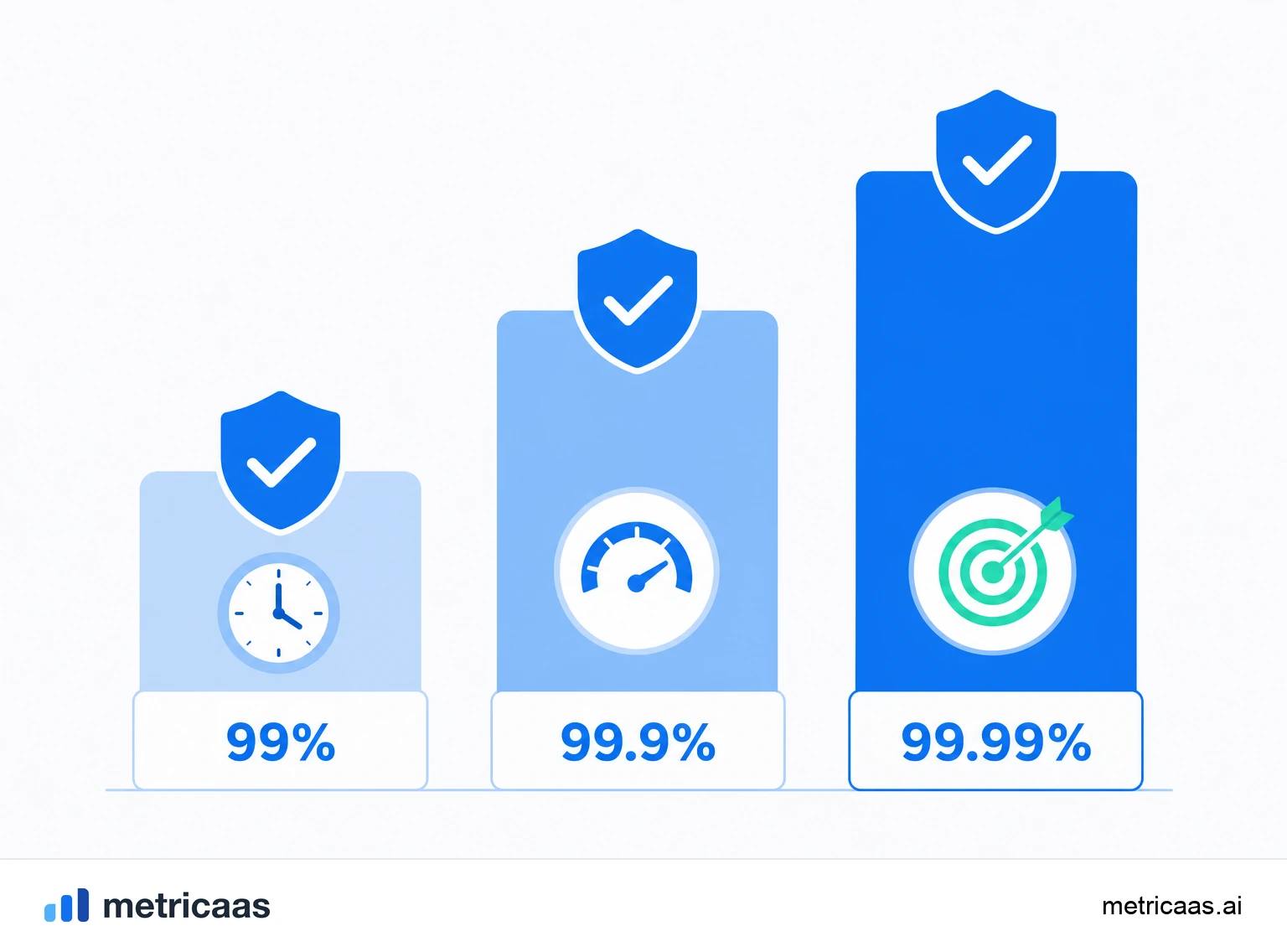
The most visible number in an SLA is availability, almost always expressed as a percentage of time online. Intuition is misleading: the gap between 99% and 99.9% looks small, but in downtime it is huge.
- 99%: about 3.65 days of downtime per year.
- 99.9% (three nines): about 8.76 hours per year.
- 99.99% (four nines): about 52.6 minutes per year.
- 99.999% (five nines): about 5.26 minutes per year.
That is why each extra nine costs dearly in engineering and redundancy. A 95% SLA, for example, allows more than 18 days of downtime per year, which is rarely acceptable for a mission-critical service.
SLA, SLO and SLI: the differences
Three similar acronyms describe different layers. The SLA is the external agreement, with contractual consequences. The SLO (Service Level Objective) is the internal target the team pursues, almost always stricter than the SLA to build a safety margin. The SLI (Service Level Indicator) is the indicator actually measured, such as the percentage of successful requests.
- SLI: what you measure.
- SLO: the internal target you want to hit.
- SLA: the contractual promise to the customer, with a penalty if it fails.
The practical order is to measure the SLI, set an SLO comfortably above the SLA, and only then promise the SLA to the customer. That way the team notices the problem before it becomes a breach of contract.
SLA credits and penalties
What gives an SLA teeth are the consequences. The most common mechanism is the service credit: if availability drops below what was promised, the customer gets back a percentage of what they paid, usually on a scale that grows as the failure worsens.
It is worth knowing the limits of this model. The credit is usually proportional to the subscription fee, not to the customer real loss, and it almost always has to be claimed within a deadline. For the vendor, paying credits often is an operational warning, not just a financial one: it signals that the service is eroding the trust the contract was meant to protect.
Why the SLA matters for SaaS
A well-calibrated SLA is both a shield and a selling point. It bounds the vendor responsibility and signals maturity to the buyer. As more operations move to the cloud, and Gartner forecasts worldwide public cloud spending to reach $723 billion in 2025, the availability guarantee stops being a detail and becomes a decision criterion.
The impact goes beyond the contract. Repeated outages and missed SLAs drag down the customer health score and are one of the classic triggers of churn in enterprise accounts. Treating the SLA as a living promise, monitored and kept, is a direct way to protect recurring revenue.
Frequently asked questions
It is the service level agreement, the part of the contract that defines in numbers the quality a SaaS vendor promises: guaranteed uptime, support response time and the penalties if the targets fail.
It means the service can be unavailable at most about 8.76 hours per year, or a little over 43 minutes per month. It is the tier known as three nines.
A 95% SLA allows more than 18 days of downtime per year. It is a low guarantee, rarely acceptable for a mission-critical service.
The common split is three: the customer-based SLA (an agreement tailored to one customer), the service-based SLA (the same terms for all customers of a service) and the multi-level SLA, which combines layers for different audiences.
The SLA is the contractual promise to the customer, with a penalty. The SLO is the internal target the team pursues, stricter than the SLA. The SLI is the indicator actually measured, such as the percentage of successful requests.
The customer is usually entitled to service credits, a refund of part of what was paid, proportional to the failure. The credit almost always has to be claimed within a deadline defined in the contract.
Related concepts

Uptime
Uptime is the percentage of time a service is available and working over a period. It is usually expressed in "nines": 99% allows about 3.65 days of downtime per year, 99.9% about 8.8 hours and 99.99% about 52 minutes. It is the heart of an SLA and a direct driver of trust and retention.
Churn
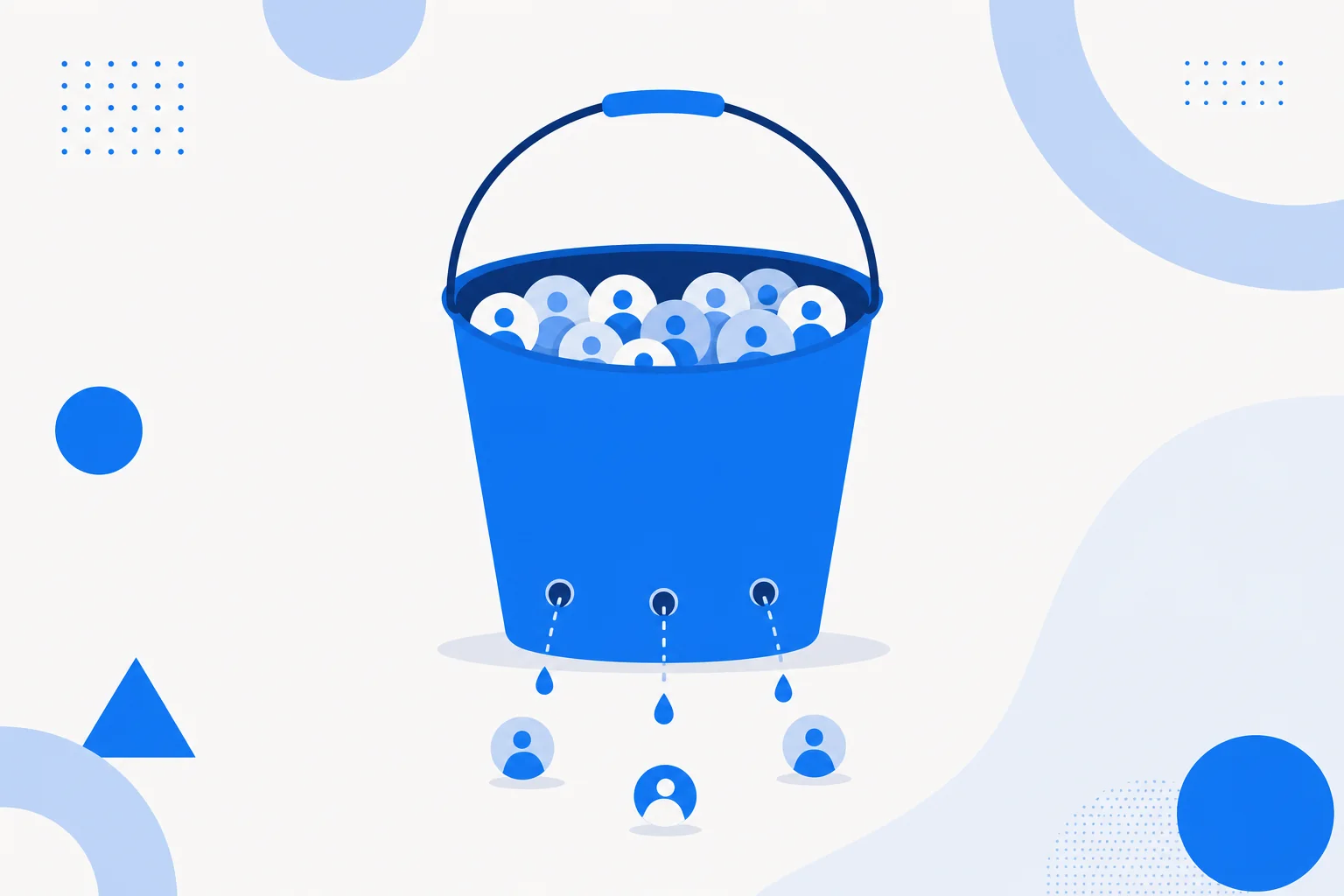
Churn is the loss of customers or revenue in a period. In a SaaS, it measures how many customers cancel (customer churn) or how much recurring revenue disappears (revenue churn). It is the metric that reveals whether growth is sustainable: the higher the churn, the more new sales you need just to avoid shrinking.
Customer health score
A customer health score is a composite score that estimates the health and risk of each customer by combining signals of product usage, engagement, support and payment. It exists to act before churn and to prioritize the accounts with the most value at risk. It is not a magic number, but a method to turn scattered signals into a single, actionable reading.