
Run rate: what it is, how to calculate it and the difference from ARR
By Tiago Costa · Updated on July 9, 2026

Definition
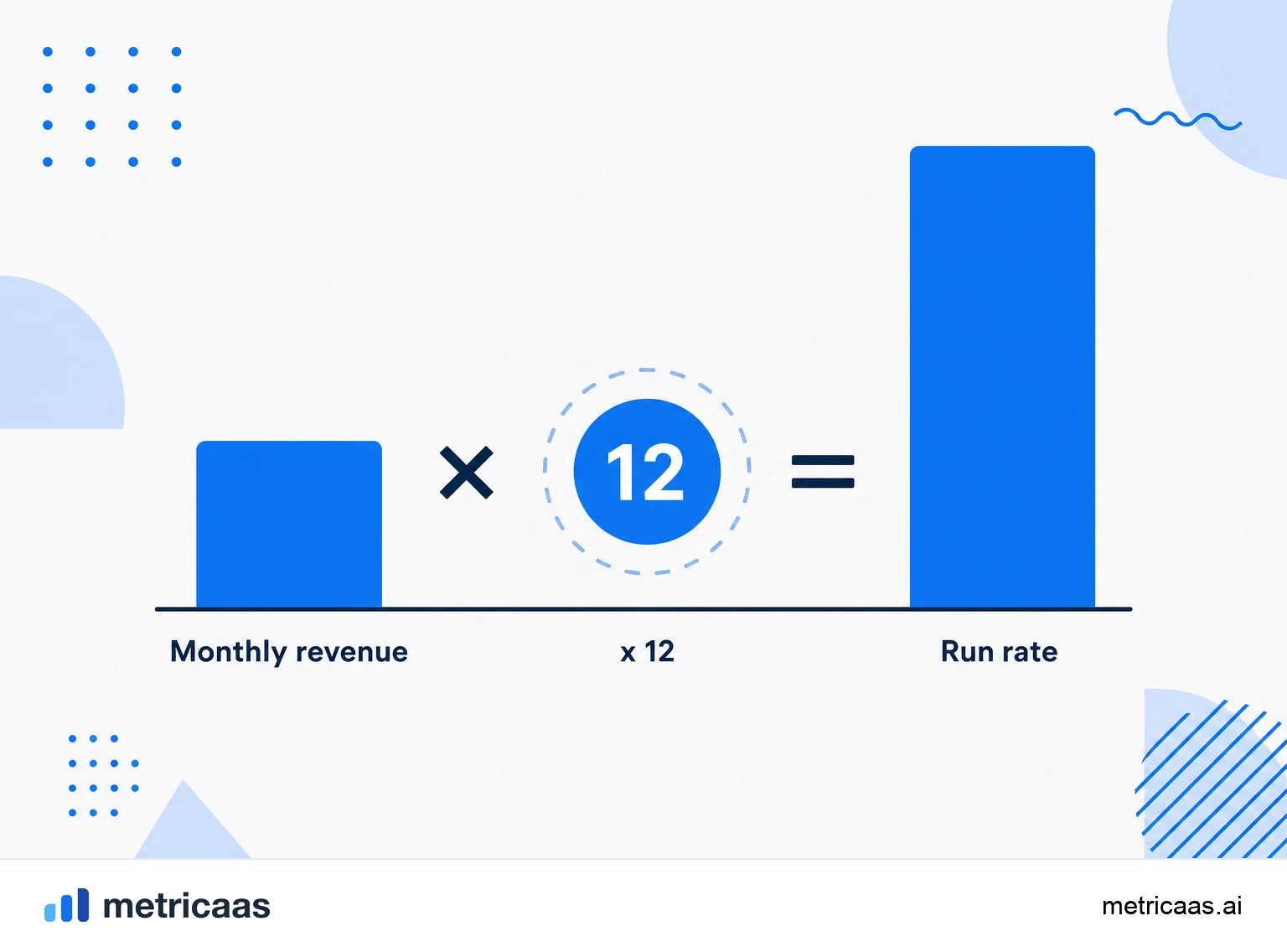
Run rate is annualized revenue projected from a recent period, like MRR multiplied by 12.
- It extrapolates the current pace as if it held for a year.
- It gives a quick read of the scale of the business.
- It misleads when the period used is not representative.
What run rate is
Run rate is an annualized revenue projection built from a recent period. The idea is simple: you take the current pace of the business, for example one month or one quarter of revenue, and stretch it to twelve months as if that pace would stay constant. The result is a quick estimate of how much the company would earn in a year if nothing changed.
It is an extrapolated snapshot, not a contracted number. That is why run rate works well for an instant read of the scale of the business, but it carries a strong assumption: that the period used is representative. In a SaaS, the most common version starts from MRR multiplied by 12.
How to calculate run rate
The calculation is a direct extrapolation: pick a recent period, measure its revenue and multiply by the factor that turns it into a year.
- From the month: run rate = month revenue x 12.
- From the quarter: run rate = quarter revenue x 4.
- From MRR: in SaaS, run rate = MRR x 12.
Example: if last month closed at $80k of revenue, the annual run rate is $960k. The shorter the period used, the more sensitive the number is to one-off swings, so the choice of window matters as much as the math itself.
Run rate and ARR: what is the difference
Run rate and ARR can land on similar numbers, but they start from different bases. A well-built ARR sums only the contracted recurring revenue of active subscriptions. Run rate annualizes a recent result, which may include one-off charges, ad hoc services or a seasonal spike.
- ARR: starts from what is recurring and contracted.
- Run rate: starts from what happened in a period, recurring or not.
When the period used in the run rate contains only clean recurring revenue, the two coincide. The gap appears precisely when the month had something that will not repeat, and then run rate inflates while ARR stays faithful to recurrence.
Run rate and recurring revenue
Confusing run rate with recurring revenue is one of the most common mistakes. Recurring revenue is what the customer pays repeatedly and predictably for the subscription. Run rate is only an annualized projection, which may or may not be built from recurring revenue.
If you annualize a month made only of subscriptions, run rate reflects recurring revenue. If you annualize a month that also had an expensive one-time implementation, run rate mixes the recurring with the one-off and stops being a good measure of predictable revenue. Rebuilding the number from MRR movements helps separate what is recurring from what is noise.
When run rate misleads
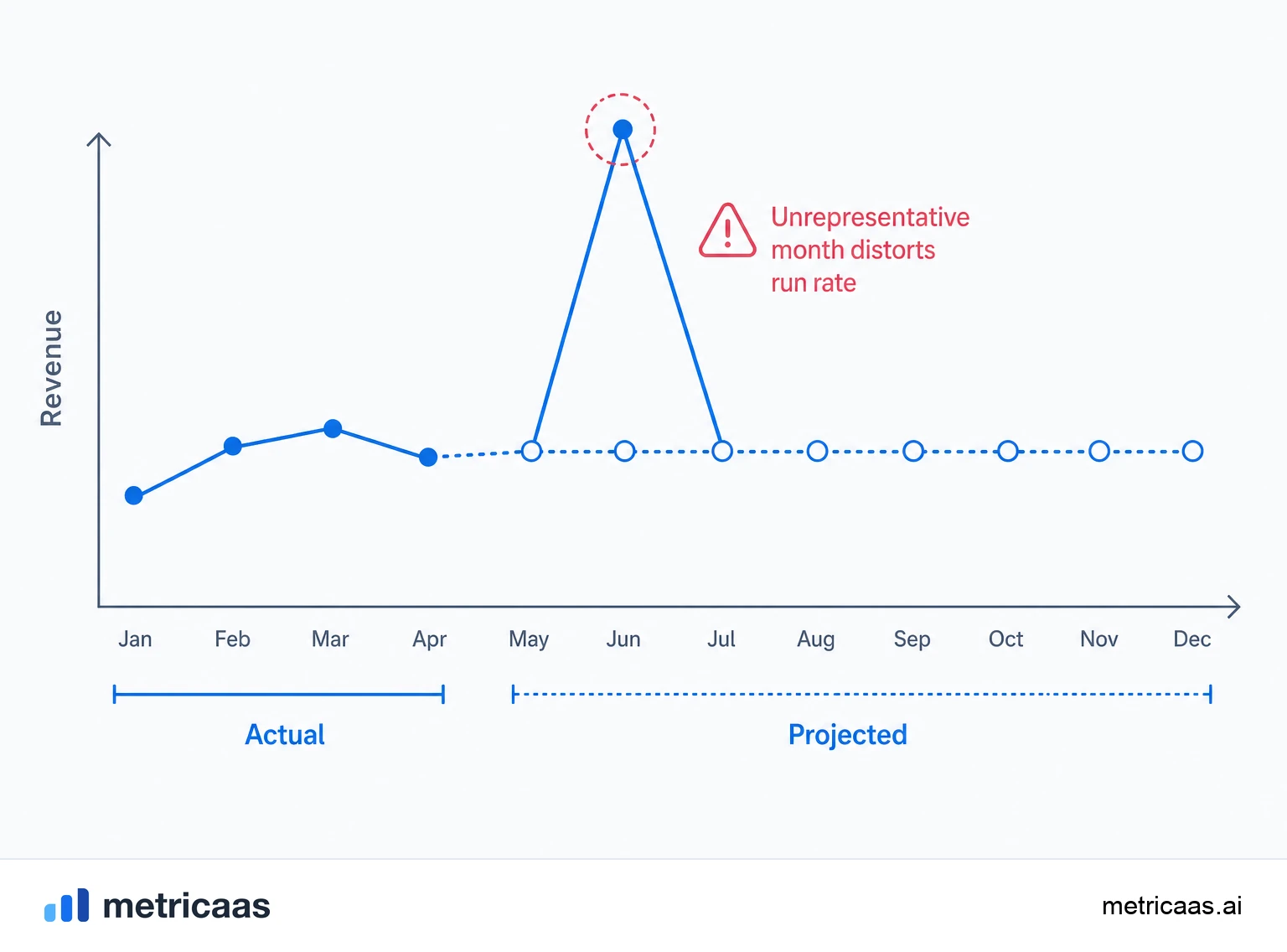
Run rate is only as good as the period it starts from. Because it assumes the current pace holds, any distortion in that period is multiplied by twelve and becomes a misleading projection.
- Seasonality: annualizing a peak month (or a trough) projects the whole year at the wrong pace.
- One-off charges: a single large sale inflates run rate as if it were recurring.
- Recent changes: high churn or a new launch do not yet show up in a single month.
That is why run rate is more reliable in stable, mature businesses, and more treacherous in young, seasonal or fast-changing companies. In those cases, it says more about the recent past than about the future.
How to use run rate responsibly
Used carefully, run rate is a useful tool for quick reads and communication. It gives an immediate sense of scale, helps compare periods and serves as a base for targets, as long as everyone knows it is an extrapolation, not a guarantee.
The best practice is to annualize only clean recurring revenue, choose a representative period and revisit the number whenever the business changes pace. The market it tries to project is huge: according to Gartner, worldwide spending on SaaS applications is set to approach $300 billion in 2025. And because run rate depends on revenue holding up, it only holds true when retention keeps the base, something the private SaaS survey by KeyBanc Capital Markets shows with net revenue retention above 100%.
Frequently asked questions
Revenue run rate is annualized revenue projected from a recent period, such as one month of MRR multiplied by 12. It shows how much the company would earn in a year if the current pace held.
By multiplying the revenue of a period by the factor that annualizes it: month revenue by 12, or quarter revenue by 4. In SaaS, MRR x 12 is common.
Recurring revenue is what the customer pays repeatedly for the subscription. Run rate is an annualized projection, which may start from recurring revenue or include one-off charges.
Not exactly. ARR starts from contracted recurring revenue; run rate annualizes a recent result, which may include non-recurring revenue and inflate the number.
It is the run rate calculated from the most recent period available, usually the last closed month or quarter, to reflect the most current pace of the business.
When the period used is not representative: seasonal months, one-off charges or recent changes distort the projection, because run rate multiplies that period by twelve.
Related concepts

ARR
ARR (Annual Recurring Revenue) is the annual recurring revenue of a SaaS: MRR multiplied by 12. It represents how much the company earns on a recurring basis over a year, counting only active subscriptions, with no one-off charges. It is the metric of choice for companies selling annual contracts and the standard language of investors.

MRR
MRR (Monthly Recurring Revenue) is the monthly recurring revenue of a SaaS: the sum of all active subscriptions normalized to a month. It is the core metric of a subscription business because it shows, predictably, how much the company earns on a recurring basis each month, without counting one-off charges.

MRR Movements
MRR movements are the breakdown of the monthly change in MRR into its causes: new, expansion, contraction, churn and reactivation MRR. Instead of watching only the final number, you separate every dollar that came in and every dollar that left, and see why recurring revenue grew, stalled or fell. The sum of all movements is the net new MRR for the period.