
Proof of concept (POC): what it is and how to structure it in SaaS sales
By Tiago Costa · Updated on July 9, 2026

Definition
A proof of concept (POC) is a guided, scoped test that proves, before the contract, that the product delivers the promised value in the customer environment.
- Common in enterprise sales, at the end of the cycle.
- A good POC has clear success criteria and a short timeframe.
- Without scope it becomes an endless trial that stalls the deal.
What a proof of concept (POC) is
A proof of concept, or POC, is a guided, scoped test that proves, before the contract is signed, that the product delivers the promised value in the customer real environment. Instead of trusting the sales demo alone, the buyer runs the software with their own data, their own users and their own use cases, to see with their own eyes whether the solution solves the problem.
The POC is typical of enterprise sales, the high-ticket deals with several decision-makers, and usually shows up at the end of the sales cycle, once the customer already understands the proposal and needs concrete evidence to justify the purchase internally. It is not a discovery stage, it is a validation stage.
POC, pilot and free trial: the differences
Three similar formats, different purposes. Confusing them is one of the most common reasons deals drag on.
- POC: a short, guided test with defined scope and success criteria, to prove a specific value before the contract.
- Pilot: a limited rollout already in real production conditions, with an actual team or department, almost always with a contract (or pre-contract) and a longer timeframe.
- Self-serve free trial: the user signs up and explores the product alone, with no sales guidance, common in self-serve models.
The core difference of the POC is the guidance: there is a vendor sales and customer success team running the test against agreed objectives. A trial without that guidance and without scope is not a POC, it is just loose access that rarely turns into a decision.
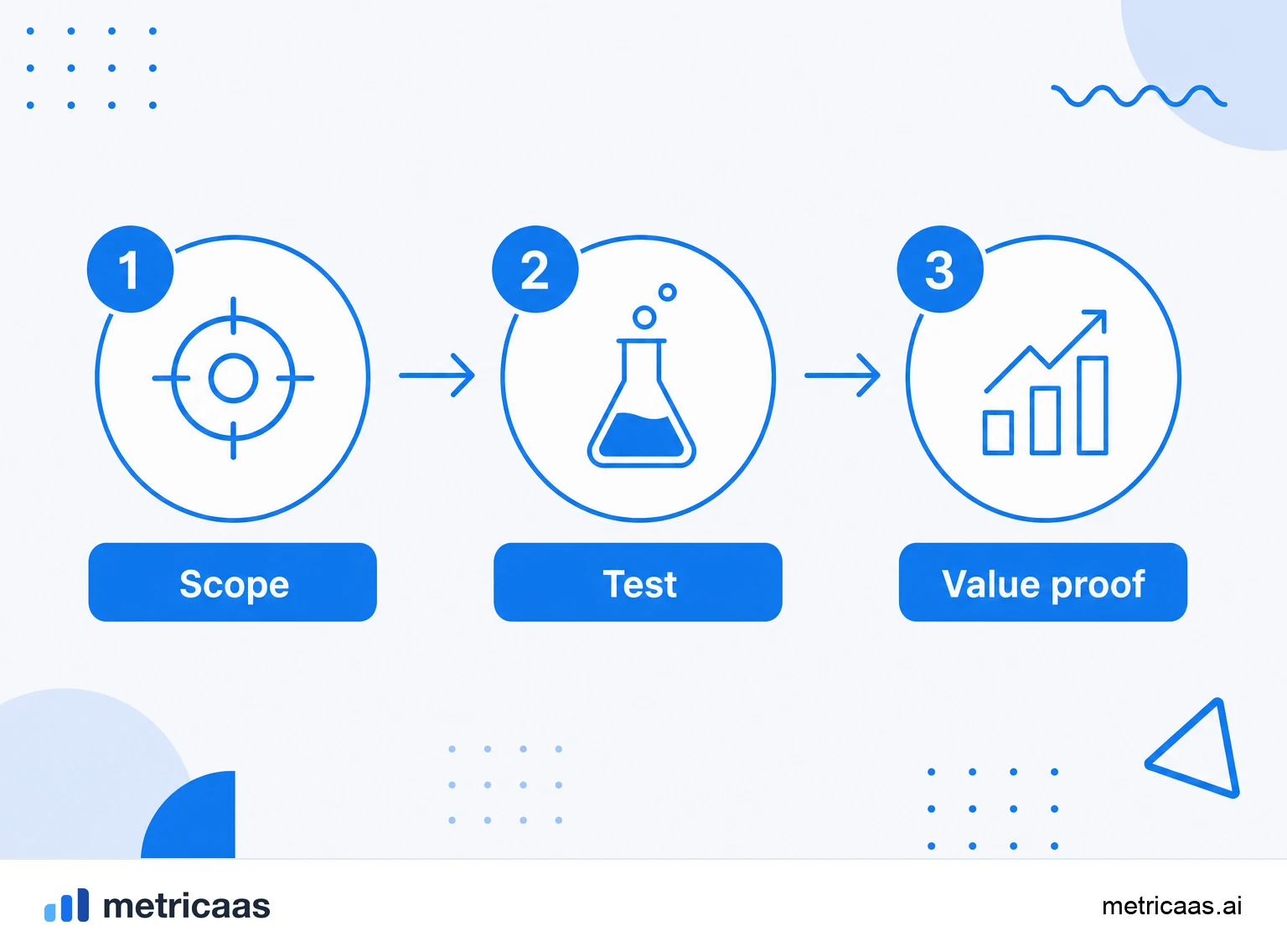
How to structure a good POC
A good POC is planned before it starts. The scope document, often called a success plan, defines in one page what will be tested and what counts as passing.
- Objective: which business problem the POC must prove it solves.
- Success criteria: objective metrics or milestones, agreed with the customer, that decide pass or fail.
- Scope: which integrations, which data and which use cases are in, and what stays out.
- Timeframe: a start date and an end date, short enough to keep a sense of urgency.
- Owners: who, on each side, decides at the end.
Without these five points written down and agreed by both sides, the POC becomes a moving target. The best moment to negotiate the success criteria is before it starts, never after the customer has already seen the product running.
The trap of the unscoped POC
The poorly defined POC is where enterprise deals die slowly. With no success criteria and no timeframe, it turns into an endless trial: the customer always finds one more use case to test, one more integration to validate, and the decision never arrives.
That dragging has a real cost. Every extra week of POC consumes sales engineering and customer success hours, pushes revenue further out and inflates the CAC of that deal. Worse, a never-ending POC is often a sign that the buyer has no urgency or no decision-making power. The fix is to agree on the timeframe and the criteria right at the start and to treat the end of the POC as a commitment: if it passes the criteria, it moves to the contract; if not, the reason is clear and documented.
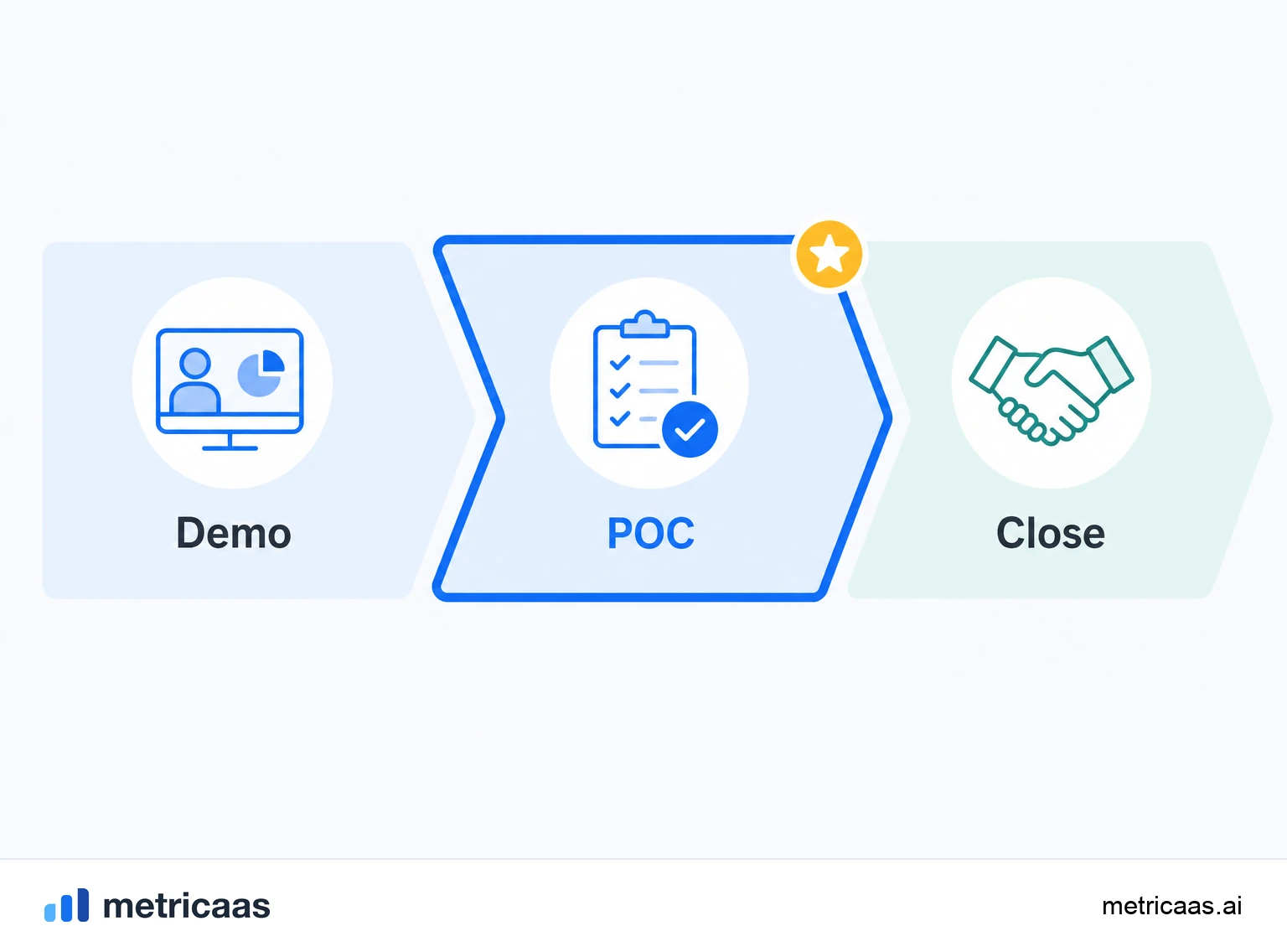
The POC within the sales cycle
The POC almost always lives at the end of the sales cycle, after discovery and the proposal, once the deal is qualified and only the last technical doubt remains. Placing it too early is expensive: you spend technical resources on someone who has not even decided to buy.
Run well, the POC raises the win rate, because a buyer who has seen the value in their own environment has far less reason to back out. Run poorly, it becomes the bottleneck that stretches the cycle and drops the conversion rate. That is why the rule for when to offer a POC, and to whom, is a commercial decision as important as the test itself.
Why the POC matters for the business
Proving value in the customer environment has become almost mandatory in enterprise software. With Gartner forecasting worldwide public cloud spending to pass $700 billion in 2025, the enterprise buyer has plenty of options and demands evidence before committing budget. The POC is the mechanism that turns a promise into proof. See the figure at Gartner.
But it is also a mirror of product-market fit: if POCs fail often, or need huge customizations to pass, the product may not yet solve the problem as well as the sale promises. Firms such as Benchmarkit track how much of the enterprise funnel runs through a POC and how that affects time to close. Reading POCs as data, and not just as a stage, helps calibrate pricing, scope and the sales strategy itself.
Frequently asked questions
POC stands for proof of concept. It is a guided, scoped test that proves, before the contract, that the product delivers the promised value in the customer environment.
The customer runs the product with their own data and use cases, guided by the vendor team, against success criteria and a timeframe agreed at the start. At the end, you measure whether the criteria were met.
A POC proves, in the customer environment and before the contract, that an existing product delivers value. An MVP is the minimum version of a product still being built, used to validate the idea with the market. Different stages and purposes.
A POC has scope, success criteria and sales guidance. A self-serve free trial is open access, with no guidance or agreed objectives, common in self-serve products.
Long enough to prove the success criteria and no longer. Short timeframes of a few weeks keep the sense of urgency. POCs with no end date tend to become an endless trial and stall the deal.
No. A POC is a short test to validate value before the contract. A pilot is a limited rollout already in production conditions, almost always with a contract or pre-contract and a longer timeframe.
Related concepts

Sales cycle
The sales cycle is the average time an opportunity takes from first contact to closed deal, moving through qualification, demo, proposal and negotiation. Short cycles enable a low CAC and fast cash; long cycles need a high deal size to justify the effort. Shortening the cycle improves sales efficiency and CAC payback.

Win rate
Win rate is the share of opportunities that turn into closed sales: deals won divided by the total deals closed (won plus lost) in a period. It measures commercial efficiency and the quality of the pipeline and qualification. A low win rate with high volume usually points to poorly qualified leads or weak fit, and raising the rate is one of the most direct ways to lower CAC.

Product-market fit (PMF)
Product-market fit (PMF) is the fit between the product and a strong, real market demand, the point where the product starts to pull on its own. The signals are retention that flattens, organic growth and word of mouth, and a large share of users who would be very disappointed without the product. Without PMF, scaling acquisition only accelerates churn.