
North Star Metric: what it is, how to define it and examples
By Tiago Costa · Updated on July 9, 2026

Definition
The North Star Metric (NSM) is the single guiding metric that captures the value delivered to customers and predicts sustainable growth.
- Measures real value received, not vanity.
- Sits above the input metrics that feed it.
- Aligns product, marketing and sales on one goal.
What a North Star Metric is
The North Star Metric (NSM) is the single number a company elects to represent, above all others, the value its product delivers to customers. The question it answers is blunt: if you could track only one metric, which one, when it rises, would prove that customers are actually getting what they came for?
It does not replace the whole dashboard; it gives direction. Just as the pole star kept navigators on course, the North Star exists so that product, marketing and sales pull the same way instead of optimizing goals that contradict each other. A good NSM has three marks: it reflects value received by the customer, it predicts future revenue, and it can be moved by the teams work.
How to choose your North Star Metric
Choosing the North Star is less about finding a pretty number and more about pinpointing the moment a customer perceives value. Start from your product core question: which repeated action means the customer succeeded? A messaging tool thinks in messages exchanged; a lodging marketplace, in nights booked; a content app, in minutes consumed.
- Reflects value: rises when the customer wins, not when the company overcharges.
- Predicts growth: correlates with retention and future revenue, not just the past.
- Is actionable: teams can move the number with what they build.
- Is simple: it fits in one sentence and everyone gets it.
If the number climbs while customers cancel, you picked the wrong star. A good North Star is one that drags retention up as it grows.
The input-metric tree
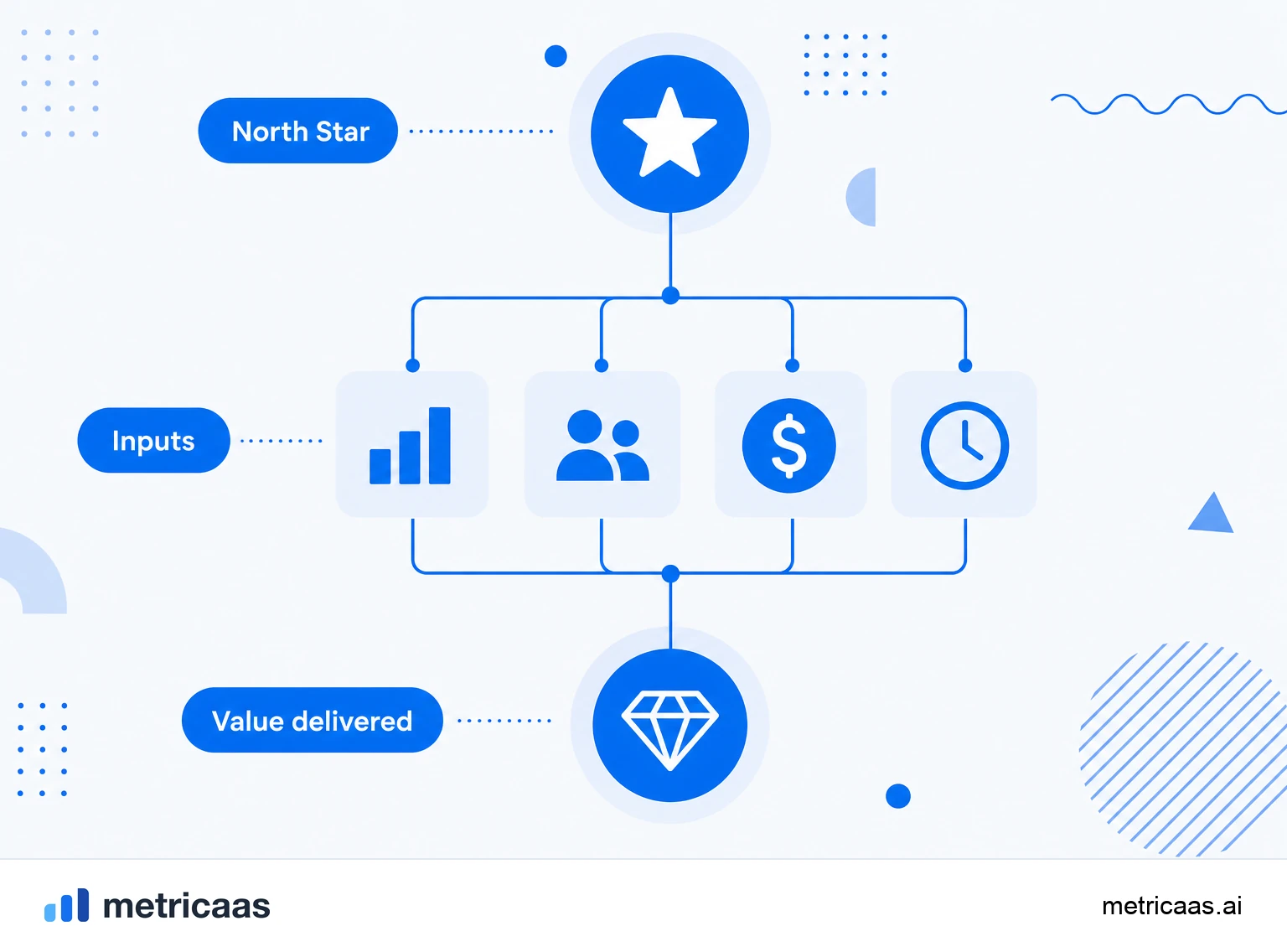
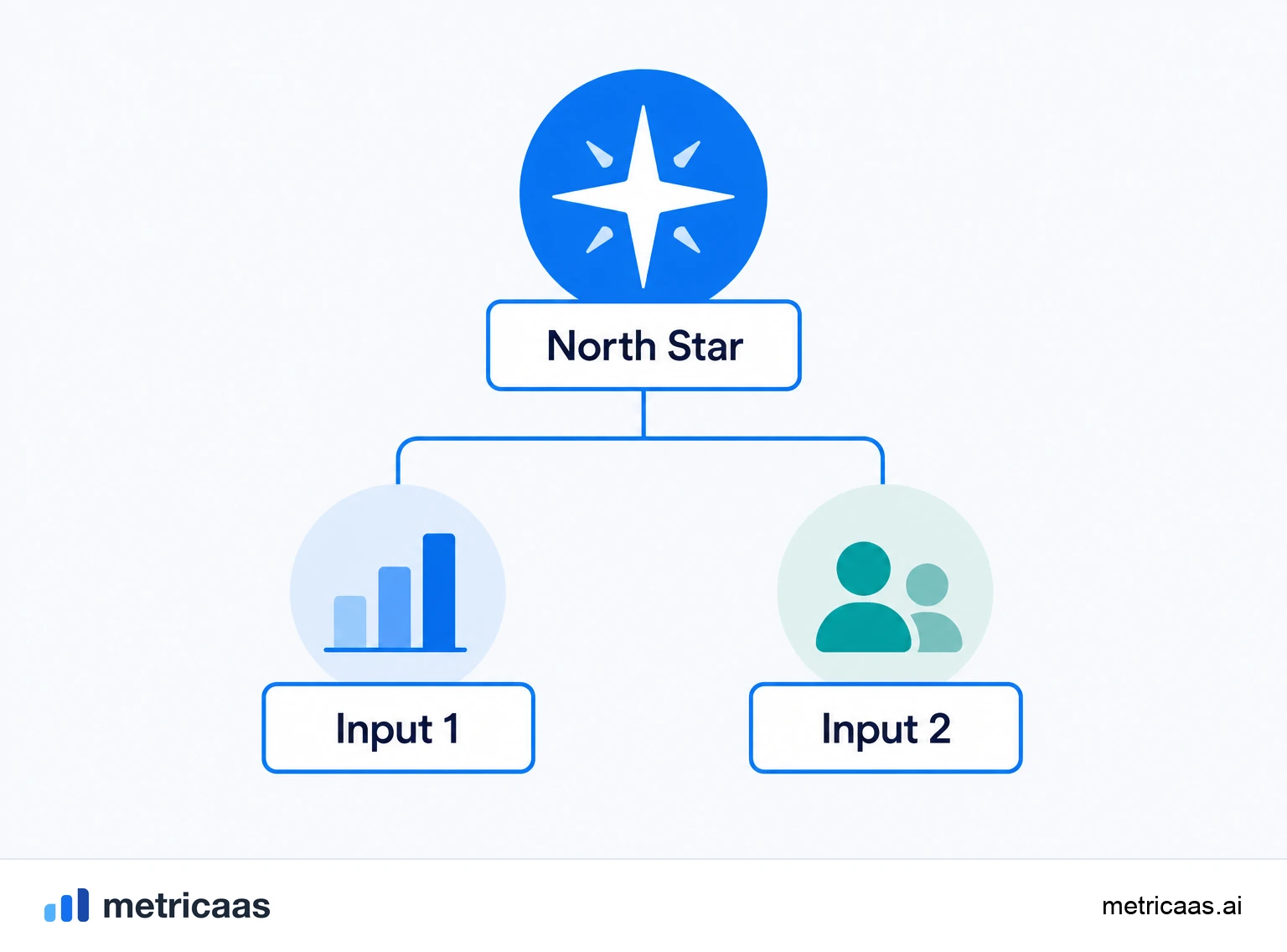
The North Star is almost never moved directly. It sits at the top of an input-metric tree: a small set of levers that, added together, push it up. Each team owns a branch of that tree, and it is on those branches that day-to-day work happens.
If the North Star is weekly active users who complete the value action, the inputs might be the activation rate of new users, the engagement rate of the base, and how often people come back, measured by DAU / MAU. Improving any of those branches nudges the star higher. This hierarchy is what turns an abstract metric into a concrete plan of work.
North Star Metric examples
The best examples share one thing: they measure a unit of value delivered, not of money extracted. A messaging service tracks messages sent; a lodging platform, nights booked; a music app, time listened; a collaboration tool, active documents per team.
Notice the pattern: each of these metrics grows precisely when the customer uses the product for what it is meant to do. Growth investors such as Sequoia and Bessemer have long argued for this logic, tying the internal scoreboard to the value the user receives. When the star measures value, revenue growth follows as a consequence, not as a target imposed from above.
North Star Metric vs vanity metrics
A vanity metric is one that goes up and makes everyone feel good but proves neither that the customer received value nor that revenue will come. Total sign-ups, cumulative downloads, followers and page views usually make the list: they grow even when the product is not truly used.
- Vanity: total sign-ups, downloads, pageviews. They rise on their own and do not predict retention.
- North Star: the repeated value action. It rises with the customer and predicts revenue.
The test is harsh and useful: if a metric can rise while customers leave, it is vanity. The North Star, by definition, does not decouple from retention. That is why it works as a compass while the vanity metric is, at best, decoration.
How the North Star aligns teams
The biggest gain from a North Star is not analytical, it is organizational. When product, marketing, sales and support chase the same number that represents customer value, they stop optimizing local goals that fight one another. Acquisition stops celebrating sign-ups that never activate; product stops piling on features nobody uses.
That alignment is the engine of product-led growth (PLG): product usage itself becomes the growth channel. And durable growth shows up in retention. SaaS Capital, which studies retention across private SaaS companies, shows why retention is the marker of growth that actually sustains itself.
Frequently asked questions
It is the single guiding metric that best captures the value a product delivers to customers and predicts sustainable growth. It sits above the input metrics that feed it.
A KPI is any performance indicator a team tracks; the North Star is the one indicator, above all others, that represents value delivered to the customer and to which the KPIs are subordinate.
Find the repeated action that means the customer succeeded and that drags retention up as it grows. It must reflect value, predict revenue and be actionable by the teams.
A metric that goes up and looks good but proves neither value nor revenue, such as total sign-ups or downloads. The North Star, by contrast, does not decouple from retention.
No. The North Star measures value delivered to the customer, like messages sent or nights booked; revenue is the expected consequence when that value grows. Tracking revenue alone does not say why it rises or falls.
The discipline, yes: choosing one number that represents value aligns the teams. The exact number varies by product, and it is worth revisiting when the value model changes.
Related concepts

DAU / MAU
DAU and MAU are the daily active users (Daily Active Users) and monthly active users (Monthly Active Users) of a product. The DAU/MAU ratio, obtained by dividing average DAU by MAU, is the stickiness metric: it shows what fraction of monthly users comes back on a typical day. Near 50% indicates a product of daily use; a low ratio indicates occasional use. The number only means something if "active" is defined honestly.

Engagement rate
Engagement rate measures how intensely the base uses the product: the share of users who perform the key value action in a period. There is no single formula, each product defines that action. High engagement precedes retention and expansion; low engagement precedes churn.

Product-led growth (PLG)
Product-led growth (PLG) is the growth strategy in which the product itself drives acquisition, activation, conversion and expansion, with little or no sales touch. The user enters through a free trial or a freemium plan, feels the value on their own and becomes a paying customer. The buying signal is no longer a filled-in form but usage: the PQL, the lead qualified by the product.