
Non-recurring revenue: what it is and why it stays out of MRR
By Tiago Costa · Updated on July 9, 2026

Definition
What non-recurring revenue is
Non-recurring revenue is all the money that comes in on a one-off basis, tied to items that do not repeat month after month: setup fees, implementation, professional services, training, customizations and consulting projects. It happens once (or sporadically) and creates no commitment to continue.
In a SaaS, this revenue lives alongside the recurring revenue from subscriptions, but it has the opposite nature. While the subscription renews and sustains MRR, non-recurring revenue is an isolated event in time. Understanding that difference is the first step to not confusing billing with predictable revenue.
Examples of non-recurring revenue
The most common examples appear at the start of the customer relationship or at specific moments of the contract:
- Setup and onboarding: a fee charged once to configure the account.
- Implementation and integrations: technical projects to connect the product to the customer systems.
- Professional services and consulting: specialist hours billed separately.
- Training and certifications: enabling the customer team.
- On-demand customizations: specific development that does not become a recurring product.
They all share one thing: they deliver value once and create no payment obligation the following month. That is why they are treated separately from the subscription.
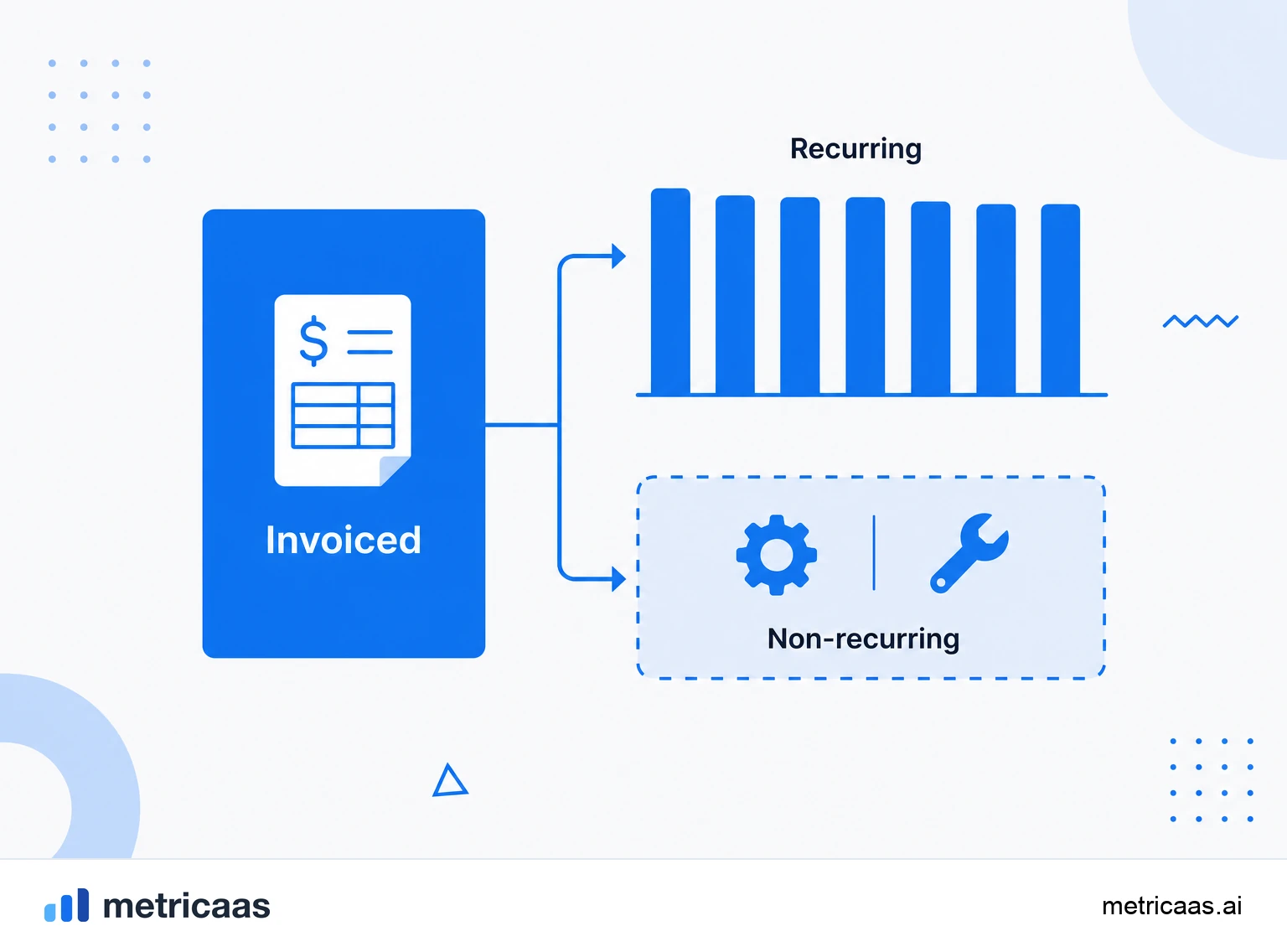
Why it stays out of MRR and ARR
MRR and ARR exist to measure only what is predictable and repeats. Because non-recurring revenue has no guaranteed renewal, including it in these metrics would break their core promise: to show the stable base of the business.
Imagine adding a $10k setup fee to the month MRR. The number goes up, but the next month that value does not return, and the metric then shows a drop that does not represent lost customers. Keeping non-recurring revenue out of MRR and ARR is what keeps these metrics reliable for forecasting cash and measuring growth.
High billing is not recurring revenue
A classic mistake is to look at total monthly billing and treat it as recurring revenue. Months with many implementation or consulting projects can inflate billing without the subscription base having grown a cent.
This distortion is dangerous for two reasons: it creates the illusion of growth that will not hold and leads to wrong hiring and investment decisions. Annualizing a strong month of services, as if it were recurring, is the same trap as a poorly built run rate. The right ruler is always to separate what repeats from what was one-off.
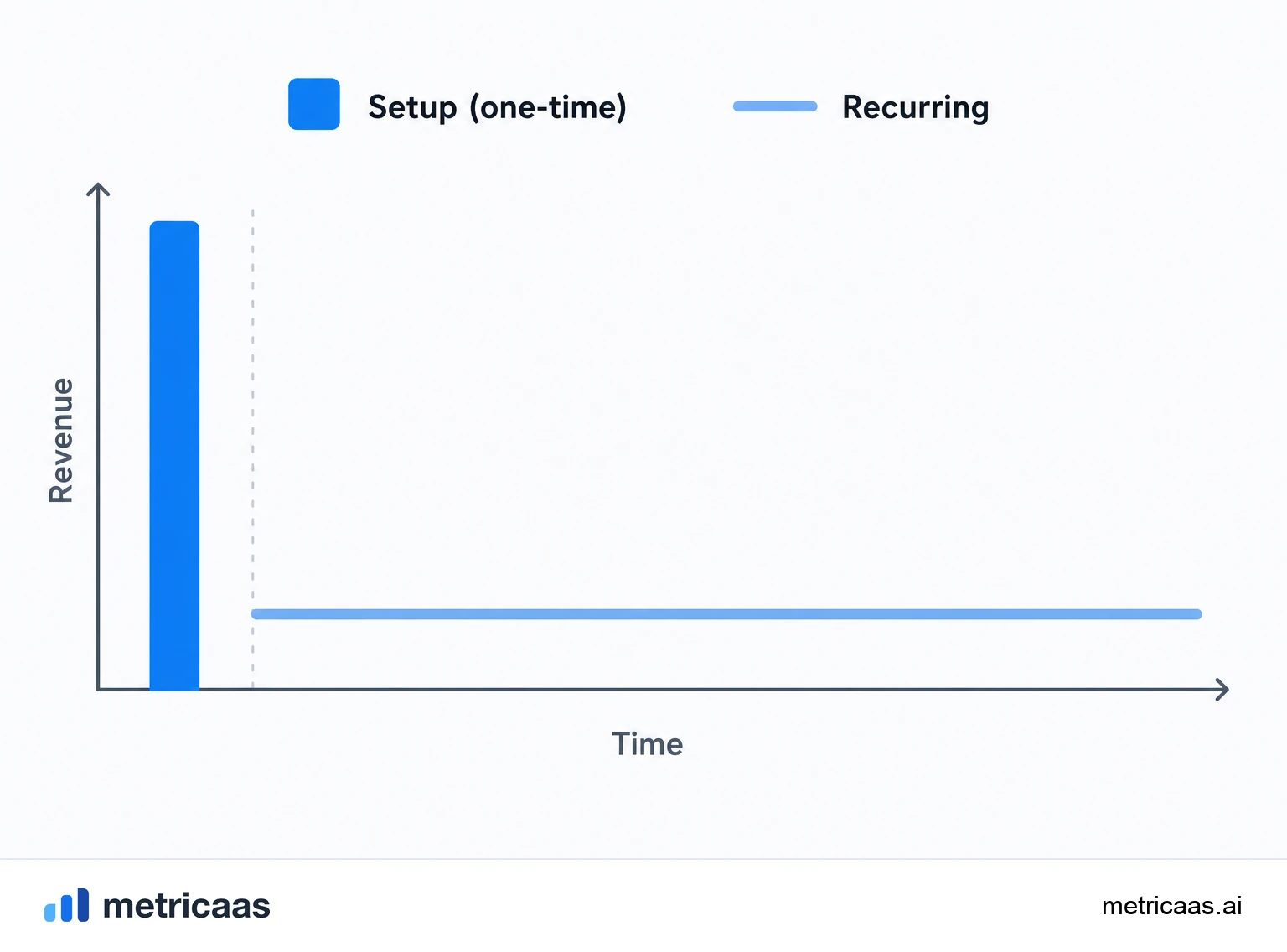
How to record and separate non-recurring revenue
The good practice is to record non-recurring revenue on its own line, distinct from subscriptions, right from the invoice. This lets you read two clean numbers: recurring revenue (which feeds MRR) and non-recurring revenue (which enters only total billing).
- Flag each invoice item as recurring or non-recurring.
- Never let a setup fee enter the MRR calculation.
- Track non-recurring revenue separately, to know how much of the cash depends on one-off projects.
With this separation, the finance team can explain every move and prevent a month full of services from being mistaken for acceleration of the subscriptions.
The role of non-recurring revenue in SaaS
Non-recurring revenue is not the villain. Setup, implementation and services are often what enables product adoption and reduces early churn risk. The point is to measure it for what it is: revenue of one-off value, not a predictable source.
In practice, it tends to be a smaller share of the total in a mature SaaS. Private SaaS surveys, such as the one by KeyBanc Capital Markets, show that most software revenue comes from recurring subscriptions, while professional services and other non-recurring lines represent a minor portion. Used consciously, non-recurring revenue funds the operation; mistaken for recurring revenue, it distorts every metric that depends on predictability.
Frequently asked questions
It is the revenue from one-off, non-repeatable items of a SaaS, such as setup, implementation, professional services and training. It does not renew, so it stays out of MRR and ARR.
Setup and onboarding fees, implementation projects, professional services and consulting, training and on-demand customizations.
No. Because it does not repeat, it stays out of MRR and ARR, which measure only recurring revenue. Including it would distort those metrics.
Recurring revenue renews month after month, like subscriptions, and sustains MRR. Non-recurring revenue is one-off, like a setup fee, and enters only total billing.
No. Setup and services often enable product adoption. The care is to measure it separately and not confuse it with predictable revenue.
Related concepts

MRR
MRR (Monthly Recurring Revenue) is the monthly recurring revenue of a SaaS: the sum of all active subscriptions normalized to a month. It is the core metric of a subscription business because it shows, predictably, how much the company earns on a recurring basis each month, without counting one-off charges.

ARR
ARR (Annual Recurring Revenue) is the annual recurring revenue of a SaaS: MRR multiplied by 12. It represents how much the company earns on a recurring basis over a year, counting only active subscriptions, with no one-off charges. It is the metric of choice for companies selling annual contracts and the standard language of investors.

MRR Movements
MRR movements are the breakdown of the monthly change in MRR into its causes: new, expansion, contraction, churn and reactivation MRR. Instead of watching only the final number, you separate every dollar that came in and every dollar that left, and see why recurring revenue grew, stalled or fell. The sum of all movements is the net new MRR for the period.