
Go-to-market (GTM): what it is and how to build the strategy
By Tiago Costa · Updated on July 9, 2026

Definition
Go-to-market (GTM) is the strategy for how a company takes a product to market and turns it into revenue in a repeatable way.
- It defines the target customer, channels, message, pricing and sales motion.
- It is not the launch, it is the system that connects product and revenue.
- The three motions are product-led, sales-led and marketing-led.
What go-to-market (GTM) is
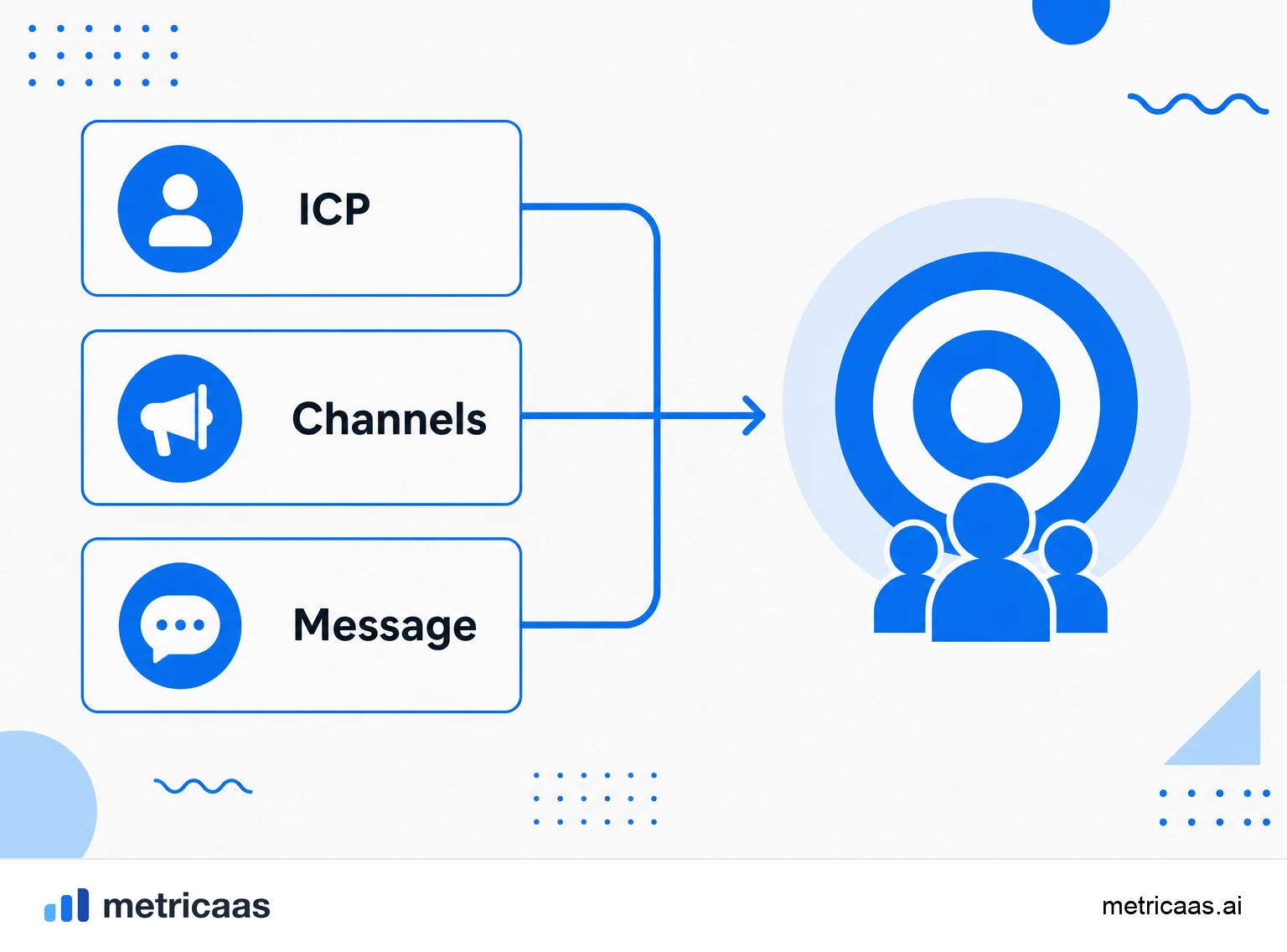
Go-to-market, or GTM, is the strategy for how a company takes a product to market: who the ideal customer is, through which channels they will be reached, with what message, at what price and with which sales motion. It is the organized answer to a simple question: how to turn a product into revenue in a repeatable way.
It is common to confuse GTM with a launch, but the launch is only an event. GTM is the system that connects product, audience and revenue, and it keeps running long after day one. A strong go-to-market strategy defines who to sell to, what to say and how to charge, so that each new sale is the result of a process rather than luck.
The components of a GTM strategy
A go-to-market strategy rests on a few pieces that need to speak to each other. When one of them is misaligned, the whole engine loses traction.
- Target customer: the ICP, the ideal customer profile, defines who the product was built for and avoids wasting energy on people who will never buy.
- Message and positioning: the core promise and the problem the product solves, said in the language of the customer.
- Channels: where the audience is and how they discover, try and buy, from content to direct sales.
- Pricing and packaging: the plans, the limits and how the value is charged.
- Sales motion: how demand becomes a contract, whether through self-serve or a sales team.
No piece works alone. A high price calls for a more consultative sales motion; a sharp message only pays off if it reaches the right audience. The job of GTM is to keep these choices coherent with each other.
The three motions: product-led, sales-led and marketing-led
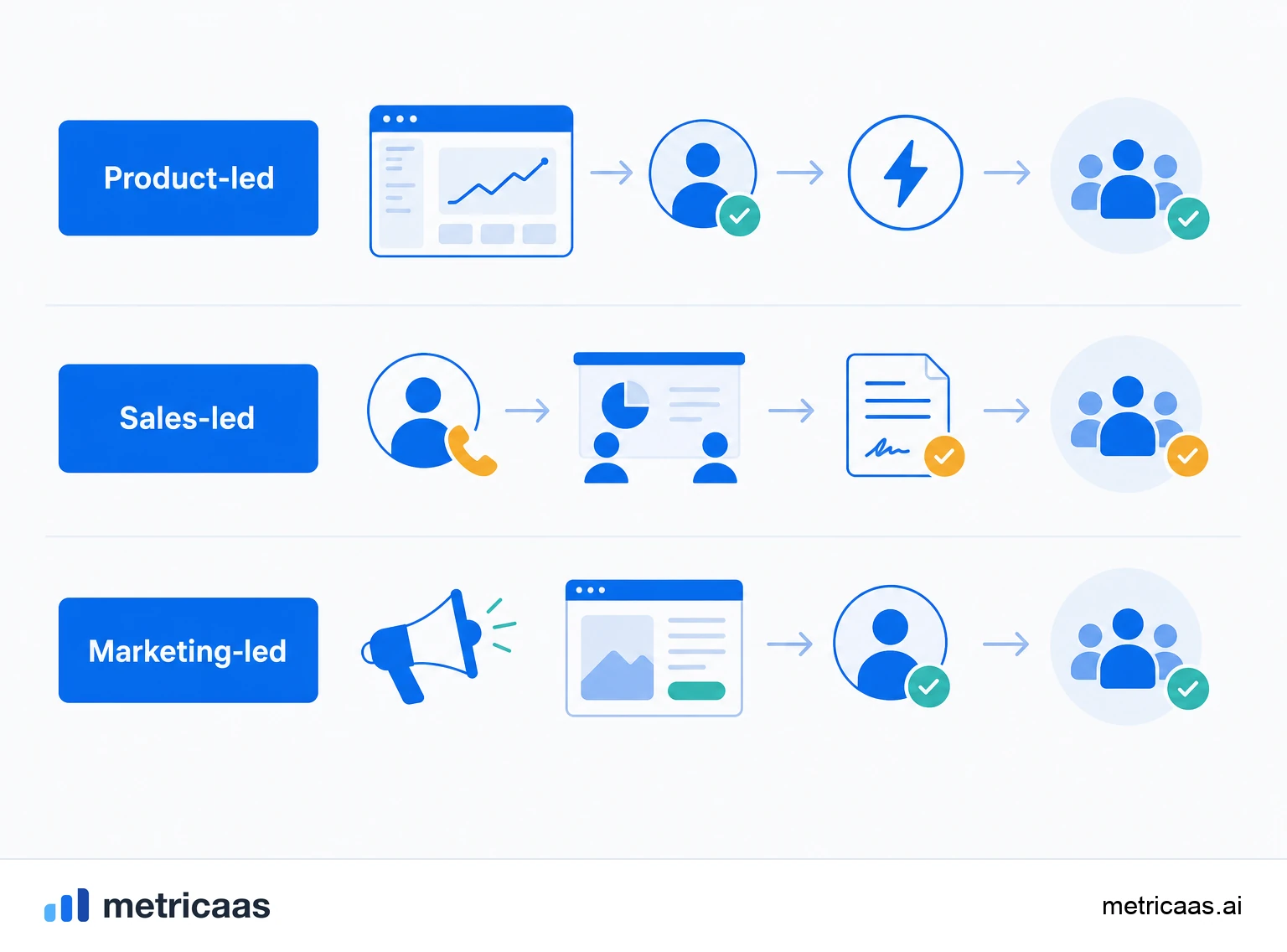
There are three main ways to take a SaaS to market, and most companies combine more than one as they grow.
- Product-led: the product itself acquires, activates and converts the user, through freemium or a free trial. It is the logic of product-led growth (PLG), where the person tries it before talking to anyone.
- Sales-led: a sales team drives the deal, suited to high price tags, long cycles and multiple decision makers.
- Marketing-led: content, media and demand generation pull interest and feed the funnel.
No motion is better by nature. The choice depends on who the customer is, on the price and on the complexity of the product. Companies backed by funds such as Bessemer and OpenView tend to start with one dominant motion and add the others as they move up in price and market.
GTM fit: when the strategy starts to work
Just as there is a fit between product and market, there is a fit between the go-to-market and the market: GTM fit. It shows up when a repeatable channel and sales motion begin to bring in customers of the right profile predictably, rather than in isolated deals that depend on the founder.
GTM fit usually comes after product-market fit (PMF). Trying to scale acquisition before the product has proven it solves the problem only speeds up the waste. First you confirm that real demand exists; then you find the most efficient, repeatable path to take the product to more people.
How to build a GTM in practice
Building a go-to-market is less about a document and more about a sequence of testable decisions.
- Define the ICP and the core problem you solve for it.
- Write the positioning and the message in the language of the customer.
- Choose one dominant motion and one or two channels to start with.
- Set pricing and packaging that fit the chosen motion.
- Run, measure and adjust before scaling the spend.
The classic mistake is trying everything at once: many channels, many audiences and many motions. One path that works, proven with numbers, is worth more than an ambitious plan that never leaves the page.
How to measure GTM
A go-to-market is only good if it is efficient, and efficiency is measurable. The central questions are how much it costs to win a customer and how long it takes to earn that cost back.
- CAC: the customer acquisition cost, the number that reveals whether the engine pays for itself.
- CAC payback: how many months it takes for the revenue from a customer to return the cost of winning them.
- Sales cycle and conversion: how long and how many steps until the contract.
According to Gartner, worldwide spending on SaaS applications is set to approach $300 billion in 2025, a large and crowded market where an efficient GTM is what separates growing with margin from growing while burning cash.
Frequently asked questions
It is the plan for how to take a product to market: who the target customer is, through which channels, with what message, pricing and sales motion. It is the system that connects product and revenue.
A launch is a one-off event. GTM is the ongoing system that defines who to sell to, what to say and how to charge, and it keeps running long after day one.
Target customer (ICP), message and positioning, channels, pricing and packaging, and the sales motion. They all need to be coherent with each other.
Product-led, where the product itself converts through a free trial or freemium; sales-led, driven by a sales team; and marketing-led, pulled by content and demand generation. Many companies combine them.
Define the ICP and core problem, write the message, choose one dominant motion and one or two channels, set coherent pricing, and validate with numbers before scaling the spend.
No. Product-market fit proves the product solves a real problem; GTM fit is finding the repeatable, efficient way to take it to market. GTM fit usually comes after PMF.
Related concepts

ICP
The ICP (Ideal Customer Profile) describes the type of company that gets the most value from your product and gives the most back in retention, expansion and referrals. It combines firmographics (industry, size, geography), the real need the product solves and fit criteria. Focusing on the ICP lowers CAC and improves retention; targeting outside it inflates cost and churn.

Product-market fit (PMF)
Product-market fit (PMF) is the fit between the product and a strong, real market demand, the point where the product starts to pull on its own. The signals are retention that flattens, organic growth and word of mouth, and a large share of users who would be very disappointed without the product. Without PMF, scaling acquisition only accelerates churn.

Product-led growth (PLG)
Product-led growth (PLG) is the growth strategy in which the product itself drives acquisition, activation, conversion and expansion, with little or no sales touch. The user enters through a free trial or a freemium plan, feels the value on their own and becomes a paying customer. The buying signal is no longer a filled-in form but usage: the PQL, the lead qualified by the product.