
GMV: what gross merchandise value is and how to calculate it
By Tiago Costa · Updated on July 9, 2026

Definition
GMV (Gross Merchandise Value) is the total value transacted through a marketplace or platform in a period.
- Sums the value of every sale, not the company revenue.
- The real revenue is the take rate charged on the GMV.
- It is the scale metric of marketplaces and transactional SaaS.
What GMV is
GMV (Gross Merchandise Value) measures the total value of the transactions that flow through a platform in a period. If a marketplace connects sellers and buyers, GMV is the sum of everything sold there, before deducting commissions, taxes or costs.
It is the scale metric of choice for marketplaces, e-commerce platforms and transactional SaaS. It answers a simple question: how much money flowed through the platform? That is why GMV became a gauge of a business size, even though it is not, on its own, what the company keeps.
How to calculate GMV
The most direct way is to sum the value of every completed transaction in the period. A useful breakdown is to multiply order volume by average order value.
- GMV = number of orders x average order value.
- Sum the gross value of each sale, before commissions and taxes.
- Pick a clear window (month, quarter, year) and keep the criterion fixed.
Example: a marketplace processing 100k orders at a $200 average order value has a GMV of $20 million in the period. Note that this number does not say how much the platform earned, only how much was transacted through it.
GMV is not revenue: the difference that confuses most
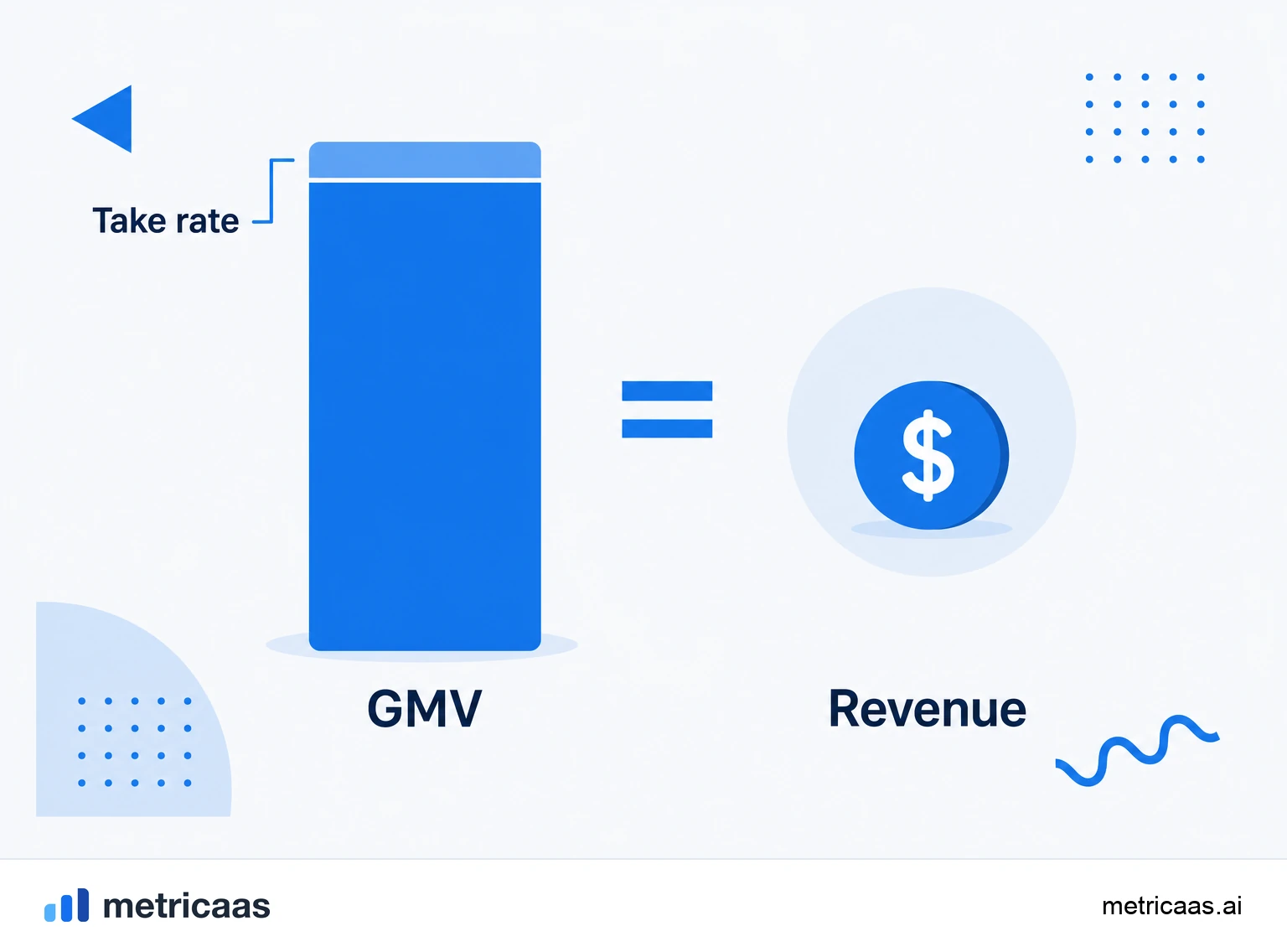
The most common mistake is treating GMV as revenue. They are not the same. GMV is the total value moved; the platform revenue is only the slice it keeps, the take rate, a commission on each transaction.
In the example of the marketplace with $20 million of GMV and a 15% take rate, revenue is $3 million, not $20 million. It is that revenue, not the GMV, that usually becomes MRR or recognized revenue. Confusing the two overstates the business several times over, which is why serious investors always ask what take rate sits behind the GMV.
GMV, take rate and AOV: the numbers that move together
GMV is rarely read on its own. It makes sense next to three other measures that explain where it comes from and where it goes.
- Average order value (AOV): the average value per order; a high GMV can come from many small orders or a few large ones.
- Take rate: the commission that turns GMV into revenue; two marketplaces with the same GMV can earn very differently.
- Frequency: how often the same buyer transacts, which sustains GMV over time.
Reading GMV alongside take rate and AOV avoids hasty conclusions: volume alone does not tell you whether the business is healthy.
Is a high GMV traction or vanity?
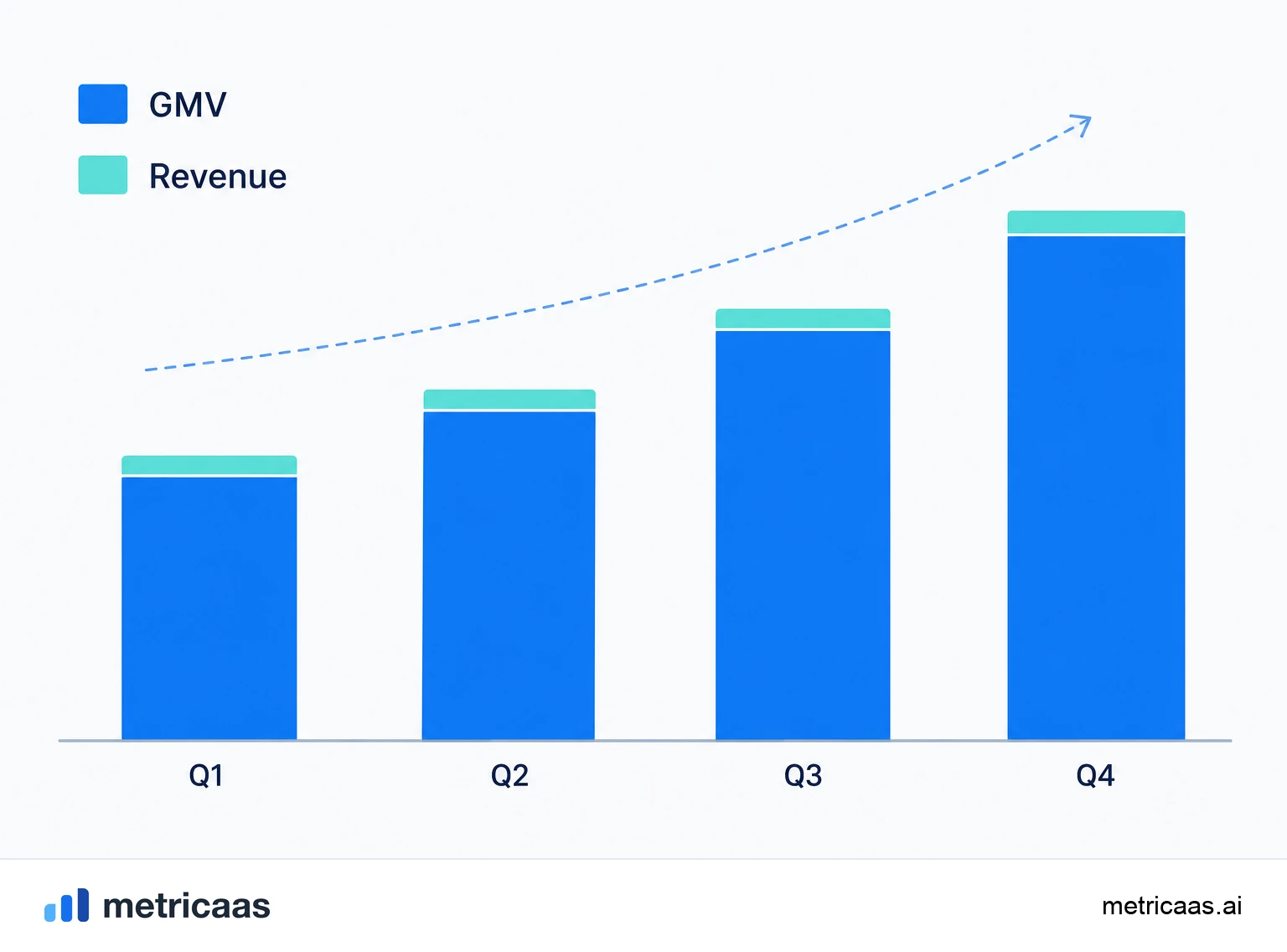
A high GMV is impressive, but it can mislead. Because it sums the gross value of sales, it is easy to inflate with aggressive promotions, high-ticket low-margin categories, or even transactions that are later canceled.
That is why it is worth separating gross GMV from net GMV, which deducts cancellations, returns, refunds and fraud. A GMV that grows while the take rate shrinks or returns spike is a warning sign, not traction. Volume only becomes value when it converts into retained, recurring revenue.
Why GMV matters
Despite the traps, GMV is a powerful scale metric. It shows the liquidity of a marketplace, the strength of the network between supply and demand, and the growth trend of the transacted flow, something revenue alone, filtered by the take rate, does not always reveal clearly.
Digital commerce keeps growing: Gartner forecasts worldwide public cloud end-user spending to approach $723 billion in 2025, a sign that transactional platforms move ever-larger volumes. Even so, GMV is a means, not an end: the goal is to convert that volume into recurring revenue, measured by metrics like ARR, which is what actually sustains the business.
Frequently asked questions
GMV is the total value of the transactions flowing through a marketplace or platform in a period. It sums the gross value of sales, not the company revenue.
By summing the value of every transaction in the period, or multiplying the number of orders by the average order value. 100k orders of $200 give a GMV of $20 million.
No. GMV is all the value transacted; revenue is only the take rate the platform keeps. With a 15% take rate, a $20 million GMV becomes $3 million of revenue.
It signals a lot of transacted volume, a sign of scale and liquidity. But it can be vanity if it comes from aggressive discounts or many canceled sales; check net GMV and the take rate.
AOV is the average value per order; GMV is the number of orders multiplied by that AOV. Together they show whether volume comes from many small orders or a few large ones.
Related concepts

MRR
MRR (Monthly Recurring Revenue) is the monthly recurring revenue of a SaaS: the sum of all active subscriptions normalized to a month. It is the core metric of a subscription business because it shows, predictably, how much the company earns on a recurring basis each month, without counting one-off charges.

ARR
ARR (Annual Recurring Revenue) is the annual recurring revenue of a SaaS: MRR multiplied by 12. It represents how much the company earns on a recurring basis over a year, counting only active subscriptions, with no one-off charges. It is the metric of choice for companies selling annual contracts and the standard language of investors.

ARPA
ARPA (Average Revenue Per Account) is a SaaS recurring revenue divided by the number of active accounts. It shows how much each account generates, on average, per month or year. It is the metric that reveals the typical value of a customer and one of the main levers for growing revenue without relying only on new sales.