
Bootstrapping: what it is and how to grow without outside capital
By Tiago Costa · Updated on July 9, 2026

Definition
Bootstrapping means growing a company with your own resources and customer revenue, without outside capital from funds or angels.
- No dilution: control stays with the founders.
- Trades speed for cash discipline and early profit.
- The runway is your own revenue, not a fund.
What bootstrapping is
Bootstrapping means growing a company with your own resources and with revenue from customers, without raising outside capital from venture funds or angel investors. The founder funds the start with savings, early revenue or small contracts, and reinvests what comes in to finance the next step.
It is a trade-off: you give up speed and a large cash cushion in exchange for control. With no outside checks there is no dilution, decisions stay with the people who founded the business, and cash discipline becomes the engine of growth.
How it works in practice
In practice, bootstrapping forces you to charge early and to keep costs below revenue. Instead of burning cash to grow fast, the company grows at the pace its own revenue allows: every dollar from customers becomes fuel for the next month.
That shapes everyday decisions:
- Favor customers who pay upfront or on annual contracts, which bring cash forward.
- Keep the team lean and outsource what is not essential.
- Validate demand before investing in structure.
Many lean software businesses, such as a MicroSaaS run by one or two founders, are born exactly this way.
Bootstrapping vs venture capital: how they differ
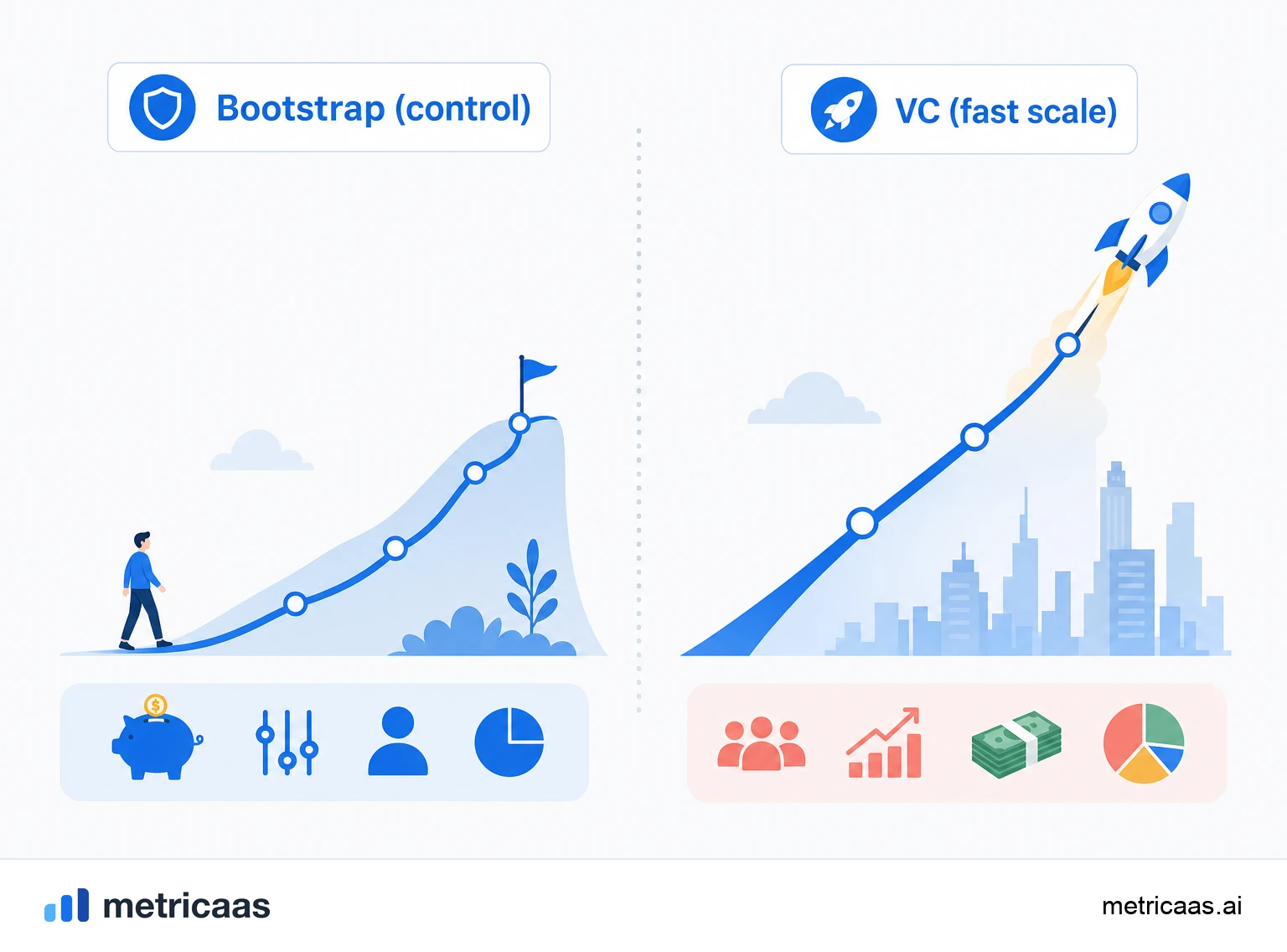
The core difference is who funds growth and at what cost. With venture capital, a fund puts in money in exchange for equity, which speeds up expansion but dilutes the founders and creates the expectation of aggressive growth. With bootstrapping, funding comes from the customer and ownership stays whole with the people who founded the business.
That choice also changes the conversation about valuation: a bootstrapped founder does not chase rounds or short-term multiples, and if they decide to raise later they arrive with more control and less pressure. Funds like Bessemer often point out that growing with capital efficiency matters more and more, even among funded companies.
Advantages and risks
The biggest advantage is control: with no outside investors, founders decide direction, culture and pace. Add to that financial discipline, which pushes the business to be profitable sooner, and full ownership, which preserves the value of an eventual sale.
- Advantages: full control, no dilution, focus on real profit and freedom of strategy.
- Risks: slower growth, tight cash, exposure of personal wealth and difficulty reacting to a well-funded rival.
The risk of running out of cash is real: many startups that shut down do so after the money runs out before they find a repeatable model. In bootstrapping, that limit shows up earlier and with no safety net.
Unit economics and self-funding cash
With no outside checks, bootstrapping only holds up if the numbers work on their own. That means reaching healthy unit economics early: what you earn from each customer has to comfortably beat the cost of winning and serving them. David Skok, at ForEntrepreneurs, shows how the gap between cash that trickles in and acquisition cost paid upfront opens a cash trough that a bootstrapped company has to cross with no outside help.
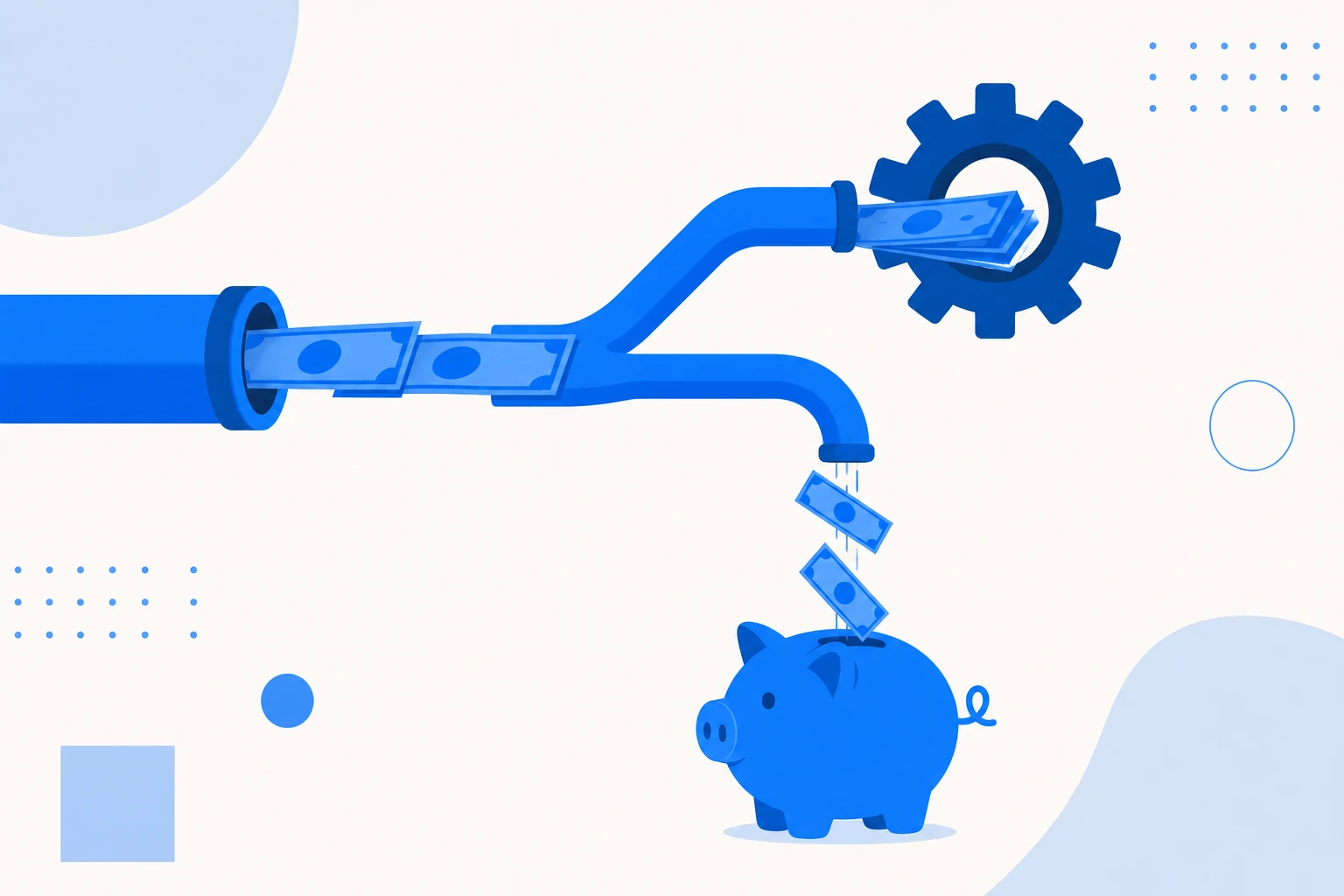
In a bootstrapped company, the runway is your own revenue, not a fund. That is why free cash flow is the metric that rules: as long as it stays positive, the operation funds itself and growth depends on no one on the outside.
When bootstrapping makes sense
Bootstrapping shines when the market lets you charge early and the product does not require heavy investment before it generates revenue. Software businesses with low delivery cost, a well-defined niche and customers willing to pay for real value are the ideal ground.
It makes less sense when the market is a race where the first to scale takes all, or when the product needs a lot of capital before the first sale. The practical question is simple: can revenue fund the next step before competition or cash run out? If the answer is yes, bootstrapping trades speed for control without putting the company at risk.
Frequently asked questions
Bootstrapping is growing a company with your own resources and customer revenue, without outside capital from VCs or angels. Control stays with the founders and cash comes from revenue.
It depends on the business. It gives more control and discipline but grows slower. It fits when revenue can fund the next step; less so when the market demands scaling fast.
Advantages: full control, no dilution and a focus on profit. Risks: slower growth, tight cash and exposure of personal wealth.
Bootstrapping preserves control and equity; venture capital speeds things up with outside money but dilutes and demands aggressive growth. The choice trades speed for control.
Yes. Several well-known SaaS companies spent years growing on their own revenue before raising or going public, proving you can scale without an outside investor.
Related concepts

MicroSaaS
MicroSaaS is a lean, niche software as a service, run by a very small team, often a single person, and almost always bootstrapped. It trades massive scale for focus: it solves one specific, well-defined problem, with high margins and low fixed costs. Success depends on a niche with real pain, a clear ICP and a product that is simple to maintain.

Runway
Runway (cash runway) is how many months a company can keep operating on the cash it has, at its current burn rate. You calculate it by dividing available cash by the monthly net burn, and it sets the urgency to raise money or reach break-even. It is the financial breathing room that buys time to get the business right.
Free cash flow
Free cash flow (FCF) is the cash left from operations after paying for capital investments (capex). It is the money truly available to pay down debt, reward investors or reinvest in growth. A SaaS that generates positive FCF funds itself and depends less on raising rounds.