
CSAT: what the Customer Satisfaction Score is and how to calculate it
By Tiago Costa · Updated on July 9, 2026

Definition
CSAT (Customer Satisfaction Score) measures customer satisfaction with a specific interaction or moment: satisfied responses over the total, as a percentage.
What CSAT is
CSAT (Customer Satisfaction Score) measures how satisfied a customer was with a specific interaction, product or moment. The classic question is "how satisfied were you?", answered on a scale. It is a point-in-time, transactional metric: it captures the feeling in the heat of the moment, right after a concrete experience, rather than a generic opinion about the brand.
Because it is tied to an event, CSAT answers direct questions: did support resolve the issue? was onboarding smooth? did the new feature land well? Each touchpoint can have its own CSAT, which turns the metric into a magnifying glass over the customer journey, not just an overall scoreboard.
How to calculate CSAT
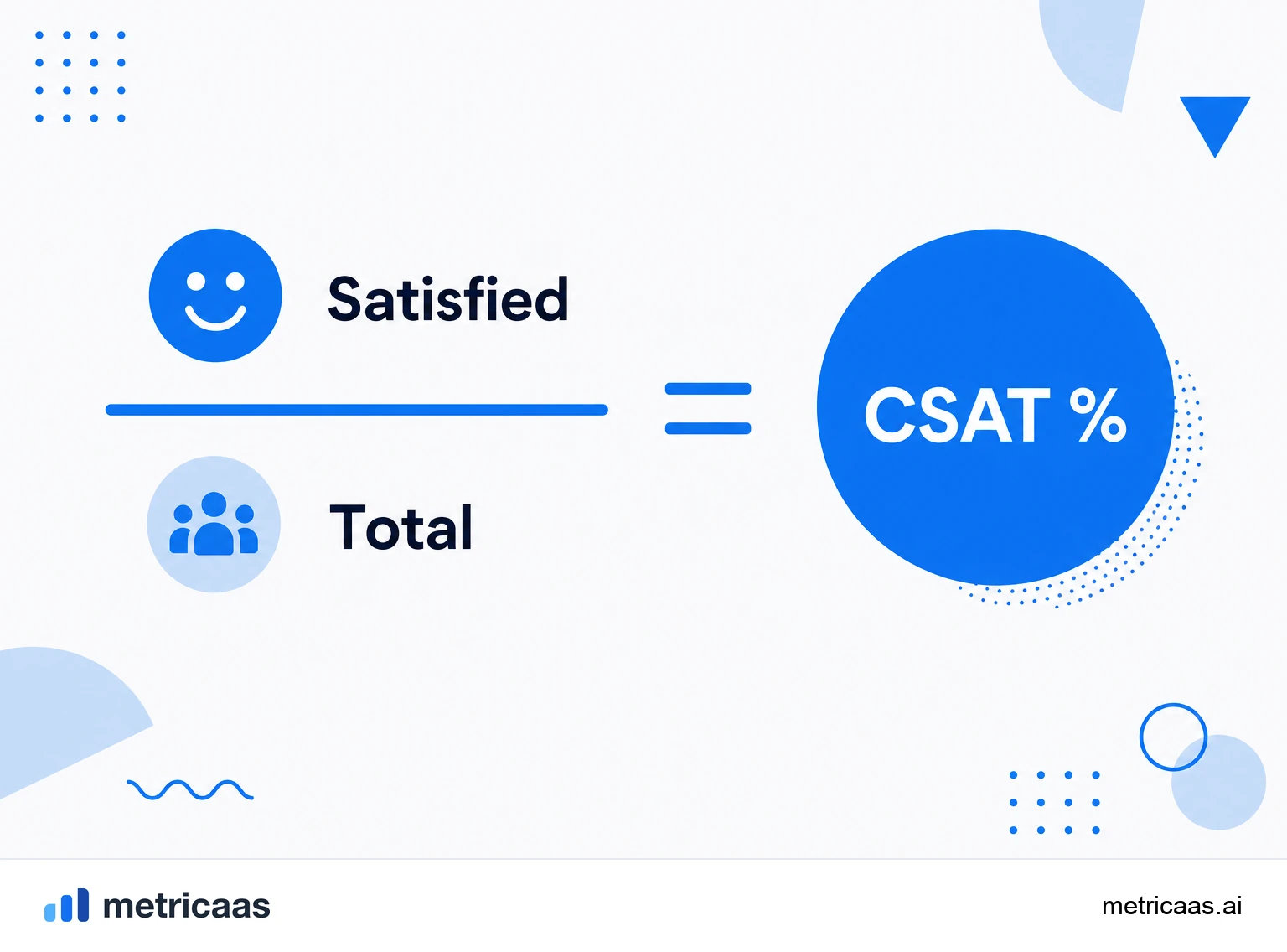
The formula is a simple ratio: the number of satisfied responses divided by the total number of responses, expressed as a percentage.
- CSAT = (satisfied responses / total responses) x 100.
- "Satisfied" is usually the sum of the two highest ratings on the scale, the so-called top-2 box, for example 4 and 5 on a 1-to-5 scale.
- The result reads as "X% of customers were satisfied".
Example: 80 positive responses out of 100 responses give a CSAT of 80%. Defining upfront what counts as "satisfied" is decisive, because changing the cutoff changes the number. The criterion must stay fixed so comparisons across periods make sense.
CSAT scales: 1 to 5 and beyond
There is no single scale. The most common runs from 1 to 5, from "very dissatisfied" to "very satisfied", but you also see scales of 1 to 3, 1 to 7, 1 to 10, stars, faces or just a thumbs up and thumbs down.
- 1 to 5: the most used, balancing granularity and simplicity.
- Binary (yes or no, thumbs): fast, great for the end of a chat.
- 1 to 10 or stars: more nuance, but they ask more thought from the respondent.
What matters is standardizing the scale and the "satisfied" cutoff across the whole company. CSAT from different touchpoints is only comparable when the ruler is the same.
CSAT, NPS and CES: what each measures
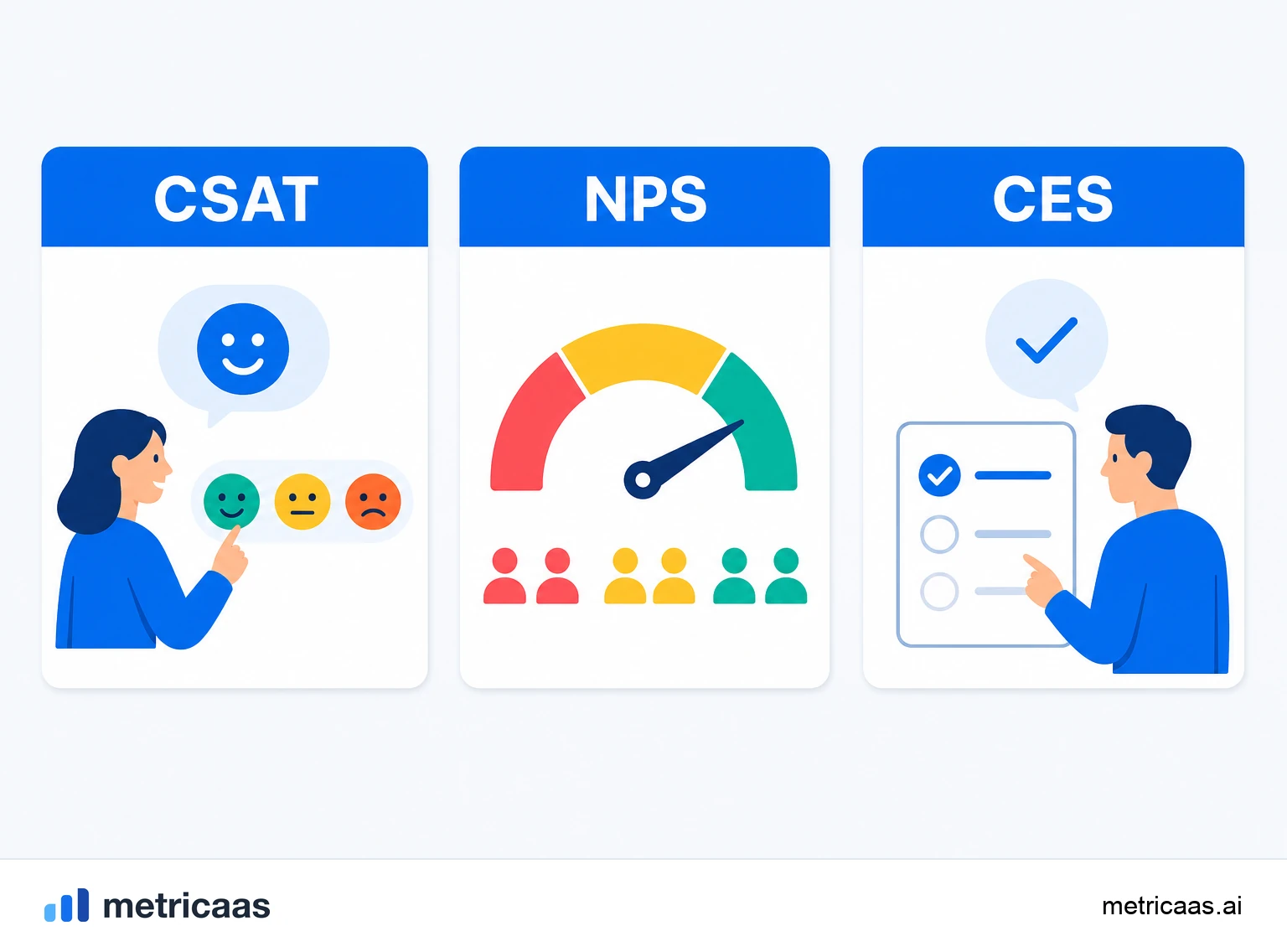
All three are experience metrics, but they look at different things. CSAT measures satisfaction with a specific moment, the now. NPS measures loyalty and the willingness to recommend over the long term. CES measures the effort the customer spent to get something done.
- CSAT: point-in-time and transactional, "how satisfied were you?".
- NPS: relational, "how likely are you to recommend us?".
- CES: focused on friction, "how easy was it to solve your problem?".
They are not competitors, they complement each other. A high CSAT right after support living alongside a low NPS, for example, suggests the company resolves isolated cases well but has not yet earned the customer loyalty.
When and how to run a CSAT survey
CSAT pays off most when it is triggered right after the experience you want to measure, while the memory is fresh: when a support ticket is closed, when onboarding wraps up, after a purchase or the first use of a new feature.
- Ask at the right moment: minutes or hours after the event, not weeks later.
- Ask a single question, with the scale visible, so you do not tire the respondent.
- Leave an optional open field: the "why" behind the rating is where the action is.
Watch out for sample bias: those who respond tend to be the ones with a very good or very bad experience. Low response volumes make CSAT unstable, so treat a handful of responses with caution before drawing conclusions.
What a good CSAT is
There is no universal magic number. What counts as a good CSAT varies a lot by touchpoint, by industry and by the scale used: the CSAT of a support interaction tends to be higher than that of a billing one, for example. That is why the most useful comparison is with your own history, not with a generic market average.
It is worth remembering the gap between what a company thinks it delivers and what the customer perceives. Bain observed that around 80% of companies believe they deliver a superior experience, while only 8% of customers agree. Tracking CSAT over time, cross-referencing it with Churn and with the Customer health score, turns an isolated rating into a signal of risk or of a healthy relationship.
Frequently asked questions
CSAT stands for Customer Satisfaction Score, the metric of customer satisfaction with a specific interaction, product or moment, expressed as a percentage.
Divide the number of satisfied responses by the total number of responses and multiply by 100. "Satisfied" is usually the sum of the two highest ratings on the scale.
There is no single value. It depends on the touchpoint, the industry and the scale used. It is best to compare with your own history rather than a market average.
CSAT measures satisfaction with a specific moment and is transactional. NPS measures loyalty and the willingness to recommend over the long term.
The 1-to-5 scale, from "very dissatisfied" to "very satisfied", is the most common, but there are also 1-to-3, 1-to-10, stars and binary (thumbs) scales.
No. CSAT measures satisfaction with an experience, while CES measures the effort the customer spent to get something done. They are complementary metrics.
Related concepts

NPS
NPS (Net Promoter Score) is a loyalty index based on the question "on a scale of 0 to 10, how likely are you to recommend us?". It is calculated by subtracting the percentage of detractors (scores 0 to 6) from the percentage of promoters (scores 9 and 10); passives (7 and 8) do not count. The result ranges from -100 to +100 and measures loyalty and word of mouth, not point-in-time satisfaction.

CES
CES (Customer Effort Score) is the customer effort score: it measures how much work a person had to put in to complete a task with your company, resolve a ticket, turn on a feature or finish a purchase. The typical question is "how easy was it?". Low effort predicts loyalty better than trying to delight, which is why CES complements NPS and CSAT.

Churn
Churn is the loss of customers or revenue in a period. In a SaaS, it measures how many customers cancel (customer churn) or how much recurring revenue disappears (revenue churn). It is the metric that reveals whether growth is sustainable: the higher the churn, the more new sales you need just to avoid shrinking.