
Aha moment: what it is and how to get users to it
By Tiago Costa · Updated on July 9, 2026

Definition
The Aha moment is the instant a user first perceives the real value of a product, the click that separates those who merely tried it from those who stay.
- It is a concrete, measurable action, not a vague feeling.
- The faster a user reaches it, the higher the chance of activation.
- Products that speed up this moment retain more and lose fewer customers.
What the Aha moment is
The Aha moment is the exact point where a person stops seeing your product as just another open tab and starts to understand, concretely, why it is worth it. It is the "now I get it" instant, when the promise on the sales page becomes a real experience. It is not a marketing pitch or a pretty screen: it is the moment the product core benefit actually happens for that user.
It is worth separating the Aha moment from the so-called wow moment. The wow moment is the positive surprise, the aesthetic or emotional delight; the Aha moment is the grasp of practical value. A user can be dazzled by the interface and still never realize what the product is for. What drives retention is the second, not the first.
How to identify your product Aha moment
The Aha moment is not guessed on a whiteboard, it is discovered in the data. The classic technique is to compare the behavior of users who stayed with those who left, looking for the action that retained users take in their first days and churned users do not. That action, when strongly correlated with staying, is the main Aha moment candidate.
A few cautions prevent wrong conclusions:
- Look for correlation with real retention, not with vanity metrics like login count.
- Set a clear threshold, such as "created X projects in the first week", not a generic action.
- Validate causation: test whether nudging users toward that action actually improves the activation rate and retention, not just whether it coincides.
Examples of Aha moments
The Aha moment is always product specific, but the most cited cases help you recognize the pattern: it is always a simple action that delivers the core value for the first time.
- Messaging and collaboration: sending the first message or exchanging a minimum number of messages within a team.
- Social networks: following a minimum number of accounts in the first days, which finally makes the feed interesting.
- Data tools: importing the first data or connecting the first source, when empty charts become a useful dashboard.
- Storage products: uploading the first file and accessing it from another device.
- Work tools: inviting the first teammate, which turns a solo account into a shared space.
Notice what these examples share: they are actions that only make sense inside the product and that, once done, make the value obvious. Finding your version of that action is half the work.
Aha moment, activation and onboarding
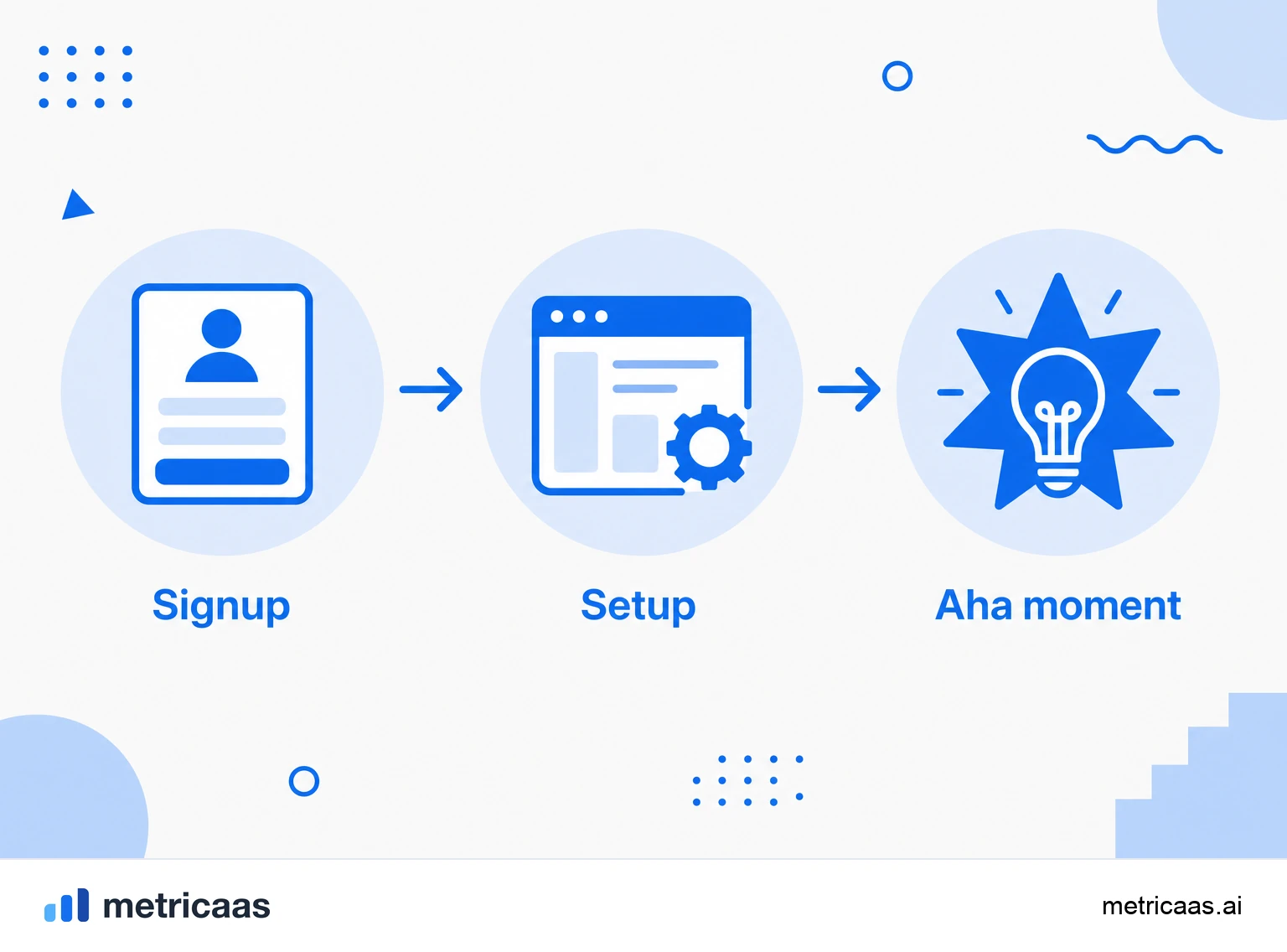
The Aha moment sits at the heart of three concepts that are often confused. Onboarding is the guided path you design to lead the user there. The activation rate measures the share of users who reached the Aha moment. And time to value (TTV) measures how long they take to get there. In other words, the Aha moment is the destination, and these three describe the road.
This distinction is practical, not academic. If you do not know which action is the Aha moment, your onboarding becomes a sightseeing tour of features, with no focus. When you do know, every onboarding screen can be judged by a single question: does this move the user closer to or further from the action that triggers the click? Reducing time to value is, in practice, shortening the distance to the Aha moment.
Aha moment and retention
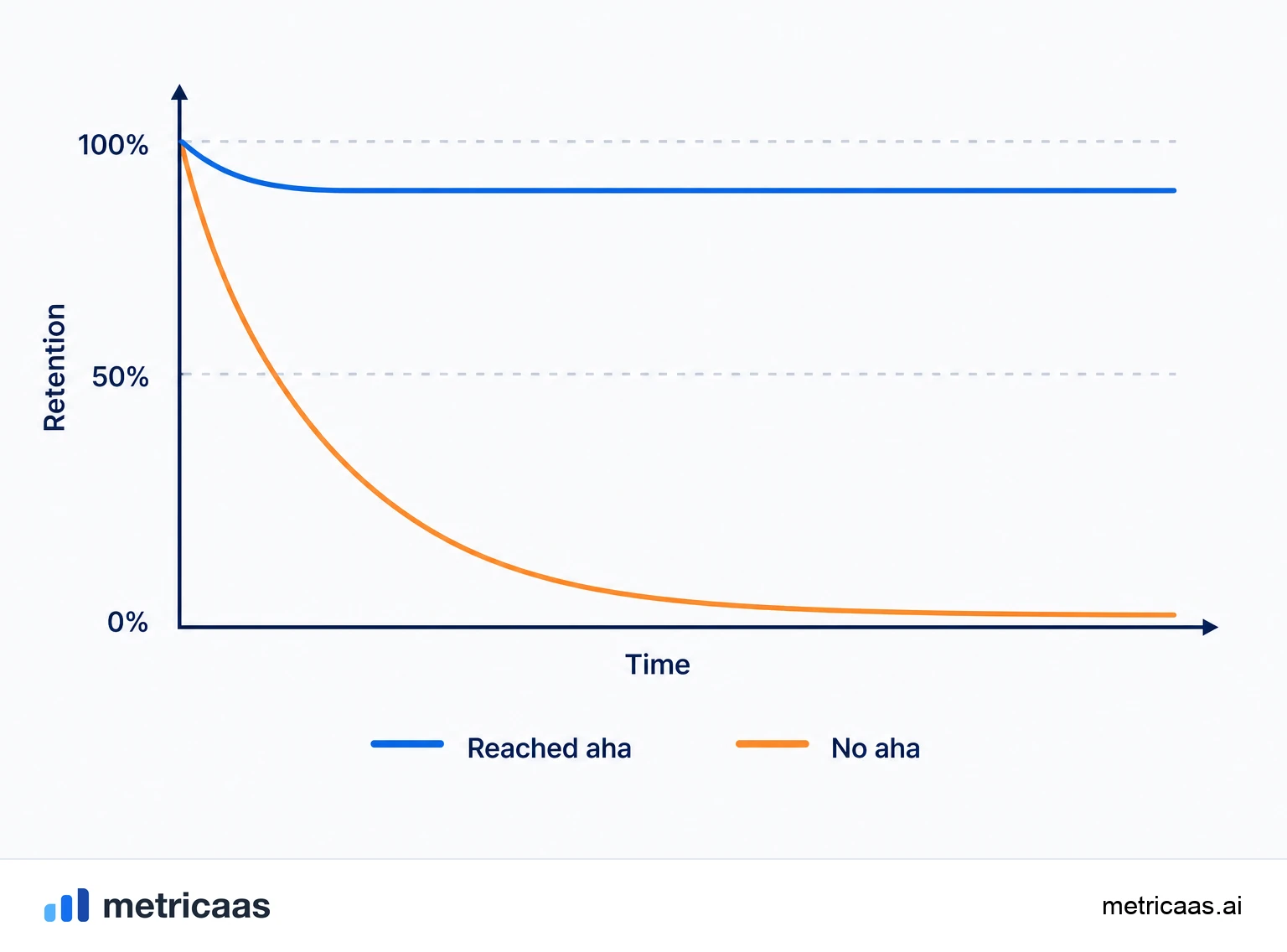
The reason for so much attention on the Aha moment is simple: those who perceive value early tend to stay, and those who do not disappear. Most churn in self-serve products happens precisely with people who signed up and never reached the value moment. It is not a lack of need, it is a lack of experiencing the benefit.
Industry research reinforces this link between value perceived early and staying power. Retention studies from SaaS Capital show that retaining revenue and customers is what separates healthy SaaS companies from the rest, and that retention begins in the first week of use, long before renewal. The benchmarks compiled by Benchmarkit point the same way: well executed activation and onboarding appear among the factors that sustain efficient growth. Firms like Bain and OpenView have documented the same pattern.
How to accelerate the Aha moment
Once you have identified the action that defines the Aha moment, all product work turns into one question: how do you get more users to it, and faster? Reducing time to value often pays off more than any acquisition campaign, because it fixes the leak that new users slip through.
- Remove steps: every form field and every screen before the value is a drop-off point.
- Show value before asking for effort: sample data, ready-made templates and automatic imports shorten the path.
- Guide with focus: an onboarding that leads straight to the key action beats a tour that shows everything.
- Measure and iterate: track activation rate and time to value as product metrics, not as trivia.
The compounding result is powerful: every point of activation gained improves retention, which sustains recurring revenue. The Aha moment is small in duration and huge in consequence.
Frequently asked questions
The Aha moment is the instant a user first perceives the real value of a product. It is a concrete action, such as sending the first message or importing the first data, that turns a curious visitor into an engaged user.
By comparing the behavior of users who stay with those who leave and finding the action, taken in the first days, that correlates with retention. Then test whether nudging users toward it truly improves activation.
The wow moment is surprise or delight, often aesthetic. The Aha moment is the grasp of the product practical value. It is the second that sustains retention.
No. The Aha moment is the value moment; the activation rate is the metric that measures how many users reached it. One is the destination, the other is the scoreboard.
By removing steps before the value, showing results with sample data and ready-made templates, and designing an onboarding focused on the key action. Reducing time to value is the goal.
Because most churn happens with people who never perceived the value. Users who reach the Aha moment early tend to stay; those who do not tend to leave.
Related concepts

Activation rate
Activation rate is the share of new users who reach the product first real value (the aha moment or setup milestone) within a defined time frame. It is the bridge between acquisition and retention: those who activate tend to stay, those who do not tend to churn. That makes it one of the strongest predictors of retention and the silent bottleneck of trial conversion in SaaS.

Onboarding
Onboarding is the process that takes a new customer from welcome to first value, the aha moment, and from there to the habit of using the product. Good onboarding shortens time to value and lifts activation and retention, while poor onboarding is one of the top causes of early churn. It can be self-serve, guided by the product, or assisted by people.

Time to value (TTV)
Time to value (TTV) is the time between signup and the moment the customer gets the first real value from the product, the so-called aha moment. The shorter that interval, the higher the odds of activating, converting the trial and retaining. Shortening TTV is one of the central goals of onboarding, because every extra step before value drags conversion down.